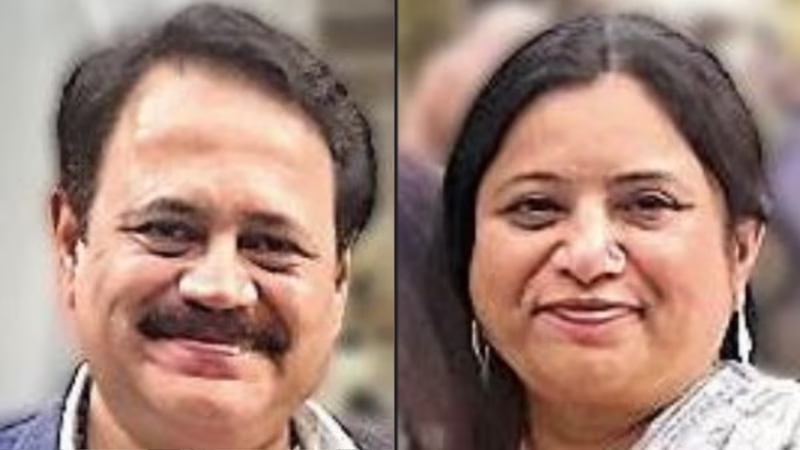
In the quiet lanes of Shalimar Bagh, a chilling echo from the past has turned into a terrifying reality. The recent Delhi witness murder of 44-year-old Rachna Yadav isn’t just another entry in the city’s crime log; it’s a deafening alarm bell for a justice system that seems to have forgotten its most vulnerable allies: the witnesses.
Rachna, who had bravely stepped forward as a key witness in the investigation of her husband Vijendra Yadav’s 2023 murder, was shot dead at point-blank range on Saturday . The method was a grim replica of her husband’s killing, with police now suspecting that one of the bike-borne assailants may have been involved in both crimes . This is not merely a personal vendetta; it’s a direct assault on the very foundation of our legal process.
Table of Contents
- The Chilling Echo of a Crime
- Why the Delhi Witness Murder is a Systemic Failure
- The State of Witness Protection in India
- What Happens Next for Justice in Delhi?
- Conclusion: A Call for Urgent Reform
- Sources
The Chilling Echo of a Crime
The details are as brutal as they are symbolic. Rachna Yadav was returning home after meeting a neighbour when she was ambushed by two men on a motorcycle . In a scene that mirrored her husband’s fate, she was shot in the head and died on the spot . The message sent by the perpetrators was clear and terrifying: cooperation with the law comes with a death sentence.
Police investigations have quickly drawn a link between the two murders, suggesting that the accused in Vijendra’s case were “afraid” of Rachna’s testimony, which could have been the final nail in their coffin . Her role as an RWA chief might have given her a public profile, but it was her status as a primary witness that made her a target . This targeted killing demonstrates a brazen confidence that the criminals will not be held accountable, a confidence that is, tragically, often well-placed.
Why the Delhi Witness Murder is a Systemic Failure
This case transcends the boundaries of a single criminal act. It exposes a deep, festering wound in India’s criminal justice system: the chronic lack of effective witness protection. When a key witness is assassinated in broad daylight, it’s not just a failure of local policing; it’s a national embarrassment.
Consider these points:
- Deterrence for Future Witnesses: Who will come forward to testify now? The murder of Rachna Yadav sends a powerful, chilling message to every potential witness in every ongoing case across the country: your life is forfeit if you speak the truth.
- Erosion of Public Trust: Such incidents severely damage the public’s faith in the state’s ability to deliver justice and protect its citizens. If the state cannot protect a witness, what hope is there for ordinary citizens?
- Empowerment of Criminals: It emboldens criminals, showing them that they can operate with impunity, silencing opposition through fear and violence.
The State of Witness Protection in India
India does have a Witness Protection Scheme, 2018, which was approved by the Supreme Court and is legally binding on all courts [[14], [22]]. On paper, it provides for measures like identity concealment, in-camera hearings, and physical security based on a threat assessment [[25], [28]]. However, the gap between policy and practice is a chasm.
The reality is starkly different. The system is plagued by a lack of dedicated infrastructure, trained personnel, and, most critically, political will. As legal analyses point out, “the safety and well-being of witnesses have historically been neglected, leading to a high incidence of witness hostility” . Many witnesses simply turn hostile or refuse to testify due to fear of intimidation and threats [[10], [11]].
While other nations have robust statutory frameworks like the US’s Witness Security Reform Act, India still lacks a comprehensive, standalone law for witness protection [[19], [20]]. The current scheme remains largely ineffective, especially in high-stakes cases involving organized crime or powerful local figures. The murder of Rachna Yadav is a tragic testament to this failure .
What Happens Next for Justice in Delhi?
The immediate focus will be on the Delhi Police’s Special Cell to apprehend the killers and establish the definitive link to the 2023 murder. But the long-term implications are far more significant. This case must become a catalyst for change.
For justice to truly be served in Rachna Yadav’s case, it must go beyond convicting her murderers. It must involve a thorough, independent inquiry into why she, as a known key witness in a high-profile murder case, was not provided with even the most basic protective measures mandated by the existing scheme.
Reforms must include:
- Mandatory Threat Assessment: An automatic, rigorous threat assessment for every witness in serious criminal cases.
- Dedicated Witness Protection Unit: A well-funded, specialized unit within the police force trained solely for this purpose.
- Fast-Track Courts: To ensure cases where witnesses are at risk are concluded swiftly, minimizing the window of vulnerability.
Conclusion: A Call for Urgent Reform
The Delhi witness murder of Rachna Yadav is a profound tragedy that should shake the nation’s conscience. It is a stark reminder that a justice system is only as strong as its ability to protect those who make it function. Until India builds a credible, reliable, and accessible witness protection program, cases like this will continue to occur, and the ‘eyes and ears of justice’ will remain blind and deaf out of fear . The time for platitudes and promises is over; the time for concrete, systemic action is now.
Sources
- Times of India: Delhi horror: Woman, witness to husband’s murder in 2023, shot dead
- Various news reports on the Rachna Yadav case [[1], [2], [3], [4], [5], [6], [7], [8]]
- Legal analyses on witness protection in India [[9], [10], [11], [12], [13], [14], [15], [17], [20], [21], [22], [23], [24], [25], [27], [28]]
- [INTERNAL_LINK:witness-protection-scheme-india-explained]
- [INTERNAL_LINK:delhi-crime-statistics-2025-analysis]