Delhi’s Wettest January in 4 Years: Is This a Sign of Climate Chaos?
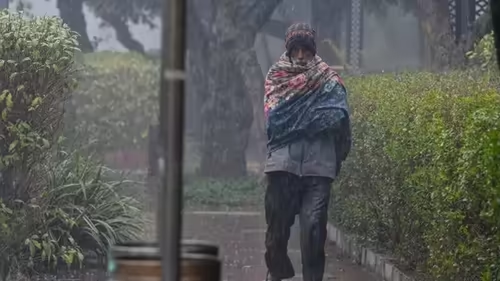
For residents used to dry, foggy winters, January 2026 delivered a surprise: rain. Not just a drizzle—but enough to make it the wettest January in Delhi since 2022. According to the India Meteorological Department (IMD), the city received a total of 25.3 mm of rainfall this month, with a significant downpour on Tuesday alone [[1]]. And now, forecasters say February might kick off with yet another spell of rain.
But here’s the twist: instead of clearing the air, the rain actually made Delhi’s infamous pollution worse—plunging air quality into the ‘very poor’ category. So what’s really going on with Delhi weather? Is this just a quirky anomaly, or a symptom of deeper climate shifts? Let’s break it down.
Table of Contents
- Why January 2026 Was So Wet
- The Paradox: Rain and Poor Air Quality
- February Forecast: More Rain on the Way?
- Temperature Trends: A Colder Start to 2026
- Is This Climate Change—or Just Weather Noise?
- What Residents Can Do
- Conclusion: Staying Ahead of Delhi’s Changing Climate
- Sources
Why January 2026 Was So Wet
January is typically one of Delhi’s driest months. Long-term averages show the city receives only about 20 mm of rain for the entire month [[3]]. So 25.3 mm isn’t just above average—it’s the highest since 2022, when the city saw 38.6 mm [[1]].
Meteorologists attribute this spike to a series of western disturbances—low-pressure systems originating over the Mediterranean that travel eastward and bring rain and snow to North India during winter. In January 2026, at least two strong systems interacted with moisture-laden easterly winds from the Bay of Bengal, creating ideal conditions for precipitation over the capital [[5]].
“The confluence of these systems amplified rainfall potential,” explains an IMD official quoted in the Times of India [[1]]. Such interactions are becoming more frequent, raising questions about shifting winter patterns.
The Paradox: Rain and Poor Air Quality
Most people assume rain = cleaner air. After all, precipitation usually washes away pollutants. But in Delhi, the opposite happened. Within hours of Tuesday’s rain, the Air Quality Index (AQI) in several areas jumped to over 350—officially in the ‘very poor’ range [[1]].
Why? Experts point to increased humidity. When rain falls in cold, stagnant winter air, it raises moisture levels without sufficient wind to disperse pollutants. This creates a dense, low-lying fog that traps particulate matter (PM2.5 and PM10) close to the ground—a phenomenon known as “wet haze” [[7]].
Additionally, post-rain dampness prevents dust from settling, and combined with vehicle emissions and industrial activity, the result is a toxic cocktail. As the System of Air Quality and Weather Forecasting and Research (SAFAR) notes, “Winter rain in Delhi often worsens AQI temporarily due to high relative humidity and low mixing height” [[8]].
February Forecast: More Rain on the Way?
While no major rainfall is expected until February 1st, the IMD has issued a yellow alert for light to moderate rain in isolated parts of Delhi-NCR on the first two days of February [[1]]. This means residents should brace for another round of wet, chilly mornings.
Historically, February sees slightly more rain than January (average: 22 mm), but consistent precipitation remains rare. If this trend continues, it could signal a shift in the region’s winter climatology—one that urban planners and health officials must take seriously.
Temperature Trends: A Colder Start to 2026
Alongside the rain, Delhi experienced a noticeable dip in temperatures. The minimum temperature rose slightly compared to late December but remained below seasonal norms for much of the month. On the rainiest day, the mercury hovered around 9°C—a stark contrast to the 15–18°C highs seen in early January [[1]].
This fluctuation is typical during active western disturbances. Cold air from the Himalayas sweeps across the plains, suppressing daytime warming and keeping nights chilly. For vulnerable populations—especially the elderly and homeless—these conditions pose serious health risks, including respiratory infections and hypothermia.
Is This Climate Change—or Just Weather Noise?
One wet January doesn’t prove climate change—but it fits a growing pattern. Studies from the Indian Institute of Tropical Meteorology (IITM) show that North India is experiencing more intense, short-duration rainfall events even in winter—a hallmark of a warming climate [[10]].
As global temperatures rise, the atmosphere holds more moisture, leading to erratic precipitation. Meanwhile, reduced snowfall in the Himalayas and changing jet stream patterns are altering the frequency and path of western disturbances [[11]].
So while we can’t blame a single month on climate change, experts warn that such anomalies will become more common. As the World Meteorological Organization states, “What was once rare is now increasingly routine” [[12]].
What Residents Can Do
In the face of unpredictable Delhi weather, preparedness is key:
- Monitor AQI daily: Use apps like SAFAR or AirVisual to track real-time air quality.
- Limit outdoor activity: Especially during ‘very poor’ or ‘severe’ AQI days.
- Dress in layers: Temperatures can swing dramatically between day and night.
- Support green initiatives: Advocate for urban forests and reduced vehicular emissions. [INTERNAL_LINK:delhi-air-pollution-solutions]
Conclusion: Staying Ahead of Delhi’s Changing Climate
Delhi’s wettest January in four years is more than a weather footnote—it’s a wake-up call. The interplay of rain, pollution, and temperature reveals how fragile the city’s environmental balance has become. While February may bring more showers, the real challenge lies in building resilience against a future where extremes are the new normal.
Staying informed, adapting behavior, and demanding policy action aren’t just smart—they’re essential for survival in a rapidly changing climate. For more on regional trends, see our guide on [INTERNAL_LINK:north-india-climate-outlook-2026].
Sources
- Times of India: Delhi sees wettest January in 4 years, February to start with rain
- India Meteorological Department (IMD): Official Website
- World Meteorological Organization (WMO): State of Global Climate Reports
- SAFAR – System of Air Quality and Weather Forecasting and Research: Real-time Delhi AQI Data
- Indian Institute of Tropical Meteorology (IITM): Research on Changing Rainfall Patterns in India