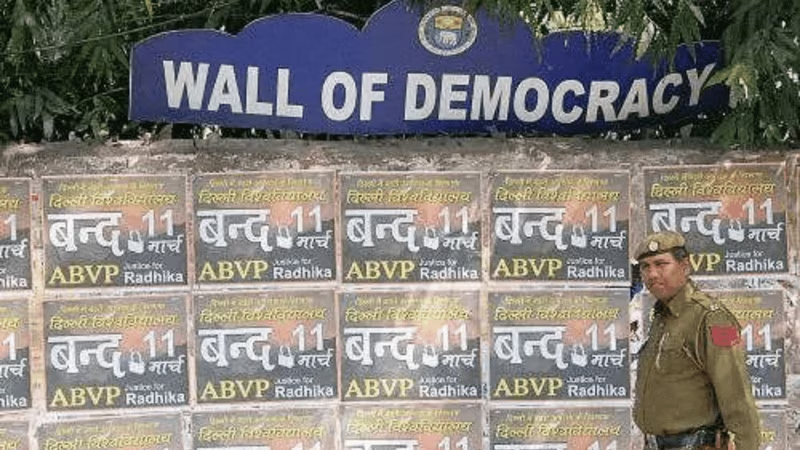
For decades, they were more than just brick and mortar. They were the vibrant, chaotic, and fiercely protected bulletin boards of dissent, debate, and democracy at one of India’s most prestigious universities. Now, the iconic Walls of Democracy at Delhi University (DU) are gone—removed without warning, leaving students stunned and questioning the future of free expression on their campus .
The decision came to light not through an official university memo, but through the actions of security staff who began tearing down student posters and verbally informing activists that the designated spaces no longer existed . This silent erasure of a cherished democratic institution has ignited a fierce debate about the balance between campus order and the fundamental right to free speech.
Table of Contents
- What Were the Walls of Democracy?
- The Sudden Removal: A Campus in Uproar
- Why This Matters: The Heart of Campus Democracy
- Student Reaction: Protests and Outrage
- A Contrasting Move: Jamia’s New Walls
- Conclusion: The Future of Free Speech at DU
- Sources
What Were the Walls of Democracy?
A Wall of Democracy is a designated physical space within a university campus where students are officially permitted to post notices, political manifestos, event flyers, and protest posters . At Delhi University, these walls were not just administrative allowances; they were sacred grounds of student politics and intellectual exchange .
For generations, these bulletin boards served as the primary public forum for student unions, cultural societies, and political groups to communicate with the wider university community. They were a microcosm of India’s own democratic spirit—messy, loud, and full of competing ideas . Their existence was a tacit acknowledgment by the university administration that a healthy academic environment thrives on open dialogue and the free flow of information.
The Sudden Removal: A Campus in Uproar
The removal of the Walls of Democracy was as abrupt as it was unexplained. There was no prior notice from the university administration. Instead, students discovered the change when security personnel actively prevented them from pasting posters and tore down existing ones .
Reports indicate that female students were particularly targeted and harassed by guards during this enforcement, adding another layer of concern to the incident . When questioned, the security staff simply stated that the university had decided to denotify these spaces, effectively erasing a long-standing tradition overnight . This lack of transparency and due process has been a major point of contention for the student body.
Why This Matters: The Heart of Campus Democracy
The significance of the Walls of Democracy extends far beyond their physical presence. They represented a critical safety valve for campus discourse. By providing a sanctioned outlet for expression, they helped prevent the defacement of other university property and channeled student energy into a constructive, visible forum .
In a country where freedom of speech is a fundamental right enshrined in the Constitution, universities are meant to be its strongest bastions. The removal of these walls sends a chilling message that dissent and open political engagement are no longer welcome or are being actively curtailed. It raises serious questions about the direction of academic freedom in premier institutions. For more on the history of student activism in India, see our guide on [INTERNAL_LINK:history-of-student-movements-in-india].
Student Reaction: Protests and Outrage
Unsurprisingly, the student community has reacted with anger and organized resistance. Various student unions, including the Students’ Federation of India (SFI), have led protests against what they see as an authoritarian move by the administration .
The core of their argument is threefold:
- Lack of Consultation: The decision was made unilaterally, without seeking input from the student body or faculty.
- Historical Erasure: It dismantles a decades-old tradition that is integral to DU’s identity as a hub of intellectual and political activity.
- Chilling Effect: It creates an atmosphere of fear and self-censorship, discouraging students from engaging in political discourse.
The protests highlight a deep-seated anxiety about the shrinking space for democratic practices within educational institutions.
A Contrasting Move: Jamia’s New Walls
In a striking contrast to Delhi University’s actions, another prominent central university in the capital, Jamia Millia Islamia, has recently taken steps to establish new Walls of Democracy. The university has announced plans to construct these designated spaces outside all eight of its main entrances to promote public expression while curbing the defacement of other walls .
This move by Jamia underscores a different institutional philosophy—one that seeks to manage and facilitate free speech rather than suppress it. The juxtaposition of these two approaches from neighboring universities in Delhi offers a powerful case study in how academic leadership can either nurture or stifle a democratic campus culture.
Conclusion: The Future of Free Speech at DU
The quiet disappearance of Delhi University’s Walls of Democracy is more than an administrative decision; it’s a symbolic act with profound implications. It represents a potential retreat from the university’s historic role as a crucible for democratic thought and action. While the administration may cite reasons of order or modernization, the cost is the erosion of a vital, student-centered democratic practice. The onus is now on the university leadership to engage in a transparent dialogue with its students and clarify its vision for free expression on campus. Without such a conversation, the silence left by the empty walls may become deafening.
Sources
- Times of India: Writing on the wall? Delhi University bids adieu to ‘walls of democracy’
- The Hindu: Jamia to set up ‘Walls of Democracy’
- Newslaundry: SFI DU leads protest against University Administration’s decision
- Election Commission of India: On the use of designated walls for election material