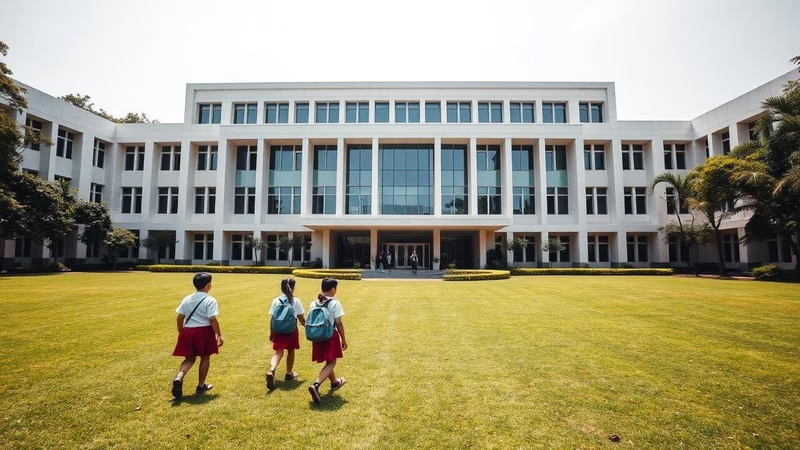
For years, the annual ritual of receiving a steep school fee hike notice has been a source of anxiety for countless parents in the capital. Now, a landmark legal battle is poised to fundamentally reshape who gets the final say on those charges. In a recent ruling that has sent shockwaves through the education sector, the Delhi High Court has refused to put the brakes on the government’s aggressive new fee regulation framework, effectively mandating that all private schools must establish their own fee regulation committees.
This decision is far more than just bureaucratic red tape; it strikes at the heart of a long-standing conflict between a government determined to protect consumers and private institutions fiercely guarding their operational independence. The court’s move to extend deadlines while letting the core law stand means that, for now, the era of unilateral fee decisions by school managements in Delhi appears to be over.
Table of Contents
- The High Court’s Decision: What’s Next for Delhi Private School Fees?
- Decoding the 2025 Law: A Three-Tier System of Oversight
- Why Schools Are Fighting Back: Autonomy vs. Accountability
- What This Means for Parents: A New Voice in Fee Fixation
- The Road Ahead: From High Court to Supreme Court?
- Conclusion
- Sources
The High Court’s Decision: What’s Next for Delhi Private School Fees?
The Delhi High Court’s recent order is a clear signal of judicial support for the government’s interventionist stance on Delhi private school fees. While the court acknowledged the concerns raised by various private school associations, it ultimately declined their plea for an interim stay on the Delhi School Education (Transparency in Fixation and Regulation of Fees) Act, 2025 .
However, in a concession to the schools’ logistical challenges, the court did extend the deadlines for them to comply with the new mandates. This means schools now have more time to set up their mandatory School-Level Fee Regulation Committees and to submit their proposed fee structures for the upcoming academic year for scrutiny .
The core of the petitioners’ argument is that the 2025 Act is unconstitutional and creates a confusing overlap with the existing Delhi School Education Act, 1973, which already provides a “broad framework for regulating fees” . The High Court, however, has chosen to let the legal process play out in full hearings, leaving the new law in force for the time being.
Decoding the 2025 Law: A Three-Tier System of Oversight
Gone are the days when a school management could simply announce its fees for the next year. The 2025 Act introduces a rigid, three-tier committee structure designed to bring unprecedented transparency and accountability to the process . Here’s how it works:
- School-Level Fee Regulation Committee (SLFRC): This is the first and most crucial checkpoint. Every private school must now constitute this committee, which includes parent representatives. The school management is legally required to submit its detailed, itemized fee proposal to this body for examination and approval before any public announcement can be made .
- District Fee Appellate Committee (DFAC): If a parent or the school itself is unhappy with the SLFRC’s decision, they can appeal to this district-level body. It acts as a formal grievance redressal forum with the power to adjudicate disputes .
- State Fee Regulation Authority: At the apex of this new system is a state-level authority that provides overarching supervision and handles the most complex appeals, ensuring a uniform policy across the National Capital Territory .
The government’s stated objective is clear: to end “arbitrary fee hikes” and ensure that fee fixation is a “transparent, accountable and time-bound” process that safeguards the interests of parents and students [[16], [22]].
Why Schools Are Fighting Back: Autonomy vs. Accountability
Private school managements are up in arms, calling the new law deeply “intrusive” . Their primary contention is that it erodes their fundamental right to manage their own affairs, a principle that has been a cornerstone of private, unaided education in India.
They argue that the 1973 Act already empowers the government to regulate fees, making the 2025 law redundant and creating a parallel, cumbersome bureaucracy. From their perspective, this isn’t about dodging accountability but about preserving the operational freedom necessary to maintain educational quality, invest in infrastructure, and pay competitive salaries to attract top talent.
Many see this as a direct challenge to their institutional autonomy, fearing that a committee dominated by parents—who naturally seek lower costs—may not fully appreciate the complex financial realities of running a high-quality educational institution. They worry this could lead to underfunded schools and a decline in educational standards across the board.
What This Means for Parents: A New Voice in Fee Fixation
For parents, this legal shift represents a significant empowerment. For the first time, they have a formal, structured platform—a seat at the table—where they can question, scrutinize, and negotiate the fees they are expected to pay. This moves them from being passive recipients of a fee notice to active participants in the financial governance of their child’s school.
The hope is that this will lead to more reasonable and justified fee structures, where every charge is backed by a clear rationale. It also provides a clear, official channel for resolving disputes, moving away from the previous scenario where parents often had little recourse beyond public complaints or legal action.
While this is a win for consumer rights in education, it also places a new responsibility on parent representatives to engage constructively, understand the school’s financial needs, and work towards a sustainable balance that ensures both affordability for families and viability for the institution.
The Road Ahead: From High Court to Supreme Court?
The legal battle is far from over. With the High Court refusing to grant an interim stay, the case will now proceed to a full hearing where the constitutional validity of the 2025 Act will be thoroughly examined. Given the high stakes involved—the financial health of hundreds of schools and the rights of millions of students—it is highly likely that whichever side loses in the High Court will appeal to the Supreme Court of India.
This protracted legal fight means that the current uncertainty will persist for some time. Schools are in a holding pattern, forced to comply with a law they believe is flawed, while parents wait to see if their newfound power will be permanent or short-lived. The final verdict could set a precedent for how private education is regulated not just in Delhi, but potentially across the entire country.
Conclusion
The Delhi High Court’s decision to uphold the government’s fee regulation committees marks a pivotal moment in the city’s educational landscape. It’s a classic clash between the state’s duty to protect citizens from potential exploitation and the private sector’s right to self-governance. While the immediate future for Delhi private school fees is one of mandated collaboration and oversight, the ultimate fate of this ambitious reform hinges on the higher judiciary. One thing is certain: the era of unchecked fee hikes in the capital is officially on life support, and the final prognosis is still pending.
Sources
- Times of India: Delhi’s private schools can’t shake off fee committees
- The Hindu: Delhi government notifies law to regulate private school fees
- Legislative Department, Government of India: The Delhi School Education Act, 1973
- [INTERNAL_LINK:school-fee-hike-india-guide]
- [INTERNAL_LINK:parents-rights-in-private-schools]