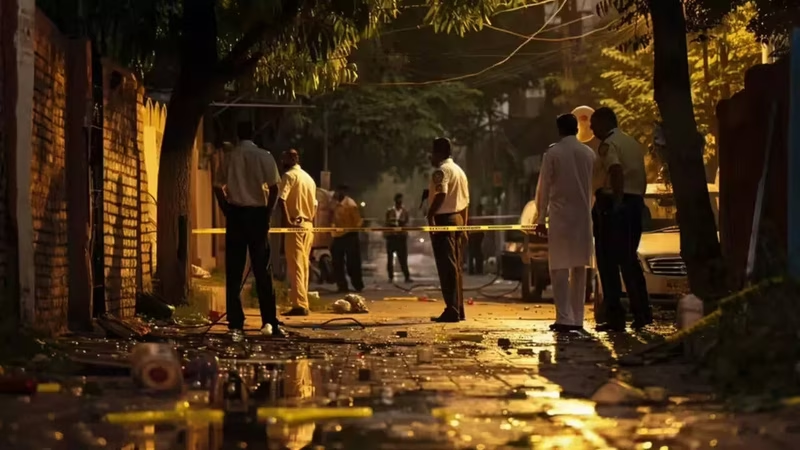
The hopeful chime of midnight on January 1, 2026, was drowned out by a chilling wave of violence across India’s capital. In a horrifying start to the new year, the city of Delhi was rocked by three separate and fatal stabbing incidents, claiming the lives of three individuals in unrelated acts of brutality [[19], [23]]. The victims—a 50-year-old tailor, a 15-year-old boy, and an e-rickshaw driver—were all ordinary citizens whose lives were cut short in moments of shocking aggression. This spate of violence has sent shockwaves through the community, raising urgent questions about public safety and the city’s ability to protect its residents during celebratory periods. The Delhi New Year stabbings have become a grim symbol of the city’s ongoing struggle with crime.
Table of Contents
- The Victims: Ordinary Lives Cut Short
- The Attacks: A Night of Horror in Delhi
- Police Response: Arrests and Investigations
- Broader Context: Delhi’s Persistent Crime Challenge
- Conclusion: A City Seeks Justice and Safety
- Sources
The Victims: Ordinary Lives Cut Short
The human toll of the Delhi New Year stabbings is both tragic and deeply personal. The first victim was Bihari Lal, a 50-year-old tailor from northwest Delhi’s Lal Bagh area . His crime? Politely asking a group of youths to lower their loud music on a night he likely hoped to spend in peace. This simple request for quiet ended in a brutal, fatal assault by the group, which police later identified as including juveniles [[18], [21]].
In another part of the city, a young life was extinguished. A 15-year-old boy was fatally stabbed in a separate, yet equally senseless, incident . Details surrounding his attack remain under investigation, but the loss of a child on what should have been a night of promise is a devastating blow to his family and community.
The third victim was an e-rickshaw driver, whose life was also claimed in a violent altercation on New Year’s Eve . While the exact motive for his killing is still being probed, his death adds to the grim tally of a night that should have been about celebration, not mourning .
The Attacks: A Night of Horror in Delhi
The three stabbings occurred in different neighborhoods across Delhi, including Mangolpuri, Sultanpuri, and Lal Bagh, suggesting a disturbing, if coincidental, citywide trend of violence on that fateful night . The attacks were not linked, but they shared a common thread of sudden, extreme aggression.
The most publicized incident involved Bihari Lal, who, after being confronted by the loud group, reportedly pleaded, “I begged them to spare my son“—a desperate cry that underscores the terror of the moment before he was fatally stabbed . In another case, police sources indicated that there may have been “bad blood” between the victim and the attackers, hinting at personal disputes that escalated to deadly violence [[18], [21]]. Despite these differences, the collective impact has been a city-wide sense of fear and vulnerability.
Police Response: Arrests and Investigations
In the immediate aftermath, the Delhi Police launched a swift and coordinated response. Authorities have confirmed that a total of six accused individuals have been apprehended in connection with these attacks [[18], [21]]. Notably, four of these suspects are juveniles, a detail that has sparked a separate but equally important debate about youth crime and its root causes in the national capital .
Police officials have stated that preliminary investigations are complete in some of the cases, and they are working to build a strong legal case for prosecution . The focus is now on ensuring that justice is served for the victims and their grieving families. The speed of the arrests, while commendable, has done little to quell the public’s anxiety about underlying safety issues.
Broader Context: Delhi’s Persistent Crime Challenge
While the Delhi New Year stabbings are a particularly shocking cluster of events, they do not occur in a vacuum. Delhi has long grappled with high crime rates. According to the National Crime Records Bureau (NCRB), the city reported over 324,000 cases under the Indian Penal Code in 2023 alone, an 8% increase from the previous year, solidifying its position at the top of the national crime charts [[11], [17]].
Although some categories of crime, like street snatching, have seen a decline in recent reports, the overall trend remains concerning . The city’s struggle with violent crime, in particular, casts a long shadow and is a critical public safety issue that demands sustained attention from law enforcement and city planners. For a deeper look at urban safety, see our analysis on [INTERNAL_LINK:urban-crime-prevention-strategies].
Conclusion: A City Seeks Justice and Safety
The tragic events of New Year’s Eve have left an indelible mark on Delhi. The Delhi New Year stabbings are a stark reminder of the fragility of peace and the urgent need for effective crime prevention strategies. As the police work to secure justice for the three victims—a tailor, a young boy, and a hardworking driver—the city must also engage in a deeper conversation about its social fabric, the factors that breed such violence, and how to create a safer environment for all its citizens. The hope for a better 2026 now hinges on the city’s ability to learn from this tragedy and take concrete action.