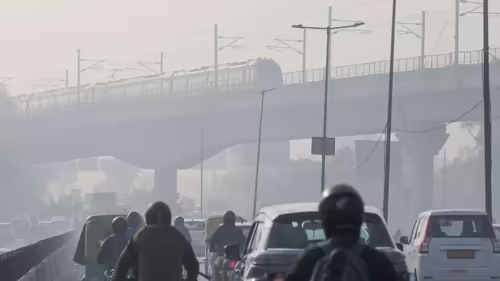
For residents of the capital region, a collective sigh of relief is in the air—literally and figuratively. The Commission for Air Quality Management (CAQM) has officially revoked the **GRAP Stage-III** restrictions that had been choking daily life and business in **Delhi-NCR air pollution**. This move, effective immediately as of January 22, 2026, comes on the heels of a noticeable, albeit fragile, improvement in the city’s Air Quality Index (AQI) .
But before you rush back to your pre-pollution routines, let’s unpack what this decision truly means. Is the air safe to breathe? Can construction sites roar back to life? And what measures are still firmly in place to keep our fragile atmospheric gains from vanishing?
Table of Contents
- What’s Behind the Decision to Lift GRAP Stage-III?
- What is GRAP and Why Does it Matter for Delhi-NCR?
- What Can You Do Now That GRAP Stage-III is Revoked?
- What Still Remains Banned or Restricted?
- Is the Air Really Safe? Expert Opinions
- Conclusion: A Temporary Reprieve, Not a Victory
- Sources
What’s Behind the Decision to Lift GRAP Stage-III?
The CAQM’s Sub-Committee made its call based on hard data. The average AQI for Delhi had improved from a concerning 378 on January 20th to a more manageable 330 by January 22nd . This shift moved the air quality from the ‘Very Poor’ category back into the ‘Poor’ to ‘Moderate’ range, which is the threshold for triggering Stage-III measures.
Stage-III restrictions were initially imposed on January 16th after the AQI plummeted into the ‘Very Poor’ zone . The subsequent revocation is a direct response to this positive trend, offering a significant reprieve to industries and citizens alike.
What is GRAP and Why Does it Matter for Delhi-NCR?
For those new to the annual smog saga, GRAP stands for the Graded Response Action Plan. It’s not just a set of rules; it’s an emergency action plan designed specifically for the National Capital Region. Think of it as a four-tiered defense system against toxic air, with each stage activating more severe measures as the AQI worsens .
Here’s a quick breakdown of the GRAP stages:
- Stage I (Poor): AQI 201-300. Focuses on basic controls like intensified road dust management and strict enforcement of vehicle pollution norms [INTERNAL_LINK:delhi-air-quality-guide].
- Stage II (Very Poor): AQI 301-400. Adds measures like a ban on diesel generator sets (except for essential services) and increased public transport frequency .
- Stage III (Severe): AQI 401-450. This is where things get serious, with bans on construction and demolition activities and potential school closures .
- Stage IV (Severe+): AQI above 450. An emergency level, often involving work-from-home orders for government offices and a complete ban on truck entry .
What Can You Do Now That GRAP Stage-III is Revoked?
The lifting of Stage-III brings welcome news for several sectors. Most notably, the blanket ban on construction and demolition activities across the NCR has been lifted . This is a massive relief for the real estate and infrastructure industries, which had been brought to a standstill.
However, it’s crucial to understand that this is not a return to business as usual. The resumption of construction is conditional and must adhere to all existing environmental safeguards and dust control protocols mandated under the lower GRAP stages.
What Still Remains Banned or Restricted?
Don’t pack away your masks just yet. While Stage-III is gone, the measures under Stage-I and Stage-II of the GRAP are still very much in effect . This means a host of restrictions remain to protect the fragile air quality gains:
- Diesel Generator Ban: The use of diesel generator sets is prohibited, except for critical services like hospitals, telecom, and railways.
- Industrial Controls: Industries not running on clean fuels (like PNG) must continue to operate at reduced capacity or remain shut.
- Vehicle Restrictions: There’s an intensified focus on enforcing Pollution Under Control (PUC) certificates and cracking down on visibly polluting vehicles.
- Waste Management: Any form of open burning of waste, garbage, or biomass remains strictly banned.
Is the Air Really Safe? Expert Opinions
An AQI of 330 is a vast improvement over the ‘Severe’ levels, but it’s still classified as ‘Poor’. For context, an AQI below 50 is considered ‘Good’. At 330, the air is still unhealthy, especially for sensitive groups like children, the elderly, and those with respiratory conditions.
Environmental experts caution that this improvement is largely due to favorable meteorological conditions, such as increased wind speed, which help disperse pollutants. They warn that the underlying sources of pollution—vehicle emissions, industrial activity, and construction dust—haven’t disappeared. The CAQM itself has urged citizens to continue following guidelines to maintain this better air quality .
Conclusion: A Temporary Reprieve, Not a Victory
The revocation of GRAP Stage-III in the **Delhi-NCR air pollution** crisis is a positive and necessary step, signaling a short-term win for the region’s environment. It allows economic activity to resume while acknowledging the current improvement in air quality. However, it is absolutely not a signal that the problem is solved. The persistent ‘Poor’ AQI and the active Stage-I and Stage-II restrictions are stark reminders that vigilance is still required. The true test will be whether we can maintain these gains once the favorable weather passes and normal activity fully resumes.
Sources
- Times of India. “Delhi-NCR air pollution: GRAP Stage-III curbs revoked; quality likely to stay moderate to poor.” https://timesofindia.indiatimes.com/…
- Commission for Air Quality Management (CAQM). Official Website. https://caqm.nic.in/
- Central Pollution Control Board (CPCB). Daily AQI Bulletin. January 2026.
- “What is GRAP Stage-2 enforced in Delhi to combat severe air pollution?” The Indian Express, 2024.