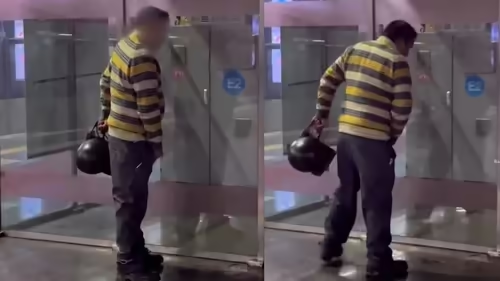
It was just another busy evening at one of Delhi’s many Metro stations—until it wasn’t. A viral video showing a man casually urinating on the platform sent shockwaves across social media, sparking widespread condemnation and forcing a reckoning with a long-ignored issue: public decency in shared urban spaces. The incident, which occurred recently in the national capital’s Metro network, has once again put the spotlight on commuter behavior, enforcement gaps, and the broader challenge of maintaining hygiene in high-footfall public infrastructure .
While the man fled after being recorded, the footage left behind a far more enduring stain—one that questions our collective commitment to civic responsibility. In response, the Delhi Metro Rail Corporation (DMRC) issued a public appeal urging passengers to uphold cleanliness standards and report such violations. But is an appeal enough?
Table of Contents
- The Incident That Went Viral
- Delhi Metro Urination and Public Hygiene Concerns
- DMRC’s Response and Existing Rules
- Why Do Such Incidents Keep Happening?
- What Can Be Done? A Call for Collective Action
- Conclusion: Beyond Outrage to Accountability
- Sources
The Incident That Went Viral
The video, captured by a fellow commuter, shows a man nonchalantly relieving himself near a staircase on a Delhi Metro platform during operational hours. Within minutes of being posted online, it amassed thousands of views and triggered a wave of disgust, anger, and calls for action. Many users labeled the act “shameful,” “disgusting,” and “a reflection of poor upbringing.”
What made the incident particularly jarring was its brazenness—in broad daylight, in full view of security cameras and other passengers. It wasn’t hidden in a corner; it was a public display of disregard for shared space and basic human decency.
Delhi Metro Urination and Public Hygiene Concerns
This isn’t an isolated case. Over the years, similar incidents—though rarely caught on camera—have been reported across various Metro stations in Delhi and other Indian cities. The Delhi Metro urination episode has reignited a critical conversation about public hygiene in mass transit systems.
Despite being hailed as a model of urban efficiency, the Delhi Metro serves over 5 million passengers daily—a number that strains even the most robust sanitation infrastructure. While clean restrooms are available at every station, accessibility, awareness, and urgency sometimes lead to lapses. However, as commuters rightly point out, convenience never justifies indecency.
DMRC’s Response and Existing Rules
Following the uproar, the DMRC swiftly responded, stating: “We appeal to all passengers to maintain cleanliness and dignity within Metro premises. Such acts are not only unhygienic but also punishable under Metro bye-laws” .
Under Rule 64 of the Delhi Metro Railway (Operation and Maintenance) Bye-Laws, 2008, any person found “soiling or defiling” Metro property can be fined up to ₹1,000 and/or imprisoned for up to six months. Yet, enforcement remains inconsistent. Security personnel are often overwhelmed, and prosecution requires formal complaints and evidence—something few bystanders are willing or able to provide.
Why Do Such Incidents Keep Happening?
Experts point to a mix of systemic and cultural factors:
- Lack of Immediate Deterrence: Without visible consequences, offenders feel emboldened.
- Anonymity in Crowds: In a sea of commuters, individuals assume they won’t be noticed or held accountable.
- Normalization of Littering and Spitting: When minor violations go unchecked, more severe ones follow.
- Inadequate Signage and Awareness: Many passengers aren’t fully aware of the penalties or restroom locations.
This creates a cycle where bad behavior becomes tolerated simply because it’s common.
What Can Be Done? A Call for Collective Action
Solving this problem requires more than just stricter policing. It demands a multi-pronged approach:
- Real-Time Monitoring: Leverage AI-powered CCTV systems to flag suspicious behavior instantly.
- Community Reporting: Introduce a DMRC mobile app feature for anonymous reporting of violations.
- Public Awareness Campaigns: Launch targeted ads inside trains and stations promoting civic pride.
- Swift Penalties: Fast-track fines for hygiene violations, with on-the-spot enforcement where possible.
As the World Health Organization (WHO) emphasizes in its guidelines on public sanitation, clean transit environments are vital for urban health and dignity.
Conclusion: Beyond Outrage to Accountability
The Delhi Metro urination incident is more than a momentary lapse—it’s a symptom of a deeper civic deficit. While the DMRC plays a crucial role, the real change must come from us: the passengers. Reporting violations, respecting shared spaces, and holding each other accountable are small acts that collectively build a culture of respect. Until then, viral videos will keep surfacing—not as scandals, but as mirrors reflecting our own apathy. For more on urban civic issues, see our coverage on [INTERNAL_LINK:urban-infrastructure-india].
Sources
- “Delhi Metro commuter caught urinating on platform, flees after being recorded,” Times of India, January 2026.
- Delhi Metro Railway (Operation and Maintenance) Bye-Laws, 2008, Rule 64.
- World Health Organization (WHO), “Water, Sanitation and Hygiene in Urban Settings.”