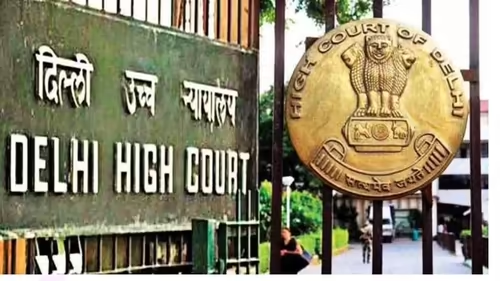
In a powerful victory for student rights and academic fairness, the Delhi High Court has delivered a landmark judgment that sends a clear message to universities nationwide: you cannot hold a student’s future hostage over attendance records alone. The court has ordered Delhi University (DU) to immediately release the examination results of its law students, specifically from the Campus Law Centre (CLC), whose results were withheld due to alleged shortfalls in their attendance.
This ruling isn’t just about grades; it’s about recognizing the immense pressure on students and ensuring that administrative rigidity doesn’t become a barrier to their academic progression. For many students who had already sat for and completed their exams, the university’s refusal to declare their results was a source of profound anxiety and uncertainty.
Table of Contents
- The Heart of the Matter: What the Court Decided
- Why This Ruling is a Game-Changer for Delhi High Court DU Law Students
- The Broader Impact on Indian Higher Education
- What Does This Mean for Students and Universities?
- Conclusion: A Step Towards a More Humane Education System
- Sources
The Heart of the Matter: What the Court Decided
The core of the Delhi High Court’s judgment is a simple yet powerful principle: if a student has been permitted to sit for an examination, they have an inherent right to receive their results. The court explicitly stated that “attendance alone cannot be a ground to withhold examinations or their results.”
This decision came in response to writ petitions filed by CLC students whose academic futures were put on hold. The university had invoked its internal rules, which often demand a minimum of 75% attendance—a standard loosely aligned with broader UGC guidelines —to justify withholding their results. However, the court found this practice to be arbitrary and unjust, especially since the students had already fulfilled the primary requirement of appearing for the exams.
The ruling also appears to be influenced by a growing judicial awareness of student mental health. In a related November 2025 order, the same court had emphasized that attendance norms should not be so stringent that they cause “mental trauma or loss of life,” highlighting a shift towards a more compassionate and student-centric approach in legal education .
Why This Ruling is a Game-Changer for Delhi High Court DU Law Students
For the affected Delhi High Court DU law students, this judgment is an immediate and immense relief. It unblocks their academic path, allowing them to apply for higher studies, internships, and job opportunities without the crippling delay caused by withheld results. But its significance goes far beyond this single cohort.
This verdict sets a crucial legal precedent. It effectively challenges the blanket application of rigid attendance policies that have long been a source of stress in Indian universities. The court’s logic is sound: the purpose of an examination is to evaluate a student’s knowledge and understanding. If a university allows a student to take that exam, it has implicitly acknowledged their eligibility to be assessed. To then deny them the outcome of that assessment based on a separate, non-academic criterion like attendance is fundamentally unfair.
This decision empowers students by affirming their rights within the educational system. It shifts the balance of power, reminding institutions that their policies must be reasonable, transparent, and above all, just.
The Broader Impact on Indian Higher Education
While this case specifically concerns DU’s law faculty, its implications ripple across the entire landscape of Indian higher education. Many universities and colleges enforce similar 75% attendance mandates, often without sufficient flexibility for genuine reasons for absence, such as illness, family emergencies, or even overlapping academic commitments.
The Delhi High Court’s stance provides a strong legal foundation for students in other institutions to challenge overly punitive attendance rules. It invites a national conversation about what truly constitutes a fair and effective educational policy. Should a student’s entire semester be jeopardized because they missed a few classes due to circumstances beyond their control, even if they have mastered the subject matter?
Furthermore, this ruling aligns with a modern understanding of education that values learning outcomes over mere physical presence. In an era of digital resources and self-directed learning, the old adage of “bums on seats” is increasingly outdated. The court’s decision nudges the system towards evaluating students on their merit and knowledge, not just their punctuality.
What Does This Mean for Students and Universities?
For Students:
- Know Your Rights: This judgment is a powerful tool. If you are barred from exams or have your results withheld solely on attendance grounds, you have a strong legal precedent to cite.
- Document Everything: Keep records of any communication with your university regarding attendance or result issues.
- Seek Support: Connect with your student union or legal aid cell for guidance on how to proceed.
For Universities:
- Review Policies: Institutions must urgently review their attendance policies to ensure they are not in conflict with this judgment and are applied with discretion and compassion.
- Focus on Learning: Shift the focus from policing attendance to fostering an engaging learning environment that naturally encourages participation.
- Implement Flexibility: Create clear, accessible channels for students to appeal attendance-related decisions based on valid reasons.
For more on navigating academic challenges, see our guide on [INTERNAL_LINK:student-rights-in-indian-universities].
Conclusion: A Step Towards a More Humane Education System
The Delhi High Court’s order to release the DU law students’ results is more than a legal win; it’s a moral one. It acknowledges the human element behind every student ID number and asserts that their academic journey should not be derailed by inflexible bureaucracy. By prioritizing the right to be evaluated and to receive results over a rigid attendance metric, the court has taken a significant step toward a more equitable, just, and humane higher education system in India. This landmark ruling will undoubtedly serve as a beacon for students and a cautionary tale for institutions for years to come.
Sources
- Times of India: Attendance alone cannot withhold exams: Delhi High Court orders DU to release law results
- LiveLaw: Delhi High Court annuls DU decision to withhold results of CLC students over attendance shortage
- Legal Service India: Delhi HC says law colleges cannot stop students from exams for low attendance
- University Grants Commission (UGC): Guidelines for Students’ Entitlement