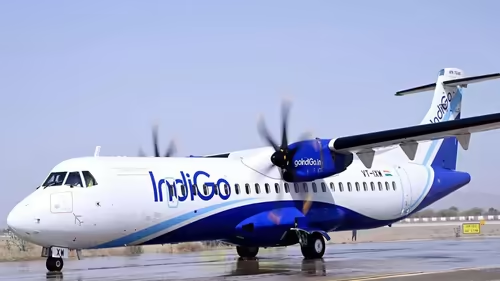
When your flight gets canceled, a refund might feel like justice—but is it really enough? The Delhi High Court doesn’t think so. In a landmark hearing that could reshape passenger rights in India, the court has directly challenged IndiGo, the country’s largest airline, to explain how it will provide meaningful flight cancellation compensation to thousands of travelers stranded during its chaotic mass cancellations last December.
The court’s blunt message was clear: “Refunds are not compensation.” This distinction cuts to the heart of a growing frustration among Indian air travelers who’ve been left stranded, out of pocket, and offered little more than discount vouchers in return for major disruptions .
Table of Contents
- What Happened During IndiGo’s December Meltdown?
- Delhi High Court Demands Real Compensation
- Why Vouchers Aren’t Enough Under Indian Law
- What Passengers Are Entitled To Under DGCA Rules
- How to Claim Proper Compensation from an Airline
- Conclusion: A Wake-Up Call for Indian Aviation
- Sources
What Happened During IndiGo’s December Meltdown?
In late December 2025, IndiGo faced an operational crisis. Citing a combination of crew shortages and severe weather, the airline abruptly canceled hundreds of flights over several days—stranding tens of thousands of passengers during one of the busiest travel periods of the year .
Many travelers were left waiting for hours at airports with no clear information. Some booked last-minute alternative flights at exorbitant prices. Others missed critical events—weddings, medical appointments, international connections. The financial and emotional toll was significant.
In response, IndiGo began offering affected passengers a standard remedy: a full refund of their ticket fare plus a Rs 10,000 travel voucher. While this gesture may seem generous on the surface, critics—and now the judiciary—argue it falls far short of true compensation.
Delhi High Court Demands Real Compensation
The court’s intervention came after multiple petitions were filed by frustrated passengers. During a recent hearing, justices expressed deep skepticism about IndiGo’s reliance on vouchers, noting that such offers do not account for the actual losses incurred by travelers—like hotel stays, rebooking fees, or lost wages .
“You are giving a voucher worth Rs 10,000. But what if the passenger had to spend Rs 25,000 to get home?” the bench reportedly asked. “Is that fair?”
The court has now ordered IndiGo to file a detailed affidavit within two weeks outlining its comprehensive flight cancellation compensation policy—not just for this incident, but as a framework for future disruptions. This move signals a potential shift toward stronger enforcement of passenger rights in India.
Why Vouchers Aren’t Enough Under Indian Law
While airlines often prefer vouchers—they keep customers loyal and avoid immediate cash outflows—Indian regulations suggest passengers deserve more. The Directorate General of Civil Aviation (DGCA) issued revised guidelines in 2023 that explicitly state passengers are entitled to compensation in cases of flight cancellations caused by the airline’s own operational failures, not just external factors like weather .
According to these rules, compensation can range from ₹5,000 to ₹10,000 depending on flight distance—but crucially, this is **in addition to** a refund or rebooking. More importantly, the DGCA emphasizes that compensation must be “monetary” unless the passenger voluntarily opts for a voucher .
Forcing passengers to accept vouchers instead of cash may violate these consumer protection principles—a point the Delhi High Court appears ready to enforce.
What Passengers Are Entitled To Under DGCA Rules
If your flight is canceled due to reasons within the airline’s control, here’s what you’re legally owed under current DGCA regulations:
- Option to Rebook or Full Refund: Free rebooking on the next available flight or a complete refund within 7 days.
- Monetary Compensation:
- Flights up to 1,500 km: ₹5,000
- Flights between 1,500–3,000 km: ₹7,500
- Flights over 3,000 km: ₹10,000
- Free Meals & Refreshments: If you’re delayed more than 2 hours, the airline must provide food and drinks.
- Hotel Accommodation: Required for overnight delays caused by the airline.
These entitlements apply only when the cancellation is due to “technical faults, crew unavailability, or other airline-side issues”—not extraordinary circumstances like natural disasters .
For more on your rights, see our guide on [INTERNAL_LINK:passenger-rights-india-air-travel].
How to Claim Proper Compensation from an Airline
If you were affected by IndiGo’s December cancellations—or any airline disruption—here’s how to ensure you get what you’re owed:
- Document Everything: Save boarding passes, emails, receipts for hotels, alternate transport, and meals.
- File a Formal Complaint: Use the airline’s customer portal first. If unresolved in 30 days, escalate to the DGCA’s online grievance system (https://dgca.gov.in).
- Quote DGCA Guidelines: Reference the 2023 circular on passenger compensation in your complaint.
- Reject Vouchers Unless You Want Them: You have the right to demand cash compensation. Don’t feel pressured to accept a voucher.
- Consider Legal Action: As the Delhi HC case shows, courts are increasingly sympathetic to passenger claims.
Conclusion: A Wake-Up Call for Indian Aviation
The Delhi High Court’s tough questioning of IndiGo marks a turning point. It sends a powerful message to all airlines operating in India: treating passengers as an afterthought is no longer acceptable. True flight cancellation compensation must reflect real-world losses—not just ticket value. As air travel grows, so must accountability. This case could set a precedent that finally puts passenger rights on equal footing with airline profits.
Sources
- Times of India. “HC: Apart from refunds, how will you compensate flyers?” https://timesofindia.indiatimes.com/india/hc-apart-from-refunds-how-will-you-compensate-flyers/articleshow/127204742.cms
- DGCA. “Revised Guidelines for Compensation and Assistance to Air Passengers.” https://dgca.gov.in
- Ministry of Civil Aviation, Government of India. “Passenger Charter on Air Travel.” https://civilaviation.gov.in