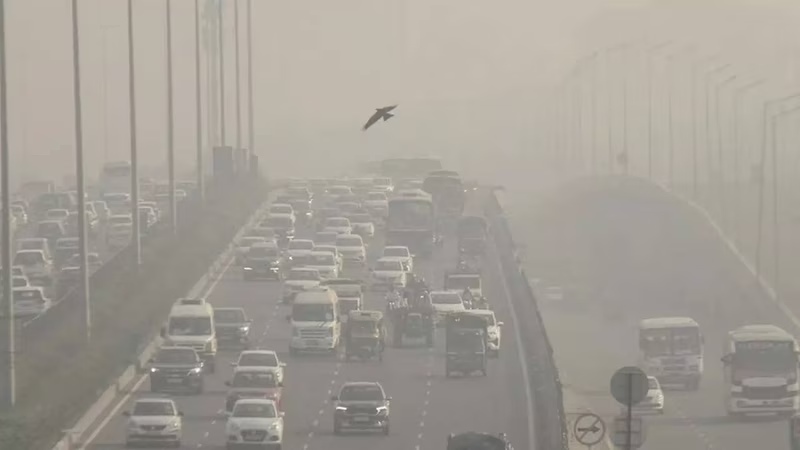
Delhi’s Air Crisis Just Got a Permanent Policy Response
Delhi is done treating its air pollution emergency as a seasonal nuisance. In a historic decision, the city’s Environment Minister has announced that two of the strictest measures under the Graded Response Action Plan (GRAP-4) will now be **permanent fixtures**—not just activated during ‘severe’ air quality episodes.
Effective immediately:
- No petrol or diesel without a valid Pollution Under Control Certificate (PUCC)
- Non-BS6 compliant vehicles barred from entering Delhi
This move—coming as Delhi’s AQI hovers in the ‘very poor’ to ‘severe’ range—signals a major shift from reactive crisis management to proactive, year-round enforcement. But while environmentalists applaud the decision, millions of vehicle owners are scrambling to understand what it means for their daily commutes, livelihoods, and wallets.
Table of Contents
- What Are the GRAP-4 Rules Now Made Permanent?
- Why PUCC Is Now a Fuel Gatekeeper
- The Non-BS6 Vehicle Ban: Who’s Affected?
- How Will This Be Enforced? Fuel Stations & Checkpoints
- Public and Expert Reactions: Praise and Pushback
- Step-by-Step Guide to Compliance
- Conclusion: A Necessary Step—But Not a Silver Bullet
- Sources
What Are the GRAP-4 Rules Now Made Permanent?
The Graded Response Action Plan (GRAP) is a set of emergency measures triggered based on Delhi’s Air Quality Index (AQI). GRAP-4—the most severe stage—was previously only activated when AQI crossed 450 (‘severe+’). Now, two of its toughest provisions are being made **permanent**, regardless of current AQI levels .
These include:
- Fuel Restriction: Petrol pumps will **refuse fuel** to any vehicle that cannot produce a valid PUCC at the time of refueling.
- Vehicle Entry Ban: All vehicles **not compliant with BS6 (Bharat Stage VI) emission norms** will be denied entry at Delhi’s interstate borders.
This marks the first time Delhi has institutionalized emergency-level pollution controls as standard operating procedure—a clear acknowledgment that the city is in a **permanent state of environmental risk**.
Why PUCC Is Now a Fuel Gatekeeper
The Pollution Under Control Certificate (PUCC) is a document issued after a vehicle passes an emissions test. Until now, it was required for annual fitness renewals but rarely checked at fuel stations.
Under the new rule, however, **fuel = PUCC**. No certificate means no petrol—even if your tank is on empty.
According to the Central Pollution Control Board (CPCB), vehicles without valid PUCC contribute disproportionately to PM2.5 and nitrogen oxide levels—especially older two-wheelers and diesel autos . By linking fuel access to emissions compliance, Delhi aims to force 5+ million vehicle owners into regular maintenance or retirement of polluting models.
The Non-BS6 Vehicle Ban: Who’s Affected?
BS6 norms were mandated nationwide from April 2020, making all new vehicles cleaner. But millions of pre-2020 BS4 (and older) vehicles remain on the road.
Now, they **won’t be allowed into Delhi**—a major blow to:
- Interstate truckers using older fleets
- Tourists or visitors from states with lax vehicle age rules
- Ride-share and delivery drivers using second-hand BS4 bikes/cars
Enforcement will be carried out via automated number plate recognition (ANPR) cameras at all 15 entry points, with fines up to ₹10,000 under the Motor Vehicles Act .
How Will This Be Enforced? Fuel Stations & Checkpoints
The success of these Delhi GRAP-4 rules permanent measures hinges on execution:
- Fuel Stations: All 500+ Delhi petrol pumps must integrate PUCC verification via a QR code scan linked to the Parivahan portal. Staff will be trained to deny fuel without it.
- Border Checkpoints: Delhi Traffic Police and the Transport Department will operate 24/7 entry screening with real-time BS6 database checks.
- Digital Integration: The government has launched a “Green Drive Delhi” app where users can check PUCC validity and BS6 status instantly [INTERNAL_LINK:delhi-green-drive-app-guide].
However, critics warn of potential chaos—long queues at pumps, fake PUCCs, and inconsistent enforcement in informal settlements.
Public and Expert Reactions: Praise and Pushback
Environmentalists: “This is the strongest signal yet that Delhi is serious about clean air,” said Aseem Shrivastava of the Centre for Ecology & Rural Development .
Transport Unions: Auto-rickshaw drivers’ associations have protested, arguing that many cannot afford BS6 vehicle upgrades. “We’re being punished for systemic failure,” said Ramesh Yadav, head of Delhi E-Rickshaw Sangh.
Legal Experts: Some question the legality of denying fuel—a basic service—based on an ancillary document, potentially inviting court challenges.
Step-by-Step Guide to Compliance
- ✅ **Check your vehicle’s emission norm:** Look at your RC book—“BS6” should be clearly printed.
- ✅ **Get PUCC renewed:** Visit any authorized emission testing center (cost: ₹60–₹100). Valid for 1 year (6 months for diesel).
- ✅ **Save digital copy:** Download the PUCC from vahan.parivahan.gov.in and store it on your phone.
- ✅ **Non-BS6 owners:** If you live outside Delhi, consider renting a BS6-compliant vehicle for trips into the city.
Conclusion: A Necessary Step—But Not a Silver Bullet
Making the Delhi GRAP-4 rules permanent is a bold, overdue move that shifts the city from crisis mode to constant vigilance. While it won’t solve stubble burning, industrial emissions, or construction dust alone, it directly targets the **28% of pollution attributed to vehicular emissions**—a controllable factor.
For residents, this means adapting fast. For the government, it means ensuring fairness, accessibility, and zero corruption in enforcement. Because clean air isn’t a luxury—it’s a right. And Delhi is finally treating it like one.
Sources
- Times of India: ‘No fuel without PUCC’: Delhi to make two key GRAP-4 curbs permanent
- Central Pollution Control Board (CPCB): Vehicular Pollution Control Guidelines – 2025
- Ministry of Road Transport: PUCC and BS6 Compliance Portal
- Centre for Science and Environment: Delhi Air Pollution Source Apportionment Study