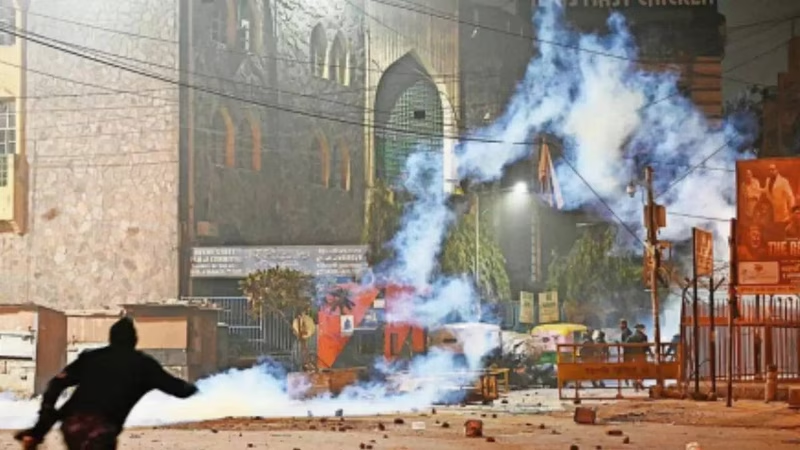
It was past midnight in one of Delhi’s oldest and most densely packed neighborhoods when the sound of bulldozers broke the silence. What was meant to be a routine anti-encroachment operation by the Municipal Corporation of Delhi (MCD) near the Faiz-e-Ilahi Mosque in Turkman Gate quickly spiraled into chaos. Stones flew, tear gas canisters exploded, and five police officers were left injured. This wasn’t just another demolition—it was a flashpoint in the city’s ongoing battle over urban space, legality, and community resistance. And now, thanks to drone footage and bodycams, authorities are moving fast to hold those responsible accountable.
Table of Contents
- What Happened During the Delhi Demolition Drive?
- Delhi Demolition Drive: The Role of Drones and Tech
- Why Turkman Gate Is a Flashpoint
- Legal vs. Illegal: The Politics of Urban Clearance
- Public Reaction and Ongoing Investigations
- Conclusion: A City at a Crossroads
- Sources
What Happened During the Delhi Demolition Drive?
On the night of January 7, 2026, MCD officials, accompanied by a heavy police contingent, arrived in the Turkman Gate area—a historic locality in Old Delhi known for its narrow lanes and tightly packed settlements. The target: structures allegedly built illegally on government land adjacent to the Faiz-e-Ilahi Mosque .
As demolition equipment moved in, a crowd gathered. Tensions escalated rapidly. According to Delhi Police, individuals in the crowd began hurling stones at officers, resulting in injuries to five personnel. In response, police deployed tear gas to disperse the mob and secure the area. The operation was temporarily halted but resumed after order was restored .
The incident highlights the volatile nature of urban enforcement in heritage zones where property rights are often ambiguous and community ties run deep.
Delhi demolition drive: The Role of Drones and Tech
What sets this incident apart from past clashes is the Delhi Police’s use of advanced surveillance technology. Within hours, authorities began analyzing:
- Drone footage capturing aerial views of the gathering and identifying key agitators.
- Body-worn camera recordings from frontline officers, providing ground-level evidence.
- CCTV feeds from nearby shops and municipal cameras.
This multi-layered tech approach led to the swift identification and arrest of five individuals allegedly involved in stone-pelting . It marks a significant shift in how law enforcement handles civil unrest in India’s capital—moving from reactive policing to proactive, evidence-based action.
Delhi Police have increasingly integrated drones into their operations since 2023, especially for crowd monitoring during protests and demolitions [[INTERNAL_LINK:delhi-police-drone-policy]]. This case may become a textbook example of their tactical deployment.
Why Turkman Gate Is a Flashpoint
Turkman Gate isn’t just any neighborhood. It carries deep historical and political weight. In 1ut 1976, during the Emergency, a brutal demolition drive here led to civilian deaths and became a symbol of state overreach—a wound that still resonates in local memory .
Today, the area remains a complex mosaic of long-standing residents, informal settlers, and disputed land claims. Many families have lived there for generations, often without formal documentation. To them, a “demolition drive” isn’t just about illegal construction—it’s about displacement, dignity, and survival.
The MCD claims the demolished structures violated building codes and encroached on public land earmarked for civic amenities. But critics argue that such operations are often poorly communicated and lack rehabilitation plans, fueling resistance .
Legal vs. Illegal: The Politics of Urban Clearance
Delhi’s struggle with unauthorized construction is decades old. The city’s Master Plan designates certain zones for green space, roads, or public infrastructure—but rapid urbanization, migration, and bureaucratic delays have led to widespread encroachment.
The MCD, empowered under the Delhi Municipal Corporation Act, conducts regular demolition drives. However, these operations often spark controversy due to:
- Lack of prior notice to residents.
- Absence of alternative housing or compensation.
- Perceived targeting of marginalized communities.
While the courts have repeatedly upheld the state’s right to reclaim public land, they’ve also emphasized the need for humane implementation . The tension between legal enforcement and social equity remains unresolved—and volatile.
Public Reaction and Ongoing Investigations
Social media erupted after the incident, with videos of the clashes going viral. Some praised the police for using technology to ensure accountability; others condemned the timing and execution of the demolition, calling it “heavy-handed.”
Local leaders have demanded transparency, while human rights groups are calling for an independent review of the MCD’s process. Meanwhile, Delhi Police have filed an FIR under sections related to rioting, unlawful assembly, and assault on public servants .
The five arrested individuals are currently in custody. Investigators are reviewing more footage to determine if additional charges—such as criminal conspiracy—apply.
Conclusion: A City at a Crossroads
The Delhi demolition drive near Turkman Gate is more than a news event—it’s a symptom of a deeper urban crisis. As India’s capital grapples with overcrowding, infrastructure strain, and the legacy of informal settlements, the way it enforces land laws will define its future. Technology like drones offers precision, but without empathy, communication, and rehabilitation, even the most “legal” action can ignite unrest. The real challenge isn’t just removing structures—it’s rebuilding trust.
Sources
- Times of India: Delhi demolition drive: Drones, videos to help identify those involved in stone-pelting
- The Hindu Archives: Turkman Gate, 1976: A Historical Perspective
- Supreme Court of India Judgments: On Demolition and Right to Shelter (e.g., Almitra Patel vs. Union of India)
- Delhi Urban Art Commission: Reports on Encroachment and Heritage Conservation in Old Delhi