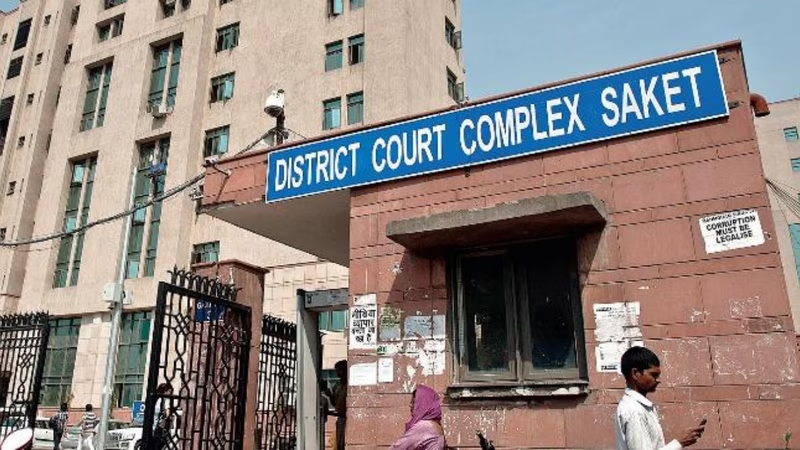
The hallowed halls of justice are meant to be places of order and resolution, but a chilling silence fell over Delhi’s Saket Court complex on Friday, January 9, 2026. In a heart-wrenching incident, a court staffer, identified as Harish Singh Mahar (35), died by suicide after jumping from a building within the complex . A suicide note was recovered, and a formal probe is now underway .
This isn’t just another crime report; it’s a profound human tragedy that forces us to confront an uncomfortable truth: the immense, often invisible, pressure faced by those who keep our judicial system running. The Delhi court suicide has sent shockwaves through the legal community and beyond, raising urgent questions about workplace well-being and mental health support.
Table of Contents
- The Tragic Incident at Saket Court
- Beyond the Headlines: The Human Story
- Delhi Court Suicide and the Hidden Epidemic of Workplace Stress
- A System Under Strain: Mental Health in the Indian Judiciary
- What Can Be Done? Prevention and Support
- Conclusion: A Call for Compassion and Change
- Sources
The Tragic Incident at Saket Court
According to police reports, the incident occurred on Friday morning at the Saket District Court complex in South Delhi. Harish Singh, who had been serving as a court staff member since 2010, was working in a digital traffic court at the time of his death . The recovery of a suicide note suggests he was grappling with deep personal or professional turmoil, though the specific contents have not been made public pending the investigation .
The immediate response has been a standard procedural probe, but many are calling for a deeper, more systemic inquiry. This event is a grim reminder that the people behind the paperwork and administrative functions are not immune to despair.
Beyond the Headlines: The Human Story
Harish Singh wasn’t just a “staffer”; he was a 35-year-old man with a life, family, and dreams. He had dedicated over 15 years of his life to the judicial system. His death is a personal catastrophe for his loved ones and a professional loss for his colleagues. It’s easy to get lost in the facts of a case, but we must remember the human cost. This tragedy underscores the need for workplaces, especially high-pressure environments like courts, to foster a culture where employees feel seen, heard, and supported.
Delhi Court Suicide and the Hidden Epidemic of Workplace Stress
While the exact reasons behind Singh’s actions are still under investigation, this incident cannot be viewed in isolation. It points to a larger, pervasive issue: chronic workplace stress. The Indian judiciary is famously overburdened, with a massive backlog of cases creating a relentless, high-stakes environment.
This pressure doesn’t just affect judges. Clerks, stenographers, and other administrative staff are on the front lines of this system, often dealing with frustrated litigants, demanding schedules, and the sheer weight of a clogged legal machine. A recent study on occupational stress in the district judiciary found that factors like heavy workload, lack of control over one’s work, and poor interpersonal relationships are significant drivers of psychological strain .
When this chronic stress goes unaddressed, it can lead to severe mental health issues, including anxiety, depression, and, in the most tragic cases, suicide. The Delhi court suicide may be a symptom of this wider, unspoken crisis.
A System Under Strain: Mental Health in the Indian Judiciary
The conversation around mental health in the legal profession has often centered on lawyers and judges. Research shows that a staggering 89% of judicial officers know of colleagues who have experienced stress or anxiety, yet a deeply ingrained stigma prevents many from seeking help .
However, the stress ecosystem extends far beyond the bench. Support staff, who are crucial to the day-to-day functioning of the courts, are frequently overlooked in these discussions. They operate in the same high-tension atmosphere but may have even fewer resources or avenues for support. The National Judicial Academy itself recognizes occupational stress as an “inevitable occupational pathology” within the system . If this is the acknowledged reality for judges, one can only imagine the compounded challenges faced by their support staff.
What Can Be Done? Prevention and Support
This tragedy must serve as a catalyst for change. Here are some critical steps that can be taken:
- Mandatory Mental Health Programs: Courts should implement regular, confidential counseling services and mental health workshops for all employees, not just judicial officers.
- Destigmatize the Conversation: Leadership must actively promote a culture where talking about mental health is seen as a sign of strength, not weakness. [INTERNAL_LINK:mental-health-awareness-in-the-workplace] could be a starting point for such initiatives.
- Workload Management: A serious review of staffing levels and work distribution is needed to ensure no single employee is overwhelmed beyond capacity.
- Crisis Intervention Training: Equip managers and colleagues with the skills to recognize signs of distress and provide immediate, compassionate support.
If you or someone you know is struggling, please reach out. You are not alone. In India, you can contact these helplines:
- Vandrevala Foundation Helpline: 1860 2662 345 or 1800 2333 330
- Sumaitri: 011-23389090 / 011-46018404
- Tele-MANAS (National Tele-Mental Health Programme): Dial 14416 or 1800-891-4416
Conclusion: A Call for Compassion and Change
The death of Harish Singh at the Saket Court is a devastating loss. It’s a stark, painful illustration of how systemic pressures can break an individual. While the police probe will focus on the immediate circumstances, the broader investigation must be societal. We need to move beyond reacting to tragedies and start proactively building resilient, supportive, and humane workplaces. The Delhi court suicide should be the last of its kind, a final wake-up call that compels us to prioritize the mental well-being of every person who serves our institutions.
Sources
- Times of India. “Delhi: Court staff member dies by suicide at Saket court complex; suicide note recovered.” Times of India, 9 Jan. 2026.
- Moneycontrol News. “Saket court staffer dies by suicide at judicial complex, cites…” Moneycontrol, 9 Jan. 2026.
- Huchhanavar, S. “Occupational Stress Among India’s District Judges.” 2025.
- National Judicial Academy. “Session -2: Why and Wherefore of Stress in Judicial Officers.”
- “Judicial Wellness for Judicial Officers: Achieving Work-Life Balance.” 15 July 2024.
- Government of India, Ministry of Health & Family Welfare. “Mental Health and Suicide Prevention Helpline Numbers.”