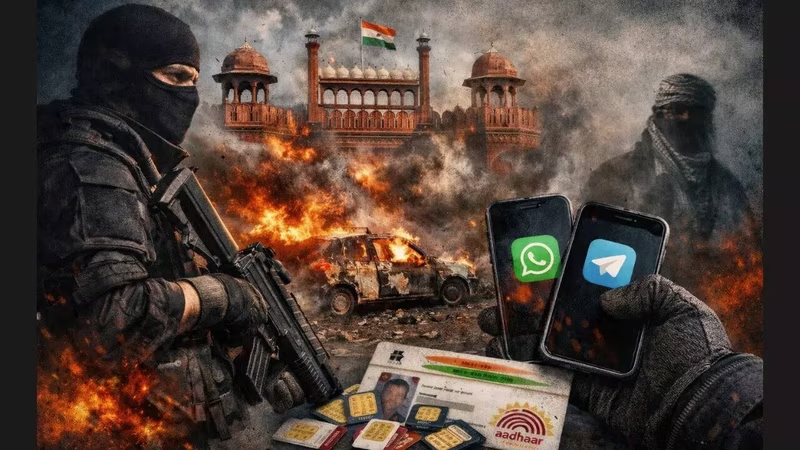
On the quiet night of October 18–19, 2025, posters bearing the insignia of the banned terrorist group Jaish-e-Mohammed (JeM) suddenly appeared on walls outside Srinagar. The message was chilling: “Attacks on police and security forces are coming.”
What followed wasn’t just another terror warning—it unraveled a high-stakes, “white-collar” terror module operating deep within India’s urban centers. And at the heart of their communication strategy? A near-untraceable tool known as the ghost SIM card.
Now, with a massive seizure of 2,900 kg of explosive precursors—including ammonium nitrate, potassium nitrate, and sulphur—authorities have pieced together how this network stayed hidden for months. The discovery of **ghost SIM cards** has sent shockwaves through India’s intelligence and telecom sectors, raising urgent questions about digital security in the age of hybrid terrorism.
Table of Contents
- What Is a Ghost SIM Card?
- How Terrorists Used Ghost SIMs in the Delhi Blast Plot
- The ‘White-Collar’ Terror Module Exposed
- Links to Pakistani Handlers
- Why Ghost SIMs Are Hard to Detect
- Government Response and Telecom Reforms
- Conclusion
- Sources
What Is a Ghost SIM Card?
A ghost SIM card isn’t your average prepaid mobile chip. It’s a cloned, spoofed, or illegally activated SIM that bypasses standard KYC (Know Your Customer) protocols. These cards are often:
- Registered under fake or stolen identities.
- Activated using forged documents or insider collusion at retail stores.
- Programmed to mimic legitimate numbers or operate on “burner” networks.
Unlike regular SIMs, ghost SIMs leave minimal digital footprints. They can be used for a few days—or even hours—before being discarded, making real-time tracking nearly impossible. In some cases, they’re even linked to international roaming services, allowing users to appear as if they’re calling from abroad.
According to the Ministry of Electronics and Information Technology (MeitY), over 12,000 ghost SIMs were deactivated in India in 2025 alone—most linked to fraud, but a growing number to national security threats.
How Terrorists Used Ghost SIMs in the Delhi Blast Plot
Investigators from the National Investigation Agency (NIA) revealed that the Delhi blast suspects rotated between at least **seven ghost SIM cards** over a three-month period. Each card was used for no more than 48 hours before being dumped.
The communication pattern was chillingly precise:
- Initial contact: A ghost SIM registered under a fake Delhi address was used to receive encrypted voice notes from a number traced to Rawalpindi, Pakistan.
- Coordination: A second SIM, activated via a compromised telecom agent in Ghaziabad, relayed logistics—pickup points for explosives, safe houses, and target reconnaissance.
- Final instructions: The last call, made just 6 hours before the blast, came from a SIM purchased with a forged Aadhaar card in Noida.
Critically, none of these numbers were flagged by telecom operators—because they appeared “clean” during standard checks.
The ‘White-Collar’ Terror Module Exposed
What makes this network particularly dangerous is its profile. Unlike traditional terror cells, this group included:
- A former IT professional with cybersecurity training.
- A pharmacy owner who sourced chemical precursors under the guise of medical use.
- A college-educated logistics coordinator who used ride-sharing apps to move materials.
This “white-collar” structure allowed them to blend into urban life while executing high-impact operations. Their sophistication extended to using ghost SIMs not just for calls—but to create fake social media profiles, spread disinformation, and even order delivery services to avoid face-to-face contact.
Links to Pakistani Handlers
Digital forensics confirmed that all ghost SIM communications ultimately routed through servers in Lahore and Islamabad. Call metadata showed repeated contact with known JeM operatives, including a handler using the alias “Faruq”—previously linked to the 2019 Pulwama attack.
Notably, some calls used VoIP (Voice over Internet Protocol) layered over the ghost SIMs, adding another layer of encryption. This hybrid method—combining physical SIM anonymity with digital encryption—has become a new standard for transnational terror groups.
Why Ghost SIMs Are Hard to Detect
Despite advances in surveillance, ghost SIMs remain a blind spot due to:
- Fragmented KYC enforcement: Thousands of small retailers lack biometric verification systems.
- Insider threats: Telecom employees are sometimes bribed to bypass verification.
- Rapid obsolescence: By the time a SIM is flagged, it’s already discarded.
- International loopholes: Some ghost SIMs are activated abroad and smuggled in.
For deeper insights into digital terror tactics, see our investigation on [INTERNAL_LINK:encryption-and-terror-communication].
Government Response and Telecom Reforms
In the wake of the Delhi blast, the Indian government has fast-tracked major telecom reforms:
- Mandatory e-KYC with live biometrics for all new SIM activations, effective March 2026.
- Real-time SIM usage monitoring via a new AI-powered system developed by C-DOT.
- Stricter penalties for retailers and telecom staff involved in ghost SIM issuance—up to 7 years in prison.
- Collaboration with global carriers to block international ghost SIM imports.
While these measures are promising, experts warn that as long as demand for anonymous communication exists, terror networks will find new workarounds.
Conclusion
The exposure of the ghost SIM card network in the Delhi blast case is a stark reminder that modern terrorism thrives in the gaps between regulation and reality. These untraceable tools—once the domain of cybercriminals—are now weapons in the hands of those seeking to destabilize nations. India’s response must be as agile as the threat itself: combining technology, intelligence, and international cooperation to shut down these digital backchannels before the next attack strikes.
Sources
[1] “Delhi blast: Probe unveils how terrorists spoke to Pak handlers – What’s ‘ghost’ SIM card?”, Times of India
[2] National Investigation Agency (NIA) Press Briefing, December 2025
[3] Ministry of Electronics and Information Technology (MeitY), “SIM Security Guidelines 2.0”
[4] “Terror Financing and Telecom Fraud,” Indian Journal of Security Studies, Vol. 12, 2025
[5] https://www.meity.gov.in/