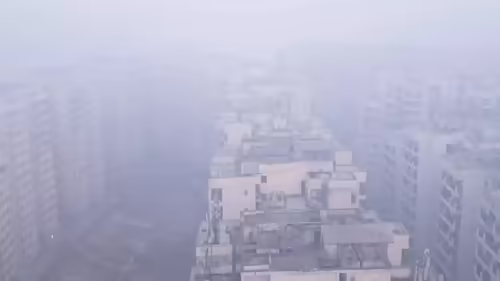
It’s that time of year again. The iconic India Gate has vanished behind a thick, grey-brown haze. Your morning jog feels like a respiratory workout you never signed up for. And your eyes sting just from stepping outside. Delhi-NCR is once again in the grip of a suffocating smog crisis, with the Delhi AQI (Air Quality Index) skyrocketing to a dangerous 439—firmly in the ‘severe’ category . This isn’t just bad air; it’s a public health emergency unfolding in real-time.
Table of Contents
- The Current Crisis: By the Numbers
- What Does a ‘Severe’ Delhi AQI Really Mean?
- Immediate Health Risks You Can’t Ignore
- Why Is This Happening Now? The Perfect Storm
- Your Essential Survival Guide: Staying Safe Indoors & Out
- Beyond Masks: What Needs to Change Long-Term
- Conclusion: A City at a Crossroads
- Sources
The Current Crisis: By the Numbers
The data paints a grim picture of a city under siege from its own air. As of January 18, 2026, multiple monitoring stations across the capital have recorded catastrophic pollution levels :
- Anand Vihar: 489
- Dwarka Sector 8: 469
- Punjabi Bagh: 476
- Wazirpur: 478
- Ashok Vihar: 463
- Bawana: 467
- Chandni Chowk: 464
- RK Puram: 467
- ITO: 448
- Narela: 412
Every single one of these locations falls under the ‘severe’ category on the AQI scale, which means the air quality is so poor that it can trigger serious health effects in the entire population, not just those with pre-existing conditions .
What Does a ‘Severe’ Delhi AQI Really Mean?
The Air Quality Index is a simple way to communicate how polluted the air is and what associated health effects might be of concern. It runs from 0 to 500, with higher numbers indicating greater levels of pollution and greater health concerns.
When the Delhi AQI crosses 400, it enters the ‘severe’ zone (401-500). At this level, the Central Pollution Control Board (CPCB) issues its most stringent health advisories. For context, an AQI between 0-50 is considered ‘good,’ and anything above 300 is ‘very poor’ or worse .
To put it simply, breathing the air in Delhi right now is equivalent to smoking multiple cigarettes a day. The primary culprit is PM2.5—microscopic particles small enough to penetrate deep into your lungs and even enter your bloodstream.
Immediate Health Risks You Can’t Ignore
The ‘severe’ air quality poses an immediate threat to everyone, but especially to vulnerable groups. Here’s what you need to watch out for:
- Respiratory Distress: Expect aggravated asthma, bronchitis, and other lung conditions. Even healthy individuals may experience shortness of breath and chest tightness.
- Cardiovascular Strain: High pollution levels are linked to increased risk of heart attacks and strokes, particularly in the elderly.
- Eye and Throat Irritation: Burning eyes, a sore throat, and a persistent dry cough are common symptoms.
- Long-Term Damage: Chronic exposure to such toxic air can lead to permanent lung damage and reduced lung function, especially in children whose lungs are still developing .
Why Is This Happening Now? The Perfect Storm
This annual crisis is never due to a single cause but a toxic cocktail of factors that converge every winter:
- Stubble Burning: Though its contribution is debated, the practice of burning crop residue in Punjab and Haryana remains a significant source of particulate matter that drifts down to Delhi .
- Local Emissions: Vehicle exhaust, industrial pollution, construction dust, and waste burning within the city itself are massive, constant contributors.
- Meteorological Conditions: The current cold wave and dense fog are the final, critical ingredients. Low wind speeds and low temperatures create a phenomenon called a ‘temperature inversion,’ where a layer of warm air traps all the pollutants close to the ground, preventing them from dispersing .
Your Essential Survival Guide: Staying Safe Indoors & Out
While waiting for systemic solutions, here’s how you can protect yourself and your family:
- Stay Indoors: Limit all non-essential outdoor activities, especially during peak traffic hours.
- Use an N95 Mask: A simple cloth mask won’t cut it. Invest in a certified N95 or N99 mask if you must go outside.
- Get an Air Purifier: A HEPA-filter-based air purifier can significantly improve the air quality inside your home. Keep windows and doors shut.
- Check Real-Time Data: Use apps like Sameer or websites from the CPCB to monitor the live Delhi AQI before making any plans [INTERNAL_LINK:how-to-read-aqi].
For more detailed guidance on protecting your health, the World Health Organization (WHO) offers comprehensive resources on air pollution and its health impacts.
Beyond Masks: What Needs to Change Long-Term
Personal protection is a band-aid, not a cure. Solving the Delhi smog crisis requires bold, sustained action:
- Strict Enforcement: Crack down on illegal waste burning and ensure industries comply with emission norms.
- Invest in Public Transport: Reduce the number of private vehicles on the road by making buses and the metro more efficient and accessible.
- Green Infrastructure: Expand the city’s green cover with more urban forests and parks to act as natural air filters.
- Regional Cooperation: Work with neighboring states on a long-term plan to provide farmers with affordable alternatives to stubble burning.
Conclusion: A City at a Crossroads
The ‘severe’ Delhi AQI of 439 is more than just a number; it’s a stark warning. It’s a reminder that without decisive, collective action, this annual health crisis will only worsen. While we take steps to protect ourselves today, we must also demand accountability and sustainable solutions for a breathable tomorrow.
Sources
- Delhi smog crisis deepens, AQI at 439 in severe category.
- Air Quality Index (AQI) Basics – Central Pollution Control Board.
- Understanding the Air Quality Index – EPA.
- Health Effects of Particulate Matter – World Health Organization.
- Stubble Burning and its Impact on Delhi’s Air Quality.
- How Weather Affects Air Pollution – National Weather Service.