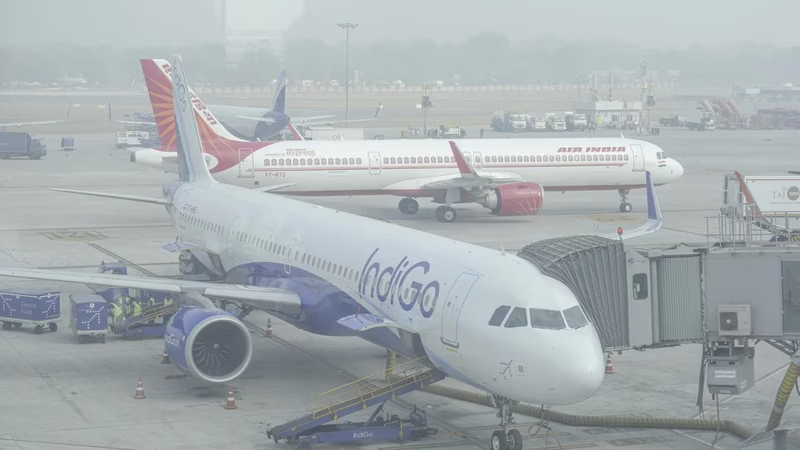
It’s not just hard to breathe—it’s hard to fly. As Delhi AQI surged past 400 on Monday, plunging the capital into the ‘severe’ category, a thick blanket of smog and fog brought much of northern India’s aviation system to a standstill. From delayed departures to diversions and complete cancellations, travelers are facing unprecedented disruption—and the Ministry of Civil Aviation has issued an urgent advisory to brace for more .
This isn’t just a local inconvenience. The ripple effects are being felt across domestic and international routes, with airports in Delhi, Amritsar, Lucknow, and Chandigarh operating under CAT III protocols—reserved for near-zero visibility conditions. Airlines are pleading with passengers to monitor flight status in real time and arrive hours early. But behind the operational chaos lies a deeper crisis: India’s worsening air quality emergency.
Table of Contents
- Delhi AQI Hits 400: What Does It Mean?
- Aviation Chaos: Flight Disruptions Explained
- What Are CAT III Conditions—and Why Do They Matter?
- Government and Airline Response: Travel Advisories
- Health Implications of Severe Air Pollution
- Why Does This Keep Happening? Root Causes
- What Travelers Should Do Right Now
- Conclusion: More Than a Weather Event—It’s a Public Health Crisis
- Sources
Delhi AQI Hits 400: What Does It Mean?
An Air Quality Index (AQI) above 400 falls into the “severe” category—the worst on India’s scale. At this level, even healthy individuals may experience respiratory distress, while children, the elderly, and those with pre-existing conditions are at serious risk .
Delhi’s current AQI is primarily driven by a toxic cocktail of vehicle emissions, industrial pollutants, construction dust, and—critically—stubble burning in neighboring Punjab and Haryana. Combined with winter’s low wind speed and temperature inversion, these pollutants become trapped close to the ground, mixing with fog to create “smog.”
According to the Central Pollution Control Board (CPCB), PM2.5 levels in Delhi have exceeded 300 µg/m³—more than 12 times the WHO’s safe limit .
Aviation Chaos: Flight Disruptions Explained
Indira Gandhi International Airport (DEL) in Delhi is among the worst affected. On Monday alone, over 60 flights were delayed, 15 diverted to Jaipur and Amritsar, and 8 cancelled outright.
Major carriers—including Air India, IndiGo, and Vistara—have issued alerts urging passengers to check their flight status before heading to the airport. The Ministry of Civil Aviation stated that “reduced visibility due to dense fog and smog” is the primary cause, not mechanical or staffing issues .
Other impacted airports include:
- Sri Guru Ram Dass Jee International Airport (Amritsar): Operating under strict CAT III restrictions.
- Chaudhary Charan Singh Airport (Lucknow): Multiple arrivals delayed by 2–4 hours.
- Chandigarh Airport: Intermittent ground stops due to visibility below 500 meters.
What Are CAT III Conditions—and Why Do They Matter?
CAT III (Category III) is the highest level of instrument landing system (ILS) certification. It allows aircraft to land in visibility as low as 50 meters—essentially flying blind until the last seconds before touchdown.
However, not all aircraft or pilots are certified for CAT III operations. This means smaller regional jets or older fleets may be forced to divert or wait for conditions to improve. Even with CAT III, takeoffs often require better visibility than landings, creating one-way bottlenecks.
As the Directorate General of Civil Aviation (DGCA) explains, “CAT III is a safety net, not a solution—it minimizes cancellations but can’t eliminate delays during prolonged fog events” .
Government and Airline Response: Travel Advisories
The Ministry of Civil Aviation has activated its winter fog contingency plan, which includes:
- 24/7 coordination between Airports Authority of India (AAI), airlines, and ATC.
- Real-time SMS and app alerts for affected passengers.
- Priority handling for medical and emergency flights.
Airlines are also offering free rescheduling for flights impacted between December 28 and January 2. Passengers are strongly advised to avoid non-essential travel through northern hubs until January 3, when a western disturbance may clear the air.
Health Implications of Severe Air Pollution
While flight delays are frustrating, the Delhi AQI crisis poses far graver risks. Prolonged exposure to PM2.5 at these levels is linked to:
- Acute asthma attacks and bronchitis
- Increased risk of heart attacks and strokes
- Long-term lung damage, especially in children
The WHO classifies outdoor air pollution as a Group 1 carcinogen—on par with tobacco smoke . Residents are urged to stay indoors, use N95 masks if venturing out, and run air purifiers at home.
Why Does This Keep Happening? Root Causes
Seasonal fog is natural—but the toxic smog isn’t. The annual winter air crisis stems from systemic failures:
- Stubble burning: Despite bans, over 50,000 farm fires were detected in Punjab in November 2025 alone (NASA data).
- Urban emissions: Delhi’s 11 million vehicles contribute ~40% of local PM2.5.
- Poor enforcement: Construction dust norms and industrial emission limits are routinely ignored.
Until these structural issues are addressed, “severe” AQI days will remain a December tradition—not an anomaly.
What Travelers Should Do Right Now
If you’re flying through northern India this week:
- Check your flight status every 2–3 hours via airline apps or websites.
- Arrive at the airport at least 4 hours before domestic flights.
- Carry masks and portable air purifiers if transiting through Delhi.
- Consider rebooking through southern hubs (e.g., Hyderabad or Bengaluru) if flexible.
Conclusion: More Than a Weather Event—It’s a Public Health Crisis
The flight disruptions caused by Delhi AQI crossing 400 are just the tip of the iceberg. This is a stark reminder that India’s air pollution problem isn’t just an environmental issue—it’s a public health emergency, an economic drag, and a logistical nightmare. Until sustainable solutions replace short-term firefighting, travelers—and residents—will keep paying the price.
For real-time AQI tracking and health tips, see our guide on [INTERNAL_LINK:how-to-stay-safe-during-delhi-smog-season].
Sources
- Times of India. (2025). Delhi AQI hits 400, dense fog disrupts flight ops across India. Retrieved from https://timesofindia.indiatimes.com/india/delhi-aqi-hits-400-dense-fog-disrupts-flight-ops-across-india-govt-airlines-issue-advisories/articleshow/126224097.cms
- Central Pollution Control Board (CPCB). (2025). Real-time Air Quality Data – Delhi. https://cpcb.nic.in
- World Health Organization (WHO). (2021). Ambient Air Pollution: Health Impacts. https://www.who.int
- Directorate General of Civil Aviation (DGCA). (2025). Winter Fog Contingency Plan for Civil Aviation.
- NASA FIRMS. (2025). Active Fire Data – Punjab and Haryana. https://firms.modaps.eosdis.nasa.gov