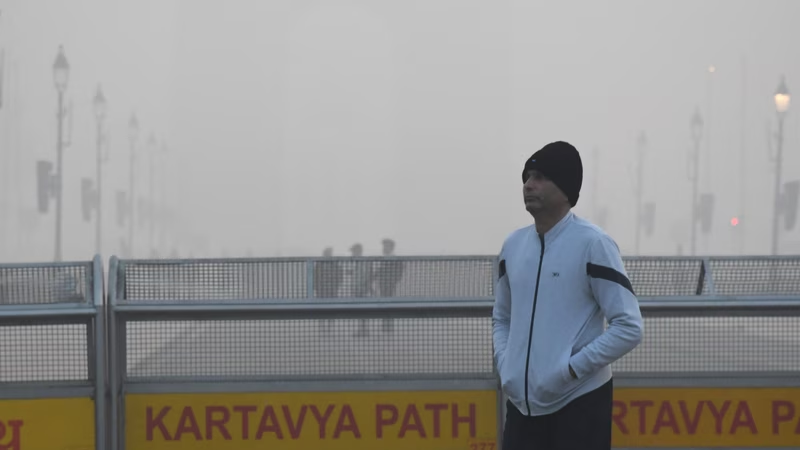
Welcome to 2026. Fireworks lit the sky, resolutions were made—but in Delhi, a harsher reality settled just below the surface: a thick, hazardous blanket of smog with an AQI of 372, firmly in the ‘very poor’ category.
While much of the country rang in the New Year with hope and cheer, the capital woke up to dense fog, near-zero visibility, and air so polluted that health authorities advise against any outdoor activity—especially for children, the elderly, and those with respiratory conditions. This isn’t just a bad start to the year. It’s a glaring alarm bell about a crisis that refuses to take a holiday.
And this time, Anand Vihar emerged as the worst-hit locality, recording the highest pollution levels in the National Capital Region (NCR). But why does Delhi keep repeating this toxic script every winter? And what can residents actually do about it?
Table of Contents
- Delhi AQI 2026: A Toxic Welcome to the New Year
- Why Does Delhi’s Air Worsen Every Winter?
- What ‘Very Poor’ AQI Means for Your Health
- Air Quality Forecast: No Relief in Sight
- Is Delhi Actually Getting Cleaner? The Data Says… Maybe, But Not Enough
- How to Protect Yourself from Toxic Air in 2026
- Conclusion: A New Year Doesn’t Mean a Fresh Start for Delhi’s Air
- Sources
Delhi AQI 2026: A Toxic Welcome to the New Year
On the morning of January 1, 2026, Delhi’s average Delhi AQI 2026 reading stood at a distressing 372—deep in the ‘very poor’ zone (301–400) as classified by the Central Pollution Control Board (CPCB). This level indicates that even healthy individuals may experience respiratory issues, while vulnerable groups are at serious risk of aggravated heart and lung conditions .
The worst readings came from Anand Vihar, a perennial hotspot, which recorded localized AQI levels well above 400. Other severely affected areas included Wazirpur, Bawana, and Punjabi Bagh, where visibility dropped due to a mix of fog and particulate matter .
This grim scenario unfolded despite city-wide efforts to curb pollution—odd-even vehicle schemes, bans on firecrackers, and industrial regulation. The persistence of such high pollution levels on a symbolic day like New Year’s underscores just how deeply entrenched the air quality crisis has become in the NCR.
Why Does Delhi’s Air Worsen Every Winter?
It’s not just emissions—it’s the weather. During winter, a phenomenon known as temperature inversion traps pollutants close to the ground. Cold, dense air sits at the surface, while a layer of warmer air above acts like a lid, preventing dispersion .
Key factors driving Delhi’s winter pollution include:
- Stubble burning in neighboring states (Punjab, Haryana), which contributes significantly to PM2.5 levels from October to December.
- Local emissions from vehicles, construction dust, and industrial activity.
- Low wind speed and high humidity, which prevent pollutants from dispersing.
- Festive firecrackers, despite bans, still see limited but impactful use during Diwali and New Year’s.
According to a 2025 study by the Centre for Science and Environment (CSE), local sources account for nearly 60% of Delhi’s winter PM2.5, while regional sources—including farm fires—add another 25–30% .
What ‘Very Poor’ AQI Means for Your Health
An AQI between 301 and 400 isn’t just “a bit smoggy.” It’s a public health emergency. The World Health Organization (WHO) states that prolonged exposure to PM2.5 levels above 25 µg/m³ significantly increases the risk of stroke, heart disease, lung cancer, and respiratory infections .
At AQI 372, expect:
- Shortness of breath during light activity
- Aggravated asthma and bronchitis
- Eye and throat irritation
- Increased hospital admissions for cardiovascular events
If you’re in Delhi right now, it’s not paranoia—it’s prudence—to wear an N95 mask outdoors and use an air purifier at home. Pregnant women and children should avoid any unnecessary exposure.
Air Quality Forecast: No Relief in Sight
Meteorological forecasts from the System of Air Quality and Weather Forecasting and Research (SAFAR) indicate that unfavorable wind patterns and stagnant air masses will keep pollution levels in the ‘very poor’ to ‘severe’ range for at least the next six days .
Wind speeds are expected to remain below 10 km/h, with no significant western disturbance to bring cleaner air from the Himalayas. This means the toxic cocktail will linger, especially in low-lying and industrial zones like Anand Vihar.
Is Delhi Actually Getting Cleaner? The Data Says… Maybe, But Not Enough
Here’s a nuanced truth: Delhi’s annual average PM2.5 levels have shown a slight decline over the past five years, thanks to policy interventions and public awareness. The 2025 annual report by the Delhi Pollution Control Committee noted a 7% drop in yearly PM2.5 concentration compared to 2020 .
However—and this is critical—this improvement is almost entirely offset during the October–January window. In fact, the **winter of 2025–2026 saw higher peak pollution episodes** than the previous year, reaffirming that seasonal spikes still dominate the annual average.
Until the city can break the winter pollution cycle, annual improvements remain a statistical illusion for residents breathing hazardous air for months on end.
How to Protect Yourself from Toxic Air in 2026
While systemic change is slow, personal protection isn’t optional. Here’s what you can do right now:
- Monitor real-time AQI using apps like AirVisual or SAFAR.
- Use N95 or N99 masks when stepping outside—cloth masks won’t cut it.
- Install a HEPA air purifier at home, especially in bedrooms.
- Avoid morning walks until AQI improves; peak pollution is often between 6–10 AM.
- Keep windows closed on high-pollution days.
For more on building a clean-air home, see our guide on [INTERNAL_LINK:best-air-purifiers-for-delhi].
Conclusion: A New Year Doesn’t Mean a Fresh Start for Delhi’s Air
Delhi’s Delhi AQI 2026 of 372 on New Year’s Day is more than a data point—it’s a symbol of a city trapped in a seasonal health crisis that policy alone hasn’t solved. While leadership sends New Year wishes for “peace and prosperity,” true prosperity must include breathable air. Until then, residents must arm themselves with knowledge, protection, and collective pressure for lasting change. Because in 2026, a new year shouldn’t mean the same old air.
Sources
[1] Times of India: New Year, same air: Delhi starts 2026 with ‘very poor’ AQI at 372
[2] India Meteorological Department (IMD): Winter Meteorological Conditions in North India
[3] Centre for Science and Environment (CSE): Air Pollution in Delhi: Sources and Solutions (2025 Report)
[4] World Health Organization (WHO): Ambient Air Pollution and Health
[5] Delhi Pollution Control Committee (DPCC): Annual Air Quality Report 2025