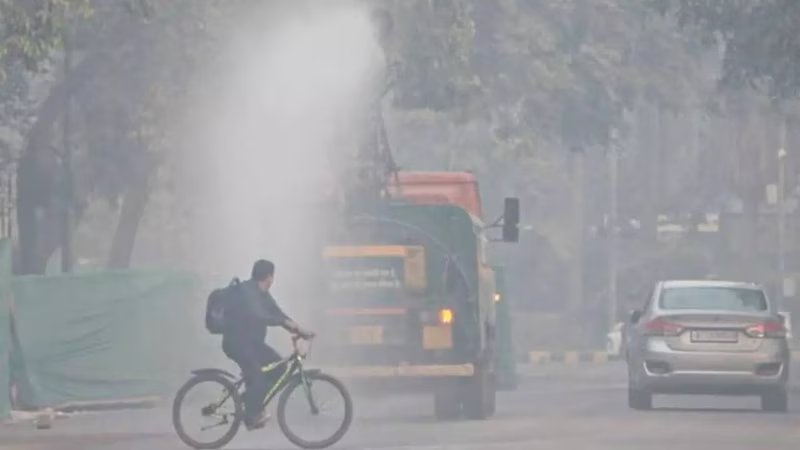
Delhi Air Pollution: A Temporary Reprieve in a Season of Smog
For residents of India’s capital, clean air often feels like a myth. But on Friday, January 2, 2026, Delhiites woke up to something unfamiliar: visibility beyond 200 meters and an Air Quality Index (AQI) that had miraculously dipped into the “Poor” category (AQI 250)—a dramatic improvement from the “Severe” levels (AQI 450+) that had gripped the city for over a week.
This brief respite led the Commission for Air Quality Management (CAQM) to officially **revoke GRAP Stage III restrictions**, which had banned diesel trucks, construction activity, and non-essential industries. Yet, the celebration is cautious. A yellow alert for dense fog has been issued, and experts warn that Delhi air pollution is set to surge back to “Very Poor” levels by Sunday—meaning the toxic cycle is far from over .
Table of Contents
- What Is GRAP and Why Was Stage III Lifted?
- Delhi Air Pollution: The Mechanics of the Improvement
- Yellow Alert for Dense Fog: A Different Kind of Hazard
- MCD’s Crackdown: Thousands of Challans and Sealed Units
- Forecast: Pollution Returns by Sunday
- Why Delhi’s Relief Is Always Temporary
- What Residents Can Do to Stay Safe
- Conclusion: Breathing Easy—for Now, But Not for Long
- Sources
What Is GRAP and Why Was Stage III Lifted?
The Graded Response Action Plan (GRAP) is a set of emergency measures triggered when Delhi’s AQI crosses predefined thresholds. Stage III activates when AQI hits “Severe” (401–450) and includes:
- Ban on diesel light commercial vehicles (except essentials)
- Complete halt on construction and demolition
- Closure of industries not using clean fuels
- Entry restrictions under the Odd-Even vehicle scheme
On Friday, with AQI stabilizing at 250 due to strong overnight northwesterly winds dispersing pollutants, CAQM deemed the emergency over and lifted these restrictions—though Stage II measures (like school closures and work-from-home for govt offices) remain under watch .
Delhi Air Pollution: The Mechanics of the Improvement
Meteorology, not policy, drove this cleanup. According to the India Meteorological Department (IMD), a sudden influx of cool, dry winds from Punjab at speeds of 15–20 km/h scoured the lower atmosphere, flushing out particulate matter.
“This is a classic case of wind-assisted dispersion,” explained Dr. Gufran Beig, founder of SAFAR. “But such relief is transient. Without systemic emission cuts, we’re just waiting for the next inversion layer to trap pollutants again.”
Yellow Alert for Dense Fog: A Different Kind of Hazard
Even as air quality improved, the IMD issued a **yellow alert** for dense to very dense fog across Delhi-NCR until Saturday morning. Visibility dropped below 50 meters in some areas, causing flight delays at IGI Airport and pile-ups on the Delhi-Meerut Expressway.
While fog itself isn’t pollution, it combines with emissions to form smog—a toxic cocktail of PM2.5, nitrogen oxides, and black carbon that penetrates deep into lungs. So even “cleaner” foggy air can be hazardous.
MCD’s Crackdown: Thousands of Challans and Sealed Units
Seizing the window of improved conditions, the Municipal Corporation of Delhi (MCD) intensified its anti-pollution drive:
- Issued over **5,200 challans** for waste burning, dust violations, and diesel generator use.
- Sealed **87 illegal industrial units** in Wazirpur and Naraina—known pollution hotspots.
- Deployed 300+ anti-smoke squads with real-time AQI monitors.
“We’re not relaxing enforcement just because the wind is blowing,” said MCD Commissioner Ashwini Kumar. “The real test is what we do on calm, windless days.”
Forecast: Pollution Returns by Sunday
Unfortunately, the reprieve won’t last. CAQM’s forecast model indicates:
- Saturday: AQI 270–290 (Poor)
- Sunday: AQI 320–350 (Very Poor)
- Monday onward: Potential return to Severe if local emissions spike and winds subside.
Key triggers include stubble residue burning in western UP, increased vehicular traffic post-holiday, and winter inversion—a meteorological lid that traps pollutants near the ground.
Why Delhi’s Relief Is Always Temporary
Delhi’s pollution crisis isn’t solved by wind—it’s masked by it. Permanent solutions require:
- Phasing out coal-based power plants within 300 km
- Universal public transport electrification
- Strict enforcement of dust control at construction sites
- Regional cooperation with Punjab, Haryana, and UP on farm residue management
Until then, every “good air day” remains a borrowed gift.
What Residents Can Do to Stay Safe
While waiting for systemic change, individuals can protect themselves:
- Use N95 or P100 masks when AQI is above 200.
- Run air purifiers with HEPA filters indoors.
- Avoid morning walks until after 10 AM (when inversion lifts).
- Monitor real-time AQI via CAQM’s portal or apps like AirVisual.
For more on long-term solutions, see our guide on [INTERNAL_LINK:how-to-reduce-exposure-to-delhi-pollution].
Conclusion: Breathing Easy—for Now, But Not for Long
The lifting of GRAP Stage III offers Delhi a momentary sigh of relief—but it’s not a victory. The city’s air remains dangerously polluted by global standards, and the forecasted rebound by Sunday is a stark reminder that without sustained, coordinated action, every clean day is just a pause before the next smog wave. The fight against Delhi air pollution demands more than emergency measures; it demands a revolution in urban planning, energy policy, and public accountability.