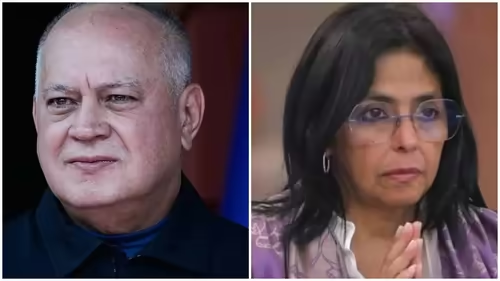
In the smoldering political vacuum left by Nicolás Maduro’s controversial detention—or “raid,” as some insiders call it—Venezuela isn’t just facing economic collapse. It’s teetering on the edge of an internal civil war among its own ruling elite. At the center of this high-stakes drama stands Delcy Rodriguez Venezuela’s de facto leader, who’s moving swiftly to appoint loyalists, shore up state institutions, and even seek quiet validation from Washington. But her grip on power may be far more fragile than it appears.
Why? Because her most dangerous adversary isn’t in exile or in prison—he’s sitting across the cabinet table. Enter Diosdado Cabello, Venezuela’s powerful Interior Minister, longtime Chavista enforcer, and rumored kingpin of the country’s feared colectivos (armed pro-government motorcycle gangs). Shockingly, credible reports now reveal that Cabello has been holding months of quiet talks with U.S. officials—both before and after Maduro’s removal . This revelation throws Venezuela’s already volatile situation into deeper uncertainty and raises a critical question: Is Delcy Rodriguez’s position truly secure?
Table of Contents
- Who Is Delcy Rodriguez—and Why Does She Matter?
- The Shadow Rival: Diosdado Cabello’s Rise
- Secret U.S. Talks: What Did Cabello Discuss?
- Delcy Rodriguez Venezuela’s Consolidation Playbook
- Economic Crisis and Public Unrest: The Wildcard
- Conclusion: A House Divided
- Sources
Who Is Delcy Rodriguez—and Why Does She Matter?
Once seen as Maduro’s loyal vice president, Delcy Rodriguez has rapidly transformed into Venezuela’s interim head of state following his abrupt removal. A seasoned diplomat and former president of the National Assembly, she’s leveraging her institutional knowledge to restructure key ministries and place trusted allies in strategic posts—from finance to communications .
Her outreach to the United States is particularly telling. After years of mutual hostility, Rodriguez appears to be testing the waters for a potential rapprochement, possibly in exchange for sanctions relief or recognition. This pragmatic shift marks a stark departure from Maduro’s defiant isolationism and signals her intent to stabilize the economy—even if it means bending to external pressures.
The Shadow Rival: Diosdado Cabello’s Rise
But while Rodriguez plays the diplomat, Diosdado Cabello commands the streets—and the guns. As Interior Minister, he controls Venezuela’s intelligence apparatus, police forces, and, crucially, the colectivos: paramilitary-style groups that have long acted as the regime’s unofficial enforcers .
Cabello’s influence runs so deep that many analysts consider him the true power behind the throne during Maduro’s rule. Now, with Maduro gone, Cabello isn’t fading into the background. Instead, he’s reportedly using his security network to build parallel channels of authority, creating a de facto power center that rivals Rodriguez’s formal government.
Secret U.S. Talks: What Did Cabello Discuss?
The most explosive detail? According to the Times of India and corroborated by regional intelligence sources, Cabello has been in quiet, sustained contact with U.S. officials for months—spanning the period before and after Maduro’s detention .
While the exact agenda remains classified, experts speculate the talks could involve:
- Potential guarantees of immunity or safe passage for Cabello and his inner circle.
- Discussions about a transitional government that excludes both Maduro and Rodriguez.
- U.S. intelligence gathering on Venezuela’s military and criminal networks.
This backchannel diplomacy suggests Washington may be hedging its bets—engaging not just with the official interim leadership but also with the man who controls Venezuela’s coercive machinery. For Rodriguez, this is a direct threat to her legitimacy and authority.
Delcy Rodriguez Venezuela’s Consolidation Playbook
Facing this dual challenge—internal rivalry and economic freefall—Rodriguez has launched a three-pronged strategy:
- Institutional Takeover: Appointing loyalists to head PDVSA (the state oil company), the Central Bank, and media outlets to control narratives and revenue streams.
- International Outreach: Sending discreet feelers to the U.S., EU, and Latin American neighbors to signal openness to dialogue and reform.
- Security Balancing Act: Attempting to keep Cabello close while subtly sidelining his most aggressive allies in the armed forces.
Yet this balancing act is precarious. If Cabello senses weakness—or if the U.S. begins viewing him as a more reliable partner—Rodriguez could find herself isolated overnight. [INTERNAL_LINK:venezuela-oil-crisis] The stakes couldn’t be higher.
Economic Crisis and Public Unrest: The Wildcard
Beyond the palace intrigue, Venezuela’s economy remains in shambles. Hyperinflation, chronic fuel shortages, and collapsing public services have pushed over 7 million citizens to flee the country . Even if Rodriguez stabilizes her position internally, she must deliver tangible improvements—or risk mass protests that neither she nor Cabello can fully contain.
Ironically, both rivals may need U.S. sanctions relief to prevent total state failure. This shared dependency creates a strange dynamic: they’re competing for power, yet both are tethered to Washington’s decisions. The U.S. State Department, for its part, maintains a cautious public stance but is clearly exploring all options behind closed doors .
Conclusion: A House Divided
The future of Venezuela may hinge not on ideology or elections, but on which faction within the crumbling Chavista elite can best navigate the treacherous waters of U.S. diplomacy and domestic control. Delcy Rodriguez Venezuela’s appointed leader, represents institutional continuity and diplomatic pragmatism. Diosdado Cabello embodies raw power, street-level loyalty, and a willingness to cut backroom deals. As their silent war escalates, the Venezuelan people remain caught in the crossfire—with world peace, regional stability, and millions of lives hanging in the balance.
Sources
- Times of India: US had months of quiet talks with Venezuela’s Diosdado Cabello before and after Maduro raid
- Council on Foreign Relations: Venezuela’s Collapse and How It Happened
- Human Rights Watch: Venezuela: Events of 2024
- U.S. State Department: U.S. Relations With Venezuela
- UNHCR: Venezuela Situation – UNHCR