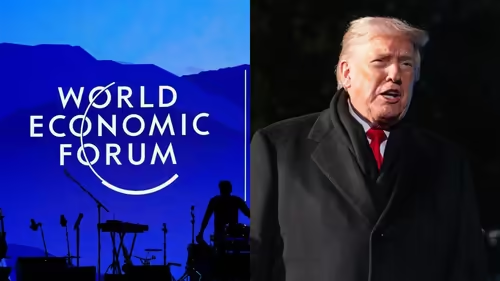
The snow-capped streets of Davos are buzzing again. Private jets line the tarmac, luxury hotels are booked solid, and the world’s most powerful CEOs, politicians, and thought leaders are gathering for the 2026 World Economic Forum (WEF). On the surface, it’s business as usual. But beneath the polished veneer, a profound crisis is unfolding—one that makes even the prospect of Donald Trump’s return seem like a manageable sideshow.
The real existential threat to the global order isn’t a single political figure; it’s the relentless advance of the K-shaped economy. This term, which describes an economic recovery where the wealthy surge ahead while the middle and lower classes stagnate or fall behind, has moved from academic jargon to a stark, lived reality for billions . At a summit historically criticized for its “elite bubble,” this structural inequality is now the central, unspoken challenge that no amount of panel discussions can easily solve.
Table of Contents
- What Is the K-Shaped Economy and Why Davos Cares
- Davos 2026’s Two-Headed Monster: Elite Image vs. Economic Reality
- Why Donald Trump Is the Easier Problem
- The Global Impact of a Permanent K-Shaped World
- Conclusion: Can Davos Fix What It Helped Create?
- Sources
What Is the K-Shaped Economy and Why Davos Cares
Imagine a chart of economic recovery. In a traditional “V-shaped” recovery, everyone dips down together and then climbs back up in unison. In a “U-shaped” recovery, the pain is longer but still shared. The K-shaped economy is different. Its two arms diverge: one arm rockets upward, representing asset owners, tech billionaires, and the financial elite who have seen their wealth explode during recent crises. The other arm plummets or flatlines, representing wage earners, small business owners, and service workers whose real incomes have been eroded by inflation and stagnant wages .
This isn’t a temporary blip. It’s a structural feature of the modern global economy, amplified by monetary policies that inflate asset prices and technological shifts that reward capital over labor. For the WEF, which prides itself on “stakeholder capitalism” and “building a better world,” this trend is a direct contradiction of its stated mission. How can you claim to serve all stakeholders when the economic system is actively designed to enrich only a select few?
Davos 2026’s Two-Headed Monster: Elite Image vs. Economic Reality
The WEF has long struggled with its public perception as a club for the global 1%. The K-shaped economy has turned this image problem into a credibility crisis. When leaders gather in $10,000-a-night suites to discuss “inclusive growth” while the wealth gap they’re discussing widens in real-time, the disconnect is impossible to ignore.
This hypocrisy fuels populist movements worldwide. Citizens see the solutions proposed at Davos—often complex, technocratic, and slow-moving—as out of touch with their daily struggles of affording groceries or paying rent. The forum’s challenge is twofold:
- Rebranding Its Image: Moving beyond the “elitist talking shop” label to demonstrate tangible, on-the-ground impact.
- Addressing the Root Cause: Developing policies that directly counter the forces driving the K-shaped divergence, such as tax reform, wage growth, and equitable access to technology.
Without concrete action, Davos risks becoming irrelevant—a beautifully curated museum of ideas that fails to change the world outside its Alpine walls.
Why Donald Trump Is the Easier Problem
Donald Trump’s potential presence at Davos is a media magnet. His anti-establishment rhetoric and history of criticizing the WEF make him a natural antagonist. Yet, paradoxically, he represents a simpler challenge. A political figure, no matter how disruptive, operates within a known framework. He can be debated, countered, or even ignored.
The K-shaped economy, however, is an impersonal, systemic force. It’s not a person you can argue with; it’s a tide that lifts only certain boats. It’s driven by decades of policy choices, global capital flows, and technological disruption that no single leader can reverse overnight. Managing Trump is a matter of diplomacy and optics. Managing the K-shaped economy requires a fundamental re-engineering of the global economic contract—a task of immense complexity that the current Davos consensus seems ill-equipped to handle .
The Global Impact of a Permanent K-Shaped World
If left unchecked, the consequences of a permanent K-shaped world are dire:
- Social Unrest: Extreme inequality is a primary driver of civil unrest, as seen in protests from Chile to France .
- Erosion of Democracy: When citizens feel the system is rigged, they lose faith in democratic institutions, paving the way for authoritarianism.
- Economic Instability: An economy reliant on the spending of a tiny elite is inherently fragile. Broad-based consumer demand is the true engine of sustainable growth.
- Geopolitical Tension: The global south, feeling left behind by a system that benefits the north, is increasingly seeking alternative alliances and economic models.
These are not hypothetical risks. They are the very forces that are already reshaping the 21st-century world order.
Conclusion: Can Davos Fix What It Helped Create?
The central irony of Davos 2026 is that the forum’s attendees—the architects of globalization and financialization—are now being asked to solve the very problems their systems have exacerbated. The K-shaped economy is the ultimate test of the WEF’s relevance. Will this year’s summit produce more than just lofty declarations? Will it commit to bold, actionable policies that redistribute opportunity and rebuild trust? The world is watching, and the stakes couldn’t be higher. The future of global stability may depend on whether the elite in Davos can finally look beyond their own reflection in the champagne flutes and see the world they’ve helped create.
Sources
- Times of India: Davos: WEF summit faces two major challenges; why Donald Trump may be the easier one
- World Economic Forum: Understanding the K-Shaped Recovery
- Peterson Institute for International Economics: What is a K-shaped recovery?
- International Monetary Fund (IMF): Global Inequality: Trends and Policy Responses
- [INTERNAL_LINK:what-is-stakeholder-capitalism]
- [INTERNAL_LINK:global-wealth-gap-statistics-2026]