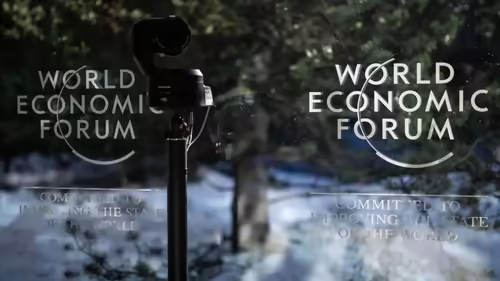
Forget the old narrative of India as just a fast-growing economy. At the World Economic Forum (WEF) Annual Meeting in Davos 2026, the country has rolled out a bold new vision: “Partner with Bharat.” This isn’t just a slogan—it’s a strategic rebranding aimed squarely at global investors, tech leaders, and policymakers gathered among the Alpine peaks. With over 100 Indian CEOs, multiple state delegations, and a fully activated India Pavilion, the message is clear: India is open for deep, collaborative, and future-focused business .
Table of Contents
- What Does “Partner with Bharat” Really Mean?
- Team India’s Unprecedented Presence at Davos 2026
- AI and Tech Take Center Stage
- Key Investment Opportunities Being Promoted
- How Is the Global Community Responding?
- Beyond the Pavilion: State-Level Diplomacy
- Why This Moment Matters for India’s Global Stature
- Conclusion: From Market to Strategic Ally
- Sources
What Does “Partner with Bharat” Really Mean?
The phrase “Partner with Bharat” is a deliberate shift from the traditional “Invest in India” messaging. While “India” often evokes images of metros like Mumbai or Bangalore, “Bharat” represents the vast, diverse, and rapidly digitizing heartland—home to over 1.4 billion people and thousands of untapped opportunities .
This reframing signals that India isn’t just seeking capital; it’s inviting co-creation. The ask is for global firms to embed themselves in India’s innovation ecosystem, collaborate on R&D, and build solutions not just for India, but from India—for the world. It’s a move that aligns with Prime Minister Modi’s long-standing vision of Viksit Bharat (Developed India) by 2047.
Team India’s Unprecedented Presence at Davos 2026
The scale of India’s delegation at WEF 2026 is historic. More than 100 Indian CEOs—from IT giants like TCS and Infosys to rising stars in fintech, renewable energy, and manufacturing—are engaging directly with over 3,000 global leaders .
Crucially, this isn’t just a central government effort. Delegations from states like Gujarat, Tamil Nadu, Karnataka, and Telangana are running their own side events, pitching sector-specific advantages—from semiconductor parks to green hydrogen hubs. This federal-level outreach shows a mature, multi-layered approach to foreign direct investment (FDI) attraction.
AI and Tech Take Center Stage
At the India Pavilion, artificial intelligence isn’t just a buzzword—it’s the headline act. Leading Indian IT firms are showcasing homegrown AI models tailored for healthcare, agriculture, and financial inclusion .
For example, one demo highlighted an AI-powered platform that helps small farmers predict crop yields and access microloans—technology that could be scaled globally. Another featured multilingual AI assistants capable of serving citizens in over 22 Indian languages, a critical innovation for inclusive digital governance.
This focus on applied, ethical, and inclusive AI positions India not just as a service provider, but as a thought leader in responsible technology—a stark contrast to the surveillance-heavy models seen elsewhere.
Key Investment Opportunities Being Promoted
Team India is strategically highlighting high-growth sectors where global partnerships can yield mutual benefit:
- Green Energy & Climate Tech: India’s $500 billion clean energy roadmap, including solar, wind, and green hydrogen.
- Digital Public Infrastructure (DPI): Building on the success of UPI, Aadhaar, and ONDC, India is offering its DPI stack as a global public good.
- Manufacturing & PLI Schemes: Incentives under the Production-Linked Incentive (PLI) scheme for electronics, pharmaceuticals, and advanced chemistry cells.
- Startup Ecosystem: With over 100 unicorns, India is positioning itself as the third-largest startup hub globally, ripe for venture collaboration.
How Is the Global Community Responding?
Early signals from Davos are positive. According to the World Bank, India is projected to be the world’s fastest-growing major economy in 2026, with GDP growth exceeding 6.5% . This macroeconomic stability, combined with a young, tech-savvy workforce, makes the “Partner with Bharat” pitch highly credible.
Several European and Middle Eastern sovereign wealth funds have expressed interest in co-investing in India’s infrastructure projects. Meanwhile, U.S. tech firms are exploring joint ventures in AI safety and quantum computing research—areas where India’s academic institutions offer deep talent pools.
Beyond the Pavilion: State-Level Diplomacy
One of the most significant developments at WEF 2026 is the rise of “competitive federalism” on the global stage. States aren’t waiting for New Delhi—they’re making their own deals.
Gujarat, for instance, signed a preliminary MoU with a German industrial conglomerate for a smart manufacturing cluster. Tamil Nadu hosted a roundtable on electric vehicle supply chains, attracting interest from Japanese automakers. This decentralized approach not only accelerates deal-making but also ensures investments are aligned with local capabilities and needs.
Why This Moment Matters for India’s Global Stature
Davos 2026 comes at a pivotal time. As geopolitical tensions reshape global supply chains, India is emerging as a trusted alternative to China—a “China+1” destination with democratic values, English fluency, and a robust legal framework. The Partner with Bharat campaign leverages this moment perfectly, framing India not as a backup plan, but as a primary strategic ally for the 21st century.
Moreover, by emphasizing collaboration over transactional investment, India is building long-term trust—a crucial asset in an era of economic uncertainty.
Conclusion: From Market to Strategic Ally
The “Partner with Bharat” message at WEF 2026 marks a turning point in India’s economic diplomacy. It’s no longer just about how much money flows in, but how deeply global partners integrate with India’s innovation engine. If successful, this strategy could redefine India’s role in the global economy—from a consumer market to a co-architect of the future. For businesses looking to future-proof their portfolios, the invitation from Davos is clear: don’t just watch Bharat rise—build with it. Explore more on India’s digital transformation in our deep dive on [INTERNAL_LINK:india-digital-public-infrastructure].
Sources
- Times of India: WEF 2026: Team India pitches ‘partner with Bharat’ message
- World Bank: India Overview – World Bank