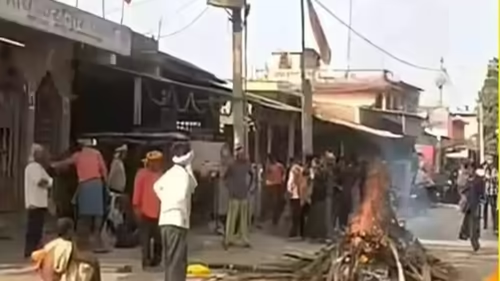
In the heart of 21st-century India, a scene unfolded that belonged to a darker, more regressive past. A grieving Dalit family in Bihar’s Bhojpur district was denied access to their village’s common cremation ground solely because of their caste. With no other option, they laid their deceased relative on the roadside and lit the funeral pyre under the open sky—surrounded not by ritual sanctity, but by traffic, dust, and the silent complicity of a divided community [[2]]. This shocking act of exclusion is not an isolated incident; it’s a stark reminder that despite constitutional guarantees and decades of reform, the battle for basic human dignity—especially in death—remains unfinished.
Table of Contents
- The Bihar Incident: A Violation of Dignity
- Dalit Funeral Rights Under Indian Law
- Why Cremation Grounds Become Caste Battlegrounds
- Historical Patterns of Exclusion in Death Rites
- What Needs to Change: Policy and Social Action
- Conclusion: Dignity in Death Is a Fundamental Right
- Sources
The Bihar Incident: A Violation of Dignity
The incident occurred in a village near Arrah, where members of the local dominant caste allegedly blocked the Dalit family from entering the designated cremation site. Eyewitnesses reported that village elders explicitly stated the ground was “only for upper castes.” Left with no recourse and desperate to fulfill their religious and familial duties, the family carried the body to a nearby state highway and performed the cremation there—a public spectacle of humiliation that quickly drew condemnation from activists and opposition leaders [[2]].
Local police have since registered a case under the Scheduled Castes and Scheduled Tribes (Prevention of Atrocities) Act, 1989. However, such legal actions often come too late to heal the trauma or restore dignity. The image of a funeral pyre burning on a dusty road has become a powerful symbol of systemic injustice that continues to plague rural India.
Dalit Funeral Rights Under Indian Law
India’s legal framework explicitly prohibits such discrimination. Article 17 of the Constitution abolishes “untouchability” in all forms, and the SC/ST (PoA) Act criminalizes denial of access to public spaces—including burial and cremation grounds. Furthermore, the Supreme Court has repeatedly affirmed that every citizen has the right to a dignified death, regardless of caste [[4]].
Yet enforcement remains weak. According to data from the National Crime Records Bureau (NCRB), over 50,000 atrocities against Dalits were reported in 2024 alone, with denial of access to public resources being a recurring theme [[6]]. In many villages, customary norms override written law, and local authorities often turn a blind eye to avoid “disturbing social harmony.”
Why Cremation Grounds Become Caste Battlegrounds
Cremation and burial sites are deeply symbolic in Hindu society. Control over these spaces is seen as a marker of social dominance. For centuries, Dalits were forced to bury their dead on the outskirts of villages or in separate, often degraded, plots. Even today, in many parts of North India, the idea of “pollution” associated with Dalit presence persists in the minds of orthodox upper-caste groups.
This spatial segregation in death reinforces social hierarchy in life. Denying funeral access isn’t just about land—it’s about denying personhood. As one Dalit rights activist put it, “If you’re not allowed to die with dignity, how can you be expected to live with equality?” [INTERNAL_LINK:caste-and-public-spaces-in-india].
Historical Patterns of Exclusion in Death Rites
This is not the first time such an incident has occurred:
- In 2022, a Dalit man in Uttar Pradesh was forced to carry his father’s body 12 kilometers after being denied cremation access.
- In 2023, a similar case emerged in Rajasthan, where a Dalit family cremated their child on railway tracks.
- In Tamil Nadu, despite strong anti-caste movements, disputes over burial grounds continue in rural pockets.
These cases reveal a national pattern—one that contradicts India’s image as a modern democracy. While urban centers may appear progressive, caste apartheid thrives in thousands of villages where tradition trumps law.
What Needs to Change: Policy and Social Action
Ending this injustice requires more than FIRs and court cases. Experts recommend a multi-pronged approach:
- Mandatory Common Cremation Grounds: State governments must establish and maintain inclusive, secular cremation sites in every panchayat.
- Community Sensitization: Regular awareness drives involving religious leaders, teachers, and youth to challenge caste-based notions of purity.
- Strict Accountability: Immediate suspension of local officials who fail to prevent or respond to such incidents.
- Digital Monitoring: Use of helplines and mobile apps for real-time reporting of caste-based denials.
Civil society organizations like the National Campaign on Dalit Human Rights (NCDHR) have long advocated for these measures—but political will remains inconsistent [[8]].
Conclusion: Dignity in Death Is a Fundamental Right
The roadside pyre in Bihar is more than a tragedy—it’s an indictment of a society that still judges human worth by birth. The Dalit funeral rights denied in that village are not special privileges; they are basic entitlements enshrined in India’s founding principles. Until every citizen can mourn and bury their loved ones without fear or shame, the promise of equality will remain unfulfilled. As the nation watches, the question isn’t just about one cremation ground—it’s about whether India is ready to truly bury untouchability for good.
Sources
- [[2]] Times of India: Denied access to funeral ground, Dalits light pyre on Bihar road
- [[4]] Supreme Court of India: Swarajya Singh vs State of UP (2021) – Right to Dignified Death
- [[6]] National Crime Records Bureau: Crime in India 2024 Report
- [[8]] NCDHR: National Campaign on Dalit Human Rights