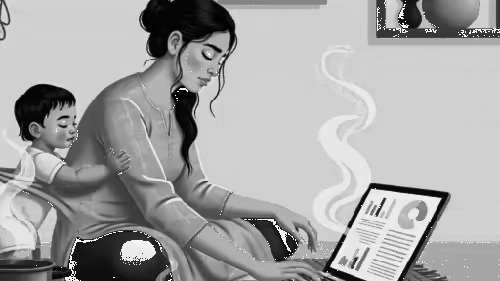
The Crushing Weight of ‘Independence’: Is the Modern Indian Woman Burning Out?
We live in an era where the independent Indian woman is held up as the ultimate symbol of progress. She’s educated, she’s employed, she makes her own choices. But behind the curated Instagram posts and the confident LinkedIn profiles lies a different, often unspoken reality: a profound, soul-crushing exhaustion.
This isn’t just about being busy. It’s about the relentless, invisible labor of constantly negotiating her space in a world that demands she be everything at once: a high-performing professional, a perfect daughter, a nurturing wife, a selfless mother, and an ever-grateful recipient of the ‘freedom’ she’s been given. The initial thrill of independence has morphed into a non-negotiable performance, and the cost is her well-being.
Table of Contents
- The Exhaustion Behind the Badge
- A Generational Hand-Me-Down of Sacrifice
- The Double Burden and the Workforce Paradox
- The Psychological Cost of Hyper-Independence
- Redefining Independence on Our Own Terms
The Exhaustion Behind the Badge of the Independent Indian Woman
The term “independent” has become a loaded expectation. It’s no longer a simple descriptor of financial or social autonomy; it’s a command to perform strength without showing vulnerability. An independent Indian woman is expected to have it all figured out, to never complain, and to gracefully manage every crisis that comes her way. This constant performance is a primary source of stress.
She must navigate a complex web of societal judgment. If she prioritizes her career, she’s selfish. If she chooses family, she’s not truly independent. If she shows fatigue, she’s weak. This leaves her in a perpetual state of negotiation, not just with the outside world, but with her own internalized expectations. The freedom she’s earned feels less like liberation and more like a new, heavier set of chains.
A Generational Hand-Me-Down of Sacrifice
For many young women today, independence wasn’t a personal discovery; it was a lesson learned through observation. They watched their mothers, aunts, and grandmothers make silent sacrifices—putting their dreams on hold, enduring hardship, and managing entire households with quiet resilience. This created a powerful, albeit painful, blueprint.
The new generation absorbed a critical message: “Don’t end up like me.” So, they pursued education and careers with fierce determination, believing that financial independence would be their shield against the fate of their foremothers. However, they soon discovered that while the battlefield has changed, the war hasn’t ended. The expectation to sacrifice hasn’t disappeared; it has simply been repackaged. Now, they are expected to excel in the public sphere *and* maintain the same level of perfection in the private one—a feat their mothers were never asked to achieve in the workplace. This creates a unique generational pressure that is both a privilege and a profound burden.
The Double Burden and the Workforce Paradox
The data paints a stark picture of this contradiction. While we celebrate the rise of the working woman, the numbers reveal a system that is far from supportive. Women still constitute only 26% of India’s total workforce, and a mere 8% hold CEO positions . This underrepresentation is not due to a lack of ambition, but often a direct result of the unsustainable double burden.
An independent Indian woman is typically expected to shoulder the majority of domestic responsibilities—cooking, cleaning, childcare, and elder care—on top of her full-time job. This “second shift” is rarely acknowledged or compensated, yet it is the primary reason many women are forced to leave the workforce or opt for less demanding (and lower-paying) roles. Cultural expectations in much of India still firmly place the priority on household duties over a woman’s career aspirations .
This creates a cruel paradox: society celebrates her independence, but the infrastructure—both at home and in the workplace—remains stubbornly unchanged, making that independence incredibly difficult to sustain.
The Psychological Cost of Hyper-Independence
The pressure to be the perfect, self-sufficient independent Indian woman has severe mental health consequences. The concept of “hyper-independence,” where a woman feels she must manage her entire life—career, home, finances, and emotional pain—entirely alone, is becoming increasingly common .
This isolation, coupled with the constant pressure to perform, is a recipe for burnout, anxiety, and depression. Studies consistently show that women in India are at a significantly higher risk for mental health disorders compared to men . The World Health Organization estimates that depressive disorders account for a staggering 41.9% of the disability from neuropsychiatric disorders among women, a figure much higher than for men .
Yet, seeking help is often seen as a sign of weakness, a failure of the very independence she’s supposed to embody. This stigma creates a vicious cycle where the woman suffers in silence, her mental health deteriorating while she maintains a facade of having it all together.
Redefining Independence on Our Own Terms
True independence for the modern Indian woman cannot be defined by external markers of success alone. It must include the freedom to be human—to be tired, to ask for help, to be vulnerable, and to set boundaries without guilt. It requires a collective shift in mindset, both from society and from women themselves.
We need to move beyond the simplistic celebration of the “strong woman” and start building systems that support her. This means equitable distribution of domestic labor at home, flexible and supportive workplace policies, accessible mental health resources, and a cultural narrative that values her well-being as much as her productivity. [INTERNAL_LINK:womens-mental-health-resources-india] [INTERNAL_LINK:work-life-balance-tips-for-professionals]
Independence should not be a solitary performance. It should be a shared journey towards a life that is not just successful, but also sustainable and fulfilling.
Summary
The myth of the effortlessly independent Indian woman masks a deep and growing crisis of exhaustion and mental strain. Her independence is often a double-edged sword, granting her opportunities while simultaneously burdening her with impossible expectations and an unfair share of domestic labor. To truly empower women, we must acknowledge this unseen burden, challenge the toxic notion of hyper-independence, and create a supportive ecosystem that allows her to thrive, not just survive.
Sources
- Great Place to Work India Report (2025). Workforce Diversity Statistics.
- ILO & National Sample Survey Office. Cultural Expectations and Women’s Work in India.
- Malhotra, S. (2015). Women and mental health in India: An overview. PMC. [[21], [26]]
- Psychology Today. (2025). The Psychological Cost of Hyper-Independence in Women.
- Original Article: Times of India. Beyond the badge: The unseen burden of independent Indian women.