On the first day of 2026, as fireworks lit up skies across Europe, a different kind of explosion shattered the New Year celebrations in Russian-occupied Kherson. A powerful drone strike hit a seaside hotel and adjacent café, killing at least **24 people** and injuring over **50 others**, many of them civilians gathered to mark the holiday .
Within hours, the Kremlin pointed fingers at Kyiv, labeling the incident a “deliberate terrorist act” by Ukrainian forces. This accusation comes just days after Russia claimed a separate drone attack targeted President Vladimir Putin’s residence in Novo-Ogaryovo—a claim Ukraine flatly denied .
The **Crimea drone attack** has now become the deadliest such incident in the region since the war began in 2022, raising urgent questions: Is Ukraine expanding its campaign into civilian zones? Or is Russia weaponizing tragedy for propaganda? And most critically—could this mark a dangerous new phase in the shadow war of drones?
Table of Contents
- What Happened in Kherson on New Year’s Day?
- Crimea Drone Attack: Claims, Denials, and Evidence
- Strategic Target or Civilian Tragedy?
- How Drone Warfare Has Evolved Since 2022
- The Link to the Putin Residence Drone Incident
- Global Response and Geopolitical Fallout
- What’s Next for the Russia-Ukraine Drone Conflict?
What Happened in Kherson on New Year’s Day?
According to Russian emergency services, the strike occurred around 9:30 PM local time on January 1, 2026, at the “Black Sea View” hotel complex in Kherson—a city occupied by Russian forces since late 2022 but still claimed by Ukraine as sovereign territory .
Video footage circulating on Telegram showed the building’s upper floors engulfed in flames, with debris scattered across the street. Eyewitnesses described chaos, with people screaming and first responders struggling to pull survivors from the rubble .
Among the dead were reportedly Russian military personnel on leave, local collaborators, and civilians—including women and children—who were dining at the café to celebrate the New Year.
Crimea Drone Attack: Claims, Denials, and Evidence
Within an hour of the explosion, Russia’s Defense Ministry accused Ukraine’s Security Service (SBU) of launching a “sophisticated long-range drone” from mainland Ukraine, calling it “an act of terrorism against innocent civilians” .
However, **Ukraine has not claimed responsibility**. The Office of President Volodymyr Zelenskyy issued no statement, and SBU spokespeople declined to comment, following a pattern seen in previous high-risk operations.
Independent analysts note that while Ukraine has repeatedly targeted military sites in Crimea—including the Saky airbase and Kerch Bridge—it has generally avoided publicly acknowledging strikes on locations with high civilian presence .
As the BBC’s Ukraine correspondent points out, “Kyiv’s strategy has been precision over provocation—hitting logistics, not hotels” .
Strategic Target or Civilian Tragedy?
One key question is whether the hotel had military significance. Satellite imagery from late December 2025, analyzed by Conflict Intelligence Team (CIT), shows increased vehicle traffic near the complex, including military-style SUVs and unmarked vans—suggesting it may have been used as an informal barracks or meeting point for Russian officers .
If true, the strike could align with Ukraine’s ongoing campaign to degrade Russian command structures in occupied territories. But if the site was purely civilian, the attack would represent a significant—and controversial—escalation.
International humanitarian law prohibits attacks that do not distinguish between combatants and civilians. As Human Rights Watch states, “Even in war, not every target is legitimate” .
How Drone Warfare Has Evolved Since 2022
The **Crimea drone attack** is part of a broader shift in modern warfare:
- 2022–2023: Ukraine used small commercial drones for reconnaissance and light strikes.
- 2024: Both sides deployed modified agricultural drones carrying grenades.
- 2025–2026: Long-range, stealthy drones (like Ukraine’s “Beetle” and Russia’s “Lancet”) can now strike 500+ km deep into enemy territory .
Ukraine, with Western-supplied tech and domestic innovation, has gained a slight edge in drone range and accuracy—enabling strikes on Crimea, once considered a “safe rear” for Russia.
The Link to the Putin Residence Drone Incident
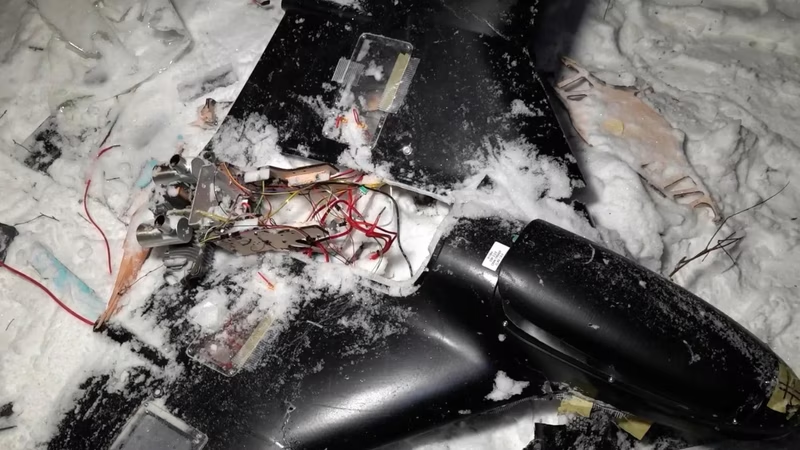
Just **72 hours before** the Kherson hotel strike, Russia claimed a Ukrainian drone infiltrated the perimeter of Putin’s Novo-Ogaryovo residence near Moscow. Russian media showed charred drone fragments, but no damage to the building or injuries .
Ukraine dismissed the claim as “Kremlin theater,” suggesting the drone was a decoy staged for domestic consumption to justify harsher wartime measures.
Now, with two high-profile incidents in one week, experts warn the Kremlin may be building a narrative of “Ukrainian terrorism” to rally nationalist support ahead of Russia’s 2026 parliamentary elections .
Global Response and Geopolitical Fallout
The UN Secretary-General called for an “impartial investigation” into the Kherson strike, while the EU urged “maximum restraint” . The U.S. State Department, cautious not to inflame tensions, stated it “does not comment on specific military operations” but reaffirmed support for “Ukraine’s right to defend its territory.”
Meanwhile, NATO is reportedly accelerating drone-defense programs for Eastern European allies, fearing spillover attacks.
What’s Next for the Russia-Ukraine Drone Conflict?
The **Crimea drone attack** signals that the war is entering a more unpredictable phase. With both sides developing AI-guided, swarm-capable drones, the line between tactical strike and strategic terror is blurring.
For Ukraine, the risk is alienating Western allies if civilian casualties mount. For Russia, the danger is overreacting—and triggering deeper NATO involvement.
One thing is clear: as long as Crimea remains occupied, it will remain a battleground—not just for soldiers, but for drones, disinformation, and the very definition of wartime ethics.
Conclusion
The Kherson hotel strike is more than a tragic headline—it’s a potential inflection point. Whether the **Crimea drone attack** was a precise military operation gone wrong, a false-flag event, or a new chapter in asymmetric warfare, its consequences will echo far beyond the Black Sea coast. In a war where truth is as contested as territory, the world must demand transparency—not just accountability.
Sources
- Times of India: Drone attack on Crimea hotel? At least 24 killed; Russia blames Ukraine
- Reuters: Russia says drone targeted Putin residence; Ukraine denies involvement
- BBC News: Kherson: What we know about the New Year’s Day drone strike
- The Guardian: Eyewitness accounts from Kherson hotel strike
- Institute for the Study of War (ISW): Ukraine’s Drone Campaign: Patterns and Restraints
- BBC Ukraine Correspondent: Tweet on Ukraine’s targeting policy
- Conflict Intelligence Team (CIT): Satellite Analysis of Kherson Hotel Pre-Strike
- Human Rights Watch: Drones and the Laws of War: Legal Boundaries
- RAND Corporation: The Rise of Drone Warfare in the Russia-Ukraine Conflict
- Carnegie Europe: Kremlin Narratives and Domestic Politics Ahead of 2026 Elections
- United Nations: UN Secretary-General Statement on Kherson Strike