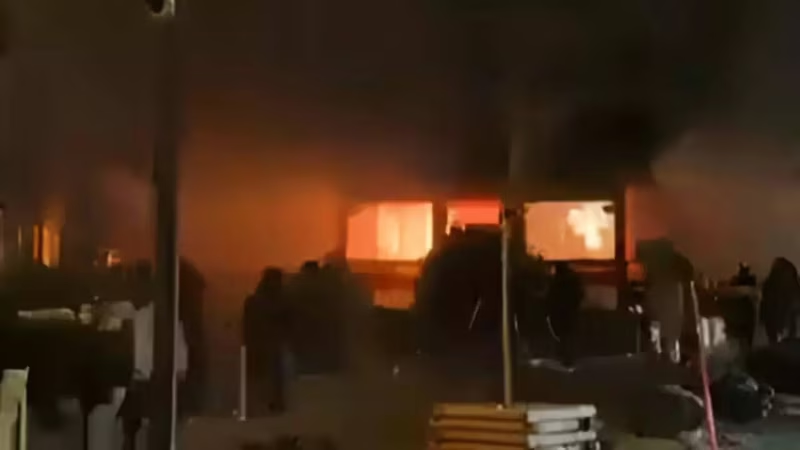
A devastating New Year’s Eve celebration in the Swiss Alps turned into one of Europe’s deadliest nightclub tragedies—and now, local authorities are owning up to a catastrophic oversight. In a rare public admission, officials in Crans-Montana have confirmed they failed to inspect the bar for fire safety compliance for **five straight years** before the Crans-Montana bar fire that claimed 40 lives .
Mayor Nicolas Feraud didn’t mince words: “We bitterly regret this,” he told reporters, as prosecutors launched a criminal investigation into the bar’s management and regulatory failures. The fire, believed to have been ignited by decorative “sparkling candles” used in a New Year’s countdown, spread with terrifying speed through the packed venue—trapping revelers in a scene now described as “preventable.”
Table of Contents
- What Happened on New Year’s Eve?
- Crans-Montana Bar Fire: The Inspection Failure
- Sparkling Candles: A Deceptively Dangerous Decor
- Legal and Regulatory Aftermath
- Global Lessons in Nightlife Safety
- How Switzerland Is Responding
- Conclusion: A Tragedy That Shouldn’t Have Happened
- Sources
What Happened on New Year’s Eve?
On the night of December 31, 2025, hundreds gathered at a popular bar in the ski resort town of Crans-Montana, Valais canton, to ring in the new year. At approximately 12:05 a.m., a decorative display featuring “sparkling candles”—pyrotechnic novelty items that emit bright sparks—was lit as part of the countdown.
Almost immediately, the sparks ignited nearby flammable materials, possibly curtains or acoustic foam. Within minutes, flames engulfed the ceiling. Panic ensued as exits became jammed. Many victims were found near blocked or unmarked emergency doors—a grim reminder of how quickly celebrations can turn fatal when safety is compromised .
Crans-Montana Bar Fire: The Inspection Failure
The most damning revelation came days later: the last official fire safety inspection at the venue was conducted in **2020**. Despite Swiss law requiring regular checks—especially for high-capacity public venues—no follow-up occurred for five years .
This lapse points to systemic issues within local oversight. Mayor Feraud acknowledged the failure was “unacceptable” and pledged a full review of municipal inspection protocols. “This wasn’t just an accident—it was a failure of our duty to protect citizens and guests,” he said .
While bar owners bear primary responsibility for compliance, regulators share culpability when enforcement vanishes. In this case, the gap allowed known risks—like inadequate exits and flammable interiors—to go unchecked.
Sparkling Candles: A Deceptively Dangerous Decor
Often mistaken for harmless party favors, “sparkling candles” (also called “sparklers” or “fountain candles”) are actually small pyrotechnic devices. They can reach temperatures of over 1,000°C (1,800°F) and easily ignite paper, fabric, or dry wood.
Following the tragedy, Swiss authorities have **banned the indoor use of all sparkling candles and similar pyrotechnics in public venues** . The move echoes safety reforms after other global disasters, such as the 2003 Station nightclub fire in Rhode Island, which was also sparked by pyrotechnics during a rock concert—killing 100 people .
Legal and Regulatory Aftermath
Swiss prosecutors have opened a criminal investigation focusing on three key areas:
- The bar’s management for allegedly violating fire codes and using hazardous materials.
- Local inspectors** (or lack thereof) for dereliction of duty.
- Suppliers or event organizers** who authorized the use of pyrotechnics indoors.
If negligence is proven, charges could include involuntary manslaughter—a rare but legally possible outcome in Switzerland for preventable mass-casualty events.
Global Lessons in Nightlife Safety
The Crans-Montana bar fire is a stark reminder that even in wealthy, well-organized nations, regulatory complacency can be deadly. Key lessons from past tragedies include:
- Strict enforcement matters more than rules on paper. The 2003 Rhode Island fire occurred despite existing pyrotechnic bans.
- Exit visibility saves lives. Many victims die not from flames, but from smoke inhalation while searching for exits.
- Public venues must be re-inspected annually—or more frequently. Occupancy, decor, and staff change constantly.
Resources like the International Building Code (IBC) and guidelines from the National Fire Protection Association (NFPA) offer clear standards—but only if enforced .
How Switzerland Is Responding
Beyond the indoor pyrotechnic ban, Swiss cantons are now launching emergency audits of all nightlife venues. The Federal Office of Civil Protection has issued new advisory guidelines emphasizing:
- Mandatory fire drills for staff every six months.
- Clear, illuminated exit signs with backup power.
- Prohibition of highly flammable interior materials (e.g., polyurethane foam).
There are also calls for a national digital registry of inspections—a move that could [INTERNAL_LINK:smart-city-safety-initiatives]—to prevent such lapses in the future.
Conclusion: A Tragedy That Shouldn’t Have Happened
The Crans-Montana bar fire wasn’t just a moment of bad luck. It was the result of years of ignored warnings, unenforced rules, and misplaced trust. With 40 lives lost, Swiss authorities’ admission of failure is a necessary first step—but it must lead to systemic change. As other nations watch, this tragedy must become a catalyst for stronger, smarter, and relentlessly enforced public safety standards worldwide.
Sources
- Times of India. “‘We bitterly regret this’: Swiss authorities admit inspection failure after Crans-Montana bar fire.” https://timesofindia.indiatimes.com/world/europe/we-bitterly-regret-this-swiss-authorities-admit-inspection-failure-after-crans-montana-bar-fire-ban-sparkling-candles-indoors/articleshow/126371161.cms
- BBC News. “Switzerland nightclub fire: What we know about the Crans-Montana tragedy.”
- Le Temps (Switzerland). “Crans-Montana : le maire reconnaît une défaillance dans les contrôles de sécurité.”
- National Fire Protection Association (NFPA). “Lessons from The Station Nightclub Fire.” https://www.nfpa.org/News-and-Research/Data-research-and-tools/US-fire-problem/Fire-in-the-United-States/Station-Nightclub-Fire
- International Code Council. “International Building Code (IBC) – Assembly Occupancies.” https://www.iccsafe.org