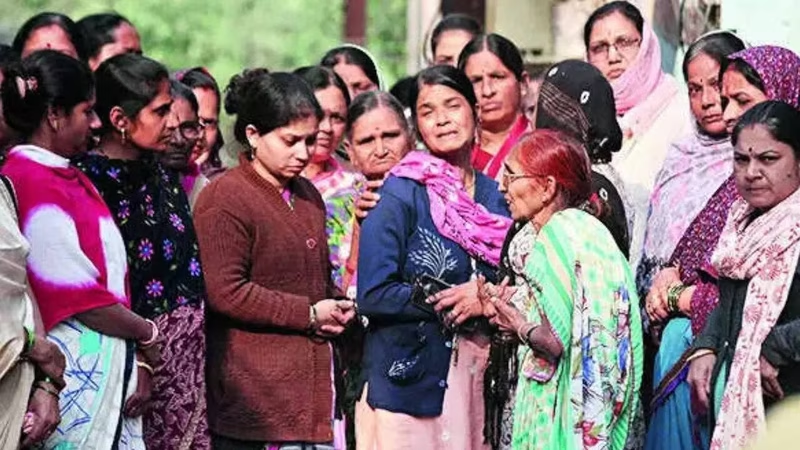
It’s a cruel irony that cuts deep: Indore, proudly crowned India’s ‘Cleanest City’ five years in a row, is now at the center of a horrific public health disaster. Contaminated Indore tap water has claimed seven lives and left 162 people hospitalized with severe diarrhoea, vomiting, and dehydration—all from drinking what they believed was safe water from their taps .
The suspected culprit? A leaking sewage line that mixed raw waste with the drinking water supply in the Bhagirathpura area. For residents, it wasn’t just a plumbing failure—it was a betrayal of trust in the very system meant to keep them safe.
How could this happen in a city held up as a national model for urban sanitation? And more urgently—could it happen in *your* city next? Let’s break down the facts, the failures, and the urgent steps you can take to safeguard your household.
Table of Contents
- What Happened? A Timeline of the Crisis
- The Root Cause: Sewage Meets Supply
- Why Indore? The Clean City Paradox
- Health Impact: Beyond Diarrhoea
- Government Response: Aid, Accountability, and Action
- How to Test and Protect Your Home Water Supply
- Broader Implications: Is India’s Water Infrastructure Failing?
- Conclusion: Clean Awards Mean Nothing Without Safe Water
- Sources
What Happened? A Timeline of the Crisis
The first cases of acute gastroenteritis were reported on December 30, 2025, in Bhagirathpura, a densely populated locality in Indore. By New Year’s Day 2026, hospitals were overwhelmed.
- Dec 30: Initial patients report severe diarrhoea and vomiting after consuming tap water.
- Jan 1: Toll rises to 3 deaths; 98 hospitalized. Water samples collected.
- Jan 2: State health teams confirm faecal contamination in tap water. Boil-water advisory issued.
- Jan 3: Death toll reaches 7; 162 under medical care. Chief Minister announces ₹5 lakh compensation per deceased family .
Contaminated Indore tap water: The Technical Breakdown
Preliminary investigations by the Madhya Pradesh Public Health Engineering Department point to a critical infrastructure failure: a cracked sewage pipe running parallel to a drinking water main developed a leak. Due to pressure differentials, contaminated groundwater—and possibly raw sewage—siphoned into the potable water line.
This cross-connection, known as a “backflow incident,” is a preventable engineering flaw. Most modern systems use backflow prevention valves, but older networks—like parts of Indore’s—often lack them.
Lab tests confirmed the presence of E. coli, coliform bacteria, and high levels of nitrates—clear indicators of faecal contamination .
Why Indore? The Clean City Paradox
Indore has won the Swachh Survekshan ‘Cleanest City’ title every year since 2017. Its waste collection, street sweeping, and public toilet systems are textbook examples for other cities.
But “clean streets” ≠ “safe water.” The Swachh Survekshan ranking heavily weights visible sanitation—not invisible threats like water quality or underground pipeline integrity. This tragedy exposes a dangerous gap in how India measures urban success.
As one public health expert noted: “You can’t award cleanliness while ignoring the water flowing beneath it.”
Health Impact: Beyond Diarrhoea
While diarrhoea is the immediate symptom, waterborne contamination can lead to far worse:
- Cholera: Rapid dehydration, fatal within hours if untreated.
- Hepatitis A & E: Liver inflammation, especially dangerous for pregnant women.
- Typhoid fever: High fever, abdominal pain, antibiotic resistance rising.
- Long-term kidney damage: From chronic exposure to nitrates and heavy metals.
Children and the elderly are at highest risk. In Indore, 60% of hospitalized patients were under 12 or over 60 .
Government Response: Aid, Accountability, and Action
The state government has taken swift—but reactive—measures:
- ₹5 lakh ex gratia to families of the deceased.
- Free treatment at all government and empanelled private hospitals.
- 24/7 water tankers with purified water deployed to Bhagirathpura.
- Formation of a high-level probe committee to fix systemic lapses.
However, critics argue this is crisis management, not prevention. Where were the routine water quality audits? Why weren’t alarm systems in place?
How to Test and Protect Your Home Water Supply
Don’t wait for a crisis. Here’s what you can do today:
- Boil all tap water for 1–3 minutes if contamination is suspected.
- Use a certified RO+UV purifier—standard filters don’t kill bacteria.
- Test your water annually via accredited labs (cost: ₹500–₹1,500). Check for coliform, nitrate, and heavy metals.
- Report foul smell, color, or taste immediately to your municipal corporation.
For a step-by-step guide, see our resource: [INTERNAL_LINK:how-to-test-home-drinking-water].
Broader Implications: Is India’s Water Infrastructure Failing?
Indore is not alone. In 2025, similar incidents were reported in Chennai, Patna, and Surat. According to the Bureau of Indian Standards (BIS), **only 18% of Indian cities** supply water that meets national safety standards .
With aging pipelines, poor maintenance, and explosive urban growth, thousands of communities live on borrowed time. The Indore tragedy is a warning bell—and it’s ringing loudly.
Conclusion: Clean Awards Mean Nothing Without Safe Water
The Contaminated Indore tap water crisis is more than a local tragedy—it’s a national wake-up call. Urban excellence shouldn’t be measured by spotless sidewalks while children drink poison from their taps. True cleanliness starts with safe water. Until then, no city—no matter how awarded—can call itself truly clean.
Sources
[1] Times of India: Contaminated Indore tap water leaves seven dead, 162 hospitalised
[2] Central Public Health and Environmental Engineering Organisation (CPHEEO): Guidelines for Drinking Water Quality
[3] Bureau of Indian Standards (BIS): Report on Urban Water Supply Quality, 2025
[4] World Health Organization (WHO): Drinking Water Fact Sheet