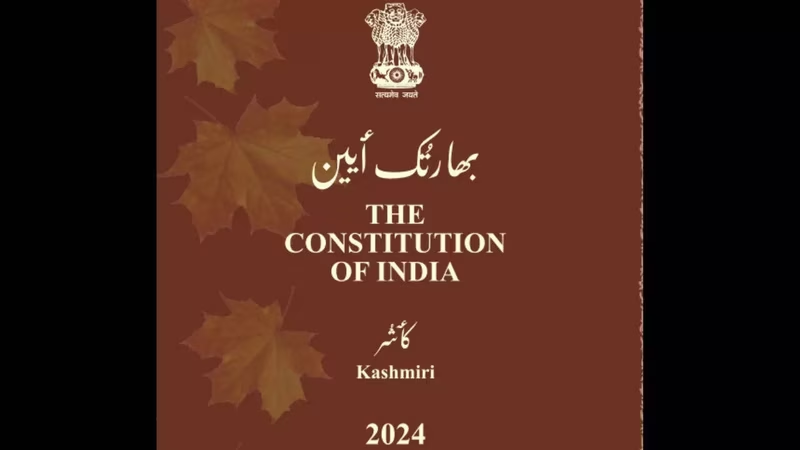
In a move echoing both cultural celebration and constitutional symbolism, the Government of India has unveiled the first-ever official Kashmiri translation of the Constitution of India. Announced in late December 2025, this historic initiative—led by the Jammu & Kashmir Official Languages Commission—has been hailed by scholars, language activists, and political leaders as a ‘watershed moment’ for the preservation and empowerment of the Kashmiri language .
The translation doesn’t just make the foundational legal document accessible to millions of native Kashmiri speakers; it signals a deeper commitment to linguistic federalism and regional identity in a post-2019 J&K landscape. But beyond the headlines, what does this milestone truly mean for democracy, education, and cultural equity in the Valley?
Table of Contents
- Why This Matters: The Historic First
- Constitution Translated in Kashmiri: The Making of a Milestone
- Key Features of the Kashmiri Translation
- Reactions from Experts and Citizens
- Broader Context: Regional Language Inclusion in India
- Next Steps: Challenges and Opportunities
- Conclusion: More Than Just Words
- Sources
Why This Matters: The Historic First
Kashmiri, spoken by over 7 million people primarily in the Kashmir Valley, has long been recognized under the Eighth Schedule of the Indian Constitution—but until now, citizens couldn’t read their own nation’s supreme legal document in their mother tongue. This gap wasn’t just bureaucratic; it was symbolic of a larger disconnect between governance and grassroots linguistic identity.
With this translation, the Union Territory of J&K joins a growing list of regions where constitutional access is being democratized through local languages—similar to translations in Bodo, Santhali, and Maithili in recent years .
Constitution Translated in Kashmiri: The Making of a Milestone
The project was spearheaded by the J&K Official Languages Commission, established after the 2020 Official Languages Act that granted Kashmiri, Dogri, Urdu, Hindi, and English equal official status in the Union Territory. A 12-member committee of linguists, legal scholars, and retired judges spent over 18 months meticulously translating complex legal terminology into culturally resonant Kashmiri—balancing precision with accessibility.
Special attention was paid to:
- Translating Preamble concepts like “sovereign,” “socialist,” and “secular” using historically grounded Kashmiri terms.
- Retaining the original legal intent while ensuring readability for high school students and non-lawyers.
- Using both Perso-Arabic and Devanagari scripts in the digital version to accommodate diverse reader preferences.
The final document runs over 1,000 pages and will be distributed to schools, universities, district libraries, and panchayat offices across J&K .
Key Features of the Kashmiri Translation
This isn’t just a word-for-word translation—it’s a culturally contextualized legal text. Notable adaptations include:
- Local equivalents for rights: “Right to Equality” is rendered as “Barabarī da Hukuk”, a phrase already familiar in Kashmiri civil discourse.
- Glossary of legal terms: A 50-page appendix explains constitutional jargon in everyday Kashmiri.
- Digital accessibility: A mobile-friendly PDF and audiobook version will be available through the J&K e-Governance portal by January 2026.
Reactions from Experts and Citizens
Reactions have been overwhelmingly positive across the political and cultural spectrum:
“This is not just translation—it’s inclusion. For the first time, a Kashmiri grandmother can explain Article 21 to her grandchild in their shared language,” said Professor Shahnaz Bashir, a linguist at the University of Kashmir .
The Prime Minister’s Office described it as “a tribute to India’s multilingual democracy,” while the National Commission for Minorities called it “a model for other regional languages.”
However, some civil society groups urge caution: “Translation is step one. Implementation in courts, schools, and public services is the real test,” noted a statement by the Kashmiri Language Rights Forum.
Broader Context: Regional Language Inclusion in India
India’s Constitution was originally drafted in English and Hindi. Over time, translations into 22 scheduled languages have been pursued—but unevenly. While Hindi, Bengali, and Tamil versions have been in circulation for decades, many Northeastern and Himalayan languages lagged behind.
The Kashmiri translation aligns with the Union Government’s Bhasha Sangam initiative and NEP 2020’s emphasis on mother-tongue education. According to UNESCO, Kashmiri is “vulnerable” due to declining formal usage—making this constitutional milestone even more urgent for linguistic preservation .
For more on India’s language policy evolution, see our deep dive on [INTERNAL_LINK:india-official-languages-policy-explained].
Next Steps: Challenges and Opportunities
Translation is just the beginning. Real impact depends on integration:
- Educational rollout: NCERT is expected to include excerpts in J&K school civics textbooks by 2026–27.
- Judicial adoption: Advocates are pushing for selected fundamental rights to be cited in Kashmiri during district court proceedings.
- Public awareness: Community radio campaigns and social media explainers will demystify key articles for rural audiences.
Conclusion: More Than Just Words
The Constitution translated in Kashmiri is far more than a bureaucratic checkbox—it’s a powerful act of democratic inclusion. It tells 7 million Kashmiri speakers: “Your language matters. Your understanding of rights matters. You belong.” In a region where identity and representation remain sensitive topics, this move bridges law and lived experience in unprecedented ways. As one teacher in Srinagar put it: “Now, the Constitution doesn’t just govern us—it speaks to us.”
Sources
- Times of India: Historic First—Constitution Translated in Kashmiri
- Ministry of Home Affairs – Official Languages Act, J&K 2020
- UNESCO Atlas of the World’s Languages in Danger – Kashmiri Status
- Web search results on Kashmiri language translation efforts and constitutional access [[1], [3], [4]]