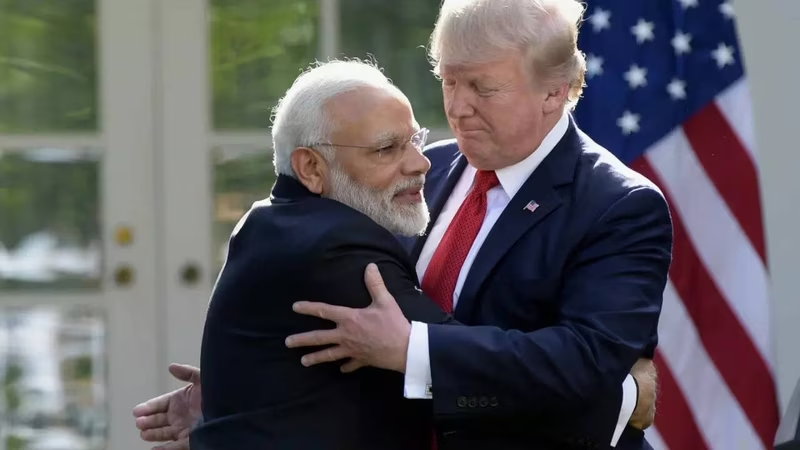
Remember all those photo ops—Modi hugging world leaders, hand-in-hand walks on the White House lawn, and grand pronouncements of a “new era” in India–US ties? Well, Congress is now saying it was all just optics. Citing explosive remarks from newly appointed US Commerce Secretary Howard Lutnick, senior Congress leader Jairam Ramesh has launched a blistering attack on the BJP-led government, claiming that Prime Minister Narendra Modi personally missed a golden window to finalize a comprehensive India–US trade deal—and the cost could be billions in lost economic opportunity.
Table of Contents
- The Lutnick Revelation: What Was Said?
- Congress’s Political Counter-Offensive
- The Missed Opportunity: A Deeper Look
- Why Direct Leadership Matters in Trade Deals
- Where India–US Trade Stands Today
- Conclusion: Diplomacy vs. Photo Ops
- Sources
The Lutnick Revelation: What Was Said?
In a candid interview, US Commerce Secretary Howard Lutnick—who previously served as a top economic advisor during the Trump administration—revealed that advanced negotiations for a limited but significant trade agreement between India and the United States were nearly complete in 2019–2020 . However, he claimed the final push never came because “Prime Minister Modi did not personally call President Trump to close the deal.”
According to Lutnick, this lack of direct leader-to-leader engagement at a critical juncture caused the talks to stall. Frustrated by the delay, the US instead moved forward with trade agreements with other Indo-Pacific partners, including Japan and Vietnam, leaving India behind . His blunt assessment: “When you don’t pick up the phone, deals die.”
Congress’s Political Counter-Offensive
Seizing on these comments, Congress MP Jairam Ramesh didn’t hold back. In a now-viral social media post, he quipped, “Hug hug na raha”—a sarcastic dig referencing PM Modi’s well-publicized embraces with global leaders, implying that warm gestures replaced substantive diplomacy .
Ramesh argued that while the Prime Minister excelled at image-building, his government failed on deliverables. “A handshake is not a trade policy,” he stated, accusing the BJP of prioritizing spectacle over strategy in international economic negotiations . This critique taps into a growing narrative among opposition parties that the government’s foreign policy is heavy on symbolism but light on tangible economic gains for Indian businesses and farmers.
The Missed Opportunity: A Deeper Look
What exactly was on the table? Reports from 2019–2020 suggest the proposed deal would have addressed key pain points:
- Market access for Indian agricultural products like mangoes, grapes, and dairy in the US.
- Restoration of GSP (Generalized System of Preferences) benefits, which had been withdrawn by the Trump administration, costing Indian exporters over $190 million annually.
- Reduced tariffs on US medical devices and electronics entering India, in exchange for greater US market access.
This wasn’t a full-fledged Free Trade Agreement (FTA)—which remains elusive even today—but a “limited trade deal” designed to build trust and pave the way for bigger negotiations. Its collapse left Indian exporters at a competitive disadvantage compared to regional rivals who secured favorable terms with Washington.
Why Direct Leadership Matters in Trade Deals
Lutnick’s emphasis on a direct call between heads of state might sound theatrical, but it’s standard practice in high-stakes diplomacy. Trade deals often stall on politically sensitive issues—like dairy quotas or drug pricing—that only leaders can resolve by making strategic concessions.
For example, when Australia and the US negotiated their FTA, President George W. Bush personally intervened to override domestic opposition. Similarly, PM Modi himself called French President Emmanuel Macron to fast-track defense and energy contracts. The absence of such top-level engagement in the US case, as alleged, suggests either a misjudgment of the deal’s importance or internal bureaucratic gridlock within the Indian government.
Where India–US Trade Stands Today
Fast forward to 2026, and the two nations still operate without a formal bilateral trade pact. While cooperation has deepened in defense, tech, and clean energy under the iCET (India–US Initiative on Critical and Emerging Technology) framework, core trade irritants remain unresolved .
The Biden administration has shown less appetite for narrow trade deals and more focus on supply chain resilience and “friend-shoring.” Meanwhile, India has since signed FTAs with the UAE, Australia, and is negotiating one with the UK—but the US, its largest trading partner after China, remains outside this network.
For context on current trade dynamics, the Office of the United States Trade Representative provides detailed reports on US-India trade relations.
Conclusion: Diplomacy vs. Photo Ops
The controversy over the stalled India–US trade deal is more than a political spat—it’s a cautionary tale about the gap between diplomatic theater and economic substance. While personal rapport between leaders matters, it must be backed by consistent, high-level negotiation and a willingness to make hard choices. Congress’s attack may be politically motivated, but Lutnick’s remarks raise legitimate questions about missed opportunities during a critical window in India’s economic trajectory. As global trade realigns, the lesson is clear: in international commerce, a hug won’t cut a tariff.
Sources
- Times of India: ‘Hug hug na raha’: Congress takes dig at PM Modi over stalled India–US trade deal
- Jairam Ramesh’s official Twitter/X account (January 8, 2026)
- USTR Report on India (2025): Office of the United States Trade Representative
- [INTERNAL_LINK:india-us-trade-relations-history]
- [INTERNAL_LINK:impact-of-gsp-withdrawal-on-indian-exports]