Introduction: A House Divided Cannot Stand
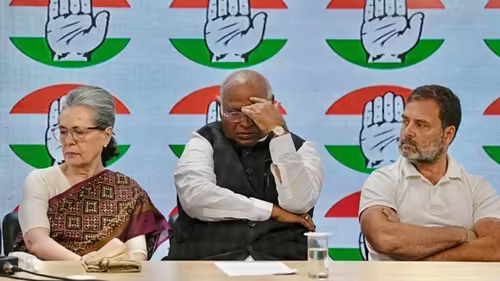
The Congress party is drawing a hard line in the sand for its Punjab unit. After months of simmering tensions, public spats, and thinly veiled accusations between rival camps, the national leadership has stepped in with a clear, uncompromising message: stop the public infighting. In a high-level meeting this week, party president Mallikarjun Kharge and senior leader Rahul Gandhi delivered a blunt directive to Punjab’s top brass—unity is non-negotiable if the party hopes to reclaim power in the 2027 assembly elections .
This crackdown on what insiders call “media lobbying” marks a significant shift in the party’s internal discipline strategy. The message is simple: raise concerns through official channels, not press conferences. And above all, present a united front to the voters of Punjab—a state the Congress cannot afford to lose again.
Table of Contents
- The Congress High Command’s Ultimatum
- Why Punjab Is the Battleground for 2027
- History of Factionalism in Punjab Congress
- What the ‘No Groupism’ Policy Really Means
- Can Enforced Unity Win Elections?
- Conclusion: A Disciplined Party or a Silenced One?
- Sources
The Congress High Command’s Ultimatum
According to sources from the All India Congress Committee (AICC), the recent meeting left no room for ambiguity. Leaders were explicitly told that any future public criticism of party decisions, colleagues, or strategies would be viewed as indiscipline—and dealt with accordingly .
Key points from the directive include:
- No airing of internal issues in the media—all grievances must go through formal party forums.
- Zero tolerance for “group activity” or factional lobbying—a direct reference to rival camps forming around prominent leaders.
- No immediate leadership change—the current Punjab leadership will remain intact to ensure stability ahead of 2027.
Both Kharge and Gandhi emphasized that electoral success hinges on projecting cohesion. “The people of Punjab don’t want to see a party at war with itself,” one senior official quoted Gandhi as saying .
Why Punjab Is the Battleground for 2027
Punjab isn’t just another state on the electoral map—it’s a symbolic and strategic stronghold for the Congress. After losing power to the Aam Aadmi Party (AAP) in 2022, the party is desperate to stage a comeback. But internal disarray has only weakened its position.
Voter trust erodes quickly when leaders publicly feud over portfolios, nominations, or policy direction. The AAP, by contrast, has maintained a tightly controlled narrative under Arvind Kejriwal. For Congress to compete, it must match that discipline—or risk irrelevance in one of its traditional bastions.
History of Factionalism in Punjab Congress
This isn’t the first time Punjab Congress has been plagued by infighting. From the days of Amarinder Singh and Navjot Singh Sidhu to more recent tensions between Charanjit Singh Channi and other regional satraps, the state unit has long been a cauldron of competing ambitions.
Analysts note that such divisions have directly contributed to electoral setbacks. In 2022, public spats between Singh and Sidhu created confusion among voters and diluted the party’s campaign message—a mistake the high command is determined not to repeat .
What the ‘No Groupism’ Policy Really Means
The phrase “no group activity” may sound bureaucratic, but it carries heavy implications. In Congress parlance, “groups” refer to informal power blocs that form around influential leaders—often leading to parallel decision-making, patronage networks, and loyalty tests.
By banning such practices, the high command is attempting to centralize authority and prevent regional strongmen from operating as de facto party heads. This move aligns with broader efforts across states like Rajasthan and Madhya Pradesh to rein in autonomous regional units .
Can Enforced Unity Win Elections?
While discipline is crucial, some political observers question whether silencing dissent is sustainable. Healthy debate, they argue, is essential for course correction. As Pratap Bhanu Mehta, a noted political commentator, once wrote in The Indian Express, “A party that fears internal dialogue is a party afraid of its own shadow” .
Still, the Congress’s calculus is pragmatic: in the short term, image matters more than internal democracy. If the party can project unity for the next 18 months, it may regain voter confidence—even if tensions simmer beneath the surface.
Conclusion: A Disciplined Party or a Silenced One?
The Congress’s crackdown on Congress Punjab internal conflict is a high-stakes gamble. On one hand, it could restore the party’s credibility and set the stage for a strong 2027 campaign. On the other, it risks alienating grassroots leaders who feel their voices are being suppressed.
One thing is certain: the eyes of the nation are on Punjab. If the Congress can truly unify its ranks—not just in public, but in purpose—it might just pull off a historic comeback. But if old rivalries resurface, even the sternest warnings from Delhi may not be enough to save it from another defeat.
Sources
- Times of India: Don’t air internal issues in public: Congress warns Punjab leaders
- Indian National Congress Official Website: INC Leadership Statements
- The Indian Express: On Internal Democracy in Political Parties
- [INTERNAL_LINK:punjab-political-landscape-2026]
- [INTERNAL_LINK:congress-strategy-for-2027-state-elections]