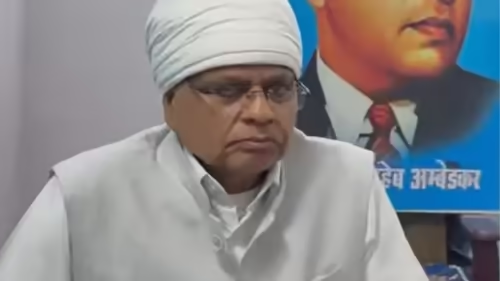
In a statement that has sent shockwaves across India, Madhya Pradesh Congress MLA Phool Singh Baraiya has made a series of deeply offensive and factually incorrect claims attempting to link rape to a woman’s physical appearance and caste. His comments, which dangerously perpetuate long-debunked myths about sexual violence, have drawn swift and severe condemnation from all corners of society.
Table of Contents
- The Controversial Claims by Phool Singh
- National Backlash and Political Fallout
- Phool Singh Rape Comments and the Law
- Debunking the Myth: Beauty and Rape
- The Insult to Adivasi and Dalit Women
- Conclusion: A Dangerous Narrative That Must Be Rejected
- Sources
The Controversial Claims by Phool Singh
During a recent interview, MLA Phool Singh Baraiya from the Bhander constituency in Madhya Pradesh offered a grotesque justification for rape. He claimed that seeing a “beautiful girl can distract a man’s mind,” implying that such distraction could lead to sexual assault . This statement alone is a textbook example of victim-blaming, shifting the responsibility for a violent crime from the perpetrator to the victim.
But his offensive remarks didn’t stop there. In a move that adds a layer of casteist venom to his misogyny, he went on to allege that religious scriptures offer spiritual rewards, or “teerth phal,” for sexual acts with women from Scheduled Castes (SC) and Scheduled Tribes (ST), even if they are “not beautiful” [[2], [30]]. This not only dehumanizes Adivasi and Dalit women but also falsely and irresponsibly invokes religious texts to justify horrific crimes.
National Backlash and Political Fallout
The reaction to Phool Singh’s Phool Singh rape comments was immediate and fierce. The opposition BJP launched a scathing attack on the Congress party, demanding his resignation and accusing the party of harboring regressive elements .
Social organizations, women’s rights activists, and citizens across the country have expressed their outrage on social media and in public forums. The consensus is clear: such statements from an elected representative are not just offensive; they are dangerous. They reinforce a toxic rape culture that excuses perpetrators and silences survivors. Leaders from various parties and civil society groups have insisted that rape cannot be justified or linked to beauty, caste, or any other factor .
Phool Singh Rape Comments and the Law
Phool Singh’s attempt to provide a rationale for rape stands in stark contrast to the letter and spirit of Indian law. The Indian Penal Code (IPC) is unequivocal on this matter.
- Section 375 IPC defines rape as an act of sexual intercourse by a man with a woman against her will, without her consent, or under circumstances where consent is obtained by fear or misrepresentation .
- Section 376 IPC prescribes stringent punishments for rape, ranging from rigorous imprisonment for 10 years to life imprisonment, and even the death penalty in the most heinous cases .
Furthermore, given his specific targeting of SC/ST communities, his remarks could potentially fall under the purview of the Scheduled Castes and Scheduled Tribes (Prevention of Atrocities) Act, 1989. This Act was specifically enacted to prevent hate crimes and atrocities against these historically marginalized groups and provides for special courts and enhanced punishments . His comments are a direct affront to the dignity and safety guaranteed to these communities by this critical legislation.
Debunking the Myth: Beauty and Rape
The core of Phool Singh’s argument—that a woman’s beauty can cause a man to commit rape—is a pernicious and entirely false myth. Sexual assault is not a crime of passion or uncontrollable desire; it is a violent act of power, control, and domination. Rapists target victims of all ages, appearances, and backgrounds. From infants to the elderly, from all walks of life, no demographic is immune. To suggest otherwise is to fundamentally misunderstand the nature of the crime and to provide a shield for criminals.
This kind of rhetoric is precisely what [INTERNAL_LINK:victim-blaming-in-india] campaigns work tirelessly to dismantle. It creates an environment where survivors are afraid to come forward for fear of being blamed for their own assault.
The Insult to Adivasi and Dalit Women
By stating that women from SC/ST communities are “not beautiful” yet still subjected to rape for supposed spiritual gain, Phool Singh has delivered a double insult. He has simultaneously propagated a harmful aesthetic standard that devalues these women and then used that very devaluation to concoct a vile justification for their sexual exploitation. This intersection of casteism and sexism is a particularly insidious form of oppression that Adivasi and Dalit women have fought against for generations. His comments are a painful reminder of the systemic vulnerabilities they face.
Conclusion: A Dangerous Narrative That Must Be Rejected
The Phool Singh rape comments are more than just the offensive words of one individual; they represent a dangerous and archaic mindset that continues to plague our society. As an elected official, his words carry weight and can influence public perception. It is the responsibility of his party, his peers, and every citizen to forcefully reject this narrative. Rape is always and only the fault of the rapist. A woman’s appearance, her caste, her clothing, or her choices are never a justification for violence. This controversy must serve as a catalyst for a renewed national commitment to education, gender equality, and the absolute protection of every citizen’s right to safety and dignity.
Sources
- PTI. “Cong MLA links beauty to rape, uses ‘teerth phal’ term.” Times of India, 17 Jan. 2026.
- “Congress MLA’s shocking remark justifying rape ignites political storm.” Daijiworld, 17 Jan. 2026.
- Jiloha, R.C. “From Rape to Sexual Assault: Legal Provisions and Mental Health Perspectives.” Indian Journal of Psychiatry, 2015.
- “Scheduled Castes and Scheduled Tribes (Prevention of Atrocities) Act, 1989.” Ministry of Social Justice & Empowerment, Government of India.
- “‘Beautiful Girl Can Distract Mind’: Congress MLA Justifies Rape, Ignites Political Storm.” India Today, 17 Jan. 2026.