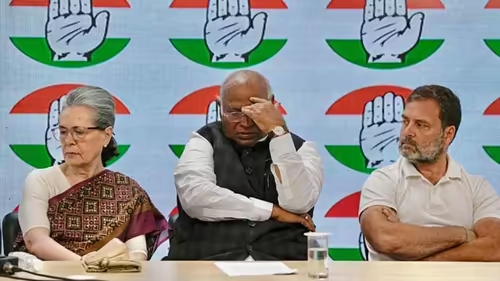
It’s a familiar scene in Indian politics: two powerful state leaders locked in a bitter feud, public spats over portfolios, and a party machinery grinding to a halt. But what’s different this time is the deafening silence from the top. The Congress leadership, once known for its iron-fisted control over state units, now appears to be masters of procrastination, consistently shying away from making the hard decisions that could resolve these crises [[1]].
As the party eyes a potential resurgence in the 2026 elections, this pattern of avoidance isn’t just an internal matter—it’s a direct threat to its credibility as a stable alternative to the ruling BJP. The question on everyone’s mind is simple: why won’t the high command step in?
Table of Contents
- The Karnataka Case Study: A Party at War With Itself
- Why Congress Leadership Is Hesitant to Act
- The Real Cost of Indecision
- Historical Precedent vs. Current Paralysis
- What Lies Ahead for the Grand Old Party?
The Karnataka Case Study: A Party at War With Itself
The most glaring example of this leadership vacuum is playing out in Karnataka. The power tussle between Chief Minister Siddaramaiah and his Deputy CM, D.K. Shivakumar, has moved from behind closed doors to the front pages of every newspaper [[7]].
Reports suggest the conflict has reached a point where it’s actively affecting governance. The Leader of the Opposition in the previous assembly, B.S. Yediyurappa, even claimed the infighting was so severe it had paralyzed the administration [[9]]. In a desperate move to consolidate his position, Siddaramaiah is reportedly considering creating new ministerial posts to dilute Shivakumar’s influence—a classic sign of a government more focused on internal survival than public service [[6]].
Despite multiple calls for intervention, the Congress high command has been slow to act. While there have been talks of summoning both leaders to Delhi for a resolution, concrete action remains elusive [[10]].
Why Congress Leadership Is Hesitant to Act
The reasons for this strategic delay are complex and rooted in the party’s current fragile state.
- Fear of Alienating Key Factions: Both Siddaramaiah and Shivakumar command massive support bases within the Karnataka unit. Picking a side could fracture the party just months before crucial elections.
- Lack of a Clear Authority Figure: Unlike the era of a single, undisputed leader, the current Congress leadership structure is more consultative, often leading to a diffusion of responsibility and slower decision-making [[1]].
- Focus on National Narrative: The party’s top brass may be prioritizing its national campaign against the BJP, viewing state-level squabbles as a distraction they can’t afford to get bogged down in.
The Real Cost of Indecision
This wait-and-see approach comes at a steep price. The most immediate cost is to the party’s image. Voters are looking for a strong, decisive alternative, not a party that seems incapable of managing its own house. The perception of chaos and indecision is a gift to the BJP’s narrative of strong, stable governance.
Beyond optics, there’s a tangible impact on policy and public welfare. When ministers are preoccupied with internal rivalries, their focus on delivering results for their constituents wanes. This governance deficit can erode the very goodwill that brought the Congress to power in states like Karnataka in the first place.
Historical Precedent vs. Current Paralysis
Historically, the Congress high command was feared for its swift and often ruthless interventions in state matters. A phone call from the central leadership was enough to make or break a chief minister. This centralized control, while sometimes criticized, ensured party discipline and a clear chain of command.
The current situation represents a stark departure from that legacy. The Congress leadership now appears to be in a reactive, rather than proactive, mode. This shift reflects a broader transformation within the party—from a top-down organization to a more federal, consensus-driven one. However, without a strong mechanism to enforce that consensus, the result is often paralysis [[1]].
What Lies Ahead for the Grand Old Party?
The path forward is fraught with difficulty. The Congress leadership must find a way to balance its need for internal unity with the necessity of decisive action. Kicking the can down the road might offer temporary peace, but it’s a strategy that will inevitably backfire.
For the party to present itself as a credible national alternative, it must first prove it can govern its own state units effectively. This means making tough choices, even if they are unpopular in the short term. The alternative is a continued slide into irrelevance, where the party’s biggest enemy isn’t the BJP, but its own inability to lead.
To understand the historical context of Congress’s internal dynamics, explore our deep dive on [INTERNAL_LINK:history-of-congress-party-structure].
Summary
The Congress leadership’s reluctance to make hard decisions in state-level power tussles is a critical vulnerability. The ongoing saga in Karnataka serves as a potent case study of how internal indecision can cripple a government and damage a party’s national prospects. For the Congress to be a viable challenger in 2026 and beyond, it must rediscover its capacity for firm, authoritative leadership.
Sources
- Times of India: Power tussle in states: Why is Congress leadership shying away from hard decisions [[1]]
- The New Indian Express: Karnataka power tussle: Siddaramaiah mulls creation of additional posts [[6]]
- The Hindu: Power sharing tussle: Party high command likely to summon CM, DYCM [[10]]
- The New Indian Express: Karnataka Congress power tussle affecting governance [[9]]
- CNBC-TV18: The power tussle between Chief Minister Siddaramaiah & his deputy DK Shivakumar [[7]]