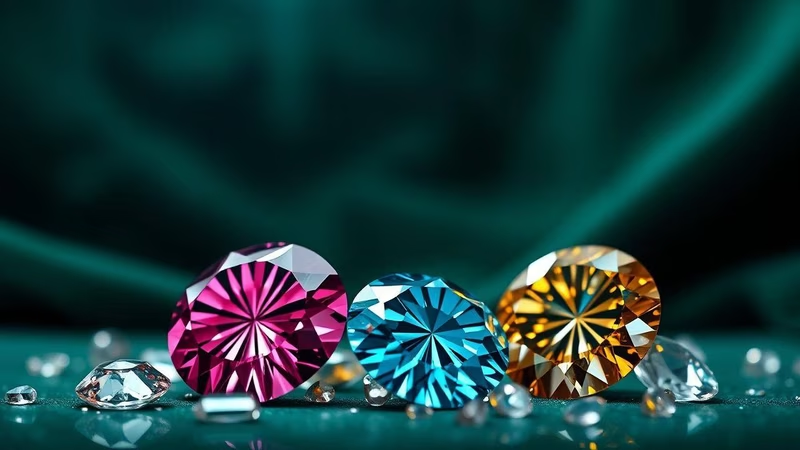
Forget stocks, forget bonds. The smartest money in the world is flowing into something far more tangible, far more beautiful, and, crucially, far more rare. That’s right—we’re talking about coloured diamonds.
Ultra-wealthy Indians are leading a global charge, driving a remarkable 20-25% surge in demand for these exotic gems . But what’s behind this obsession with pink, blue, and canary yellow stones? Is it just a new fashion fad, or is there a deeper, more strategic investment thesis at play? Let’s crack open the vault and find out.
Table of Contents
- The Ultimate Rarity Factor
- Two Decades of Stellar Price Appreciation
- Why India’s Ultra-Rich Are Leading the Charge
- Pink vs. Blue: The Battle of the Rarest
- Investment Asset or Just a Very Expensive Accessory?
- Conclusion: A Sparkling Future for Coloured Assets
- Sources
The Ultimate Rarity Factor
The entire value proposition of coloured diamonds rests on one undeniable truth: scarcity. While white or colourless diamonds are themselves a finite resource, they are practically abundant compared to their colourful cousins.
The numbers are staggering. In 2025, it’s estimated that less than 0.01% of all mined diamonds are graded as ‘fancy vivid colour’—the most prized category . To put it simply, for every 10,000 colourless diamonds you might find on the market, you’ll be lucky to find a single one with a pure, intense pink or blue hue. This extreme scarcity is the bedrock of their long-term value and why they are so coveted by collectors and investors alike.
Two Decades of Stellar Price Appreciation
Rarity alone doesn’t guarantee a good investment. But for coloured diamonds, the market has spoken loudly and clearly over the past twenty years. According to the Fancy Color Research Foundation (FCRF), fancy colour diamond prices have grown at a compound annual rate of 5.7% over this period . Other sources paint an even more dramatic picture, citing that over a single decade, prices for these gems have surged by as much as 77% .
While the luxury market saw a slight dip in 2024 with a 2.2% price decline due to broader economic uncertainties , this is widely seen as a short-term correction in a long-term, powerful upward trend. For the ultra-wealthy, such dips are often viewed as a prime buying opportunity for these finite assets.
Why India’s Ultra-Rich Are Leading the Charge
India has always had a deep cultural and economic connection to gems and jewellery. However, the current trend marks a significant evolution from traditional gold and ruby investments to these globally recognised, high-value assets. The Indian fancy colour diamond market is witnessing a sharp surge, with the broader coloured gemstone sector projected to more than double in value from $1.9 billion to $5.7 billion by 2035 .
For India’s new generation of billionaires and business magnates, coloured diamonds offer a perfect trifecta: they are a portable store of wealth that can be easily secured and transported, a prestigious status symbol for high-society events, and a tangible asset that historically appreciates in value, acting as a hedge against inflation and currency fluctuations. It’s a strategic move that blends tradition with a very modern financial savvy.
Pink vs. Blue: The Battle of the Rarest
Not all coloured diamonds are created equal. The two most coveted hues are pink and blue, often locked in a fierce battle for the title of ‘most rare’.
Pink Diamonds: Often considered the romantic rarity, pure pink diamonds with no secondary colour modifiers are exceptionally scarce . Their formation remains a mystery to scientists, adding to their allure . They consistently fetch the highest prices at auction, with values skyrocketing over the past two decades .
Blue Diamonds: Rivaling pink in desirability, blue diamonds are formed from trace amounts of boron and are found in only a handful of mines worldwide . They are the second rarest colour and can command prices up to $4 million per carat .
While some debate persists over which is rarer, the consensus is clear: both are astronomically rare and represent the pinnacle of the fancy colour diamond market .
Investment Asset or Just a Very Expensive Accessory?
This is the million-dollar (or multi-million-dollar) question. The truth is, for the ultra-wealthy, coloured diamonds are both. They are a high-performing alternative asset class that can diversify a portfolio, but they also possess an intrinsic beauty and emotional resonance that a stock certificate simply can’t match.
Unlike many other luxury goods that depreciate the moment they’re purchased, a certified, high-quality coloured diamond from a reputable source like the GIA (Gemological Institute of America) has a proven track record of long-term value retention and growth. You can wear your investment to a gala, and it will likely be worth more the next day.
Conclusion: A Sparkling Future for Coloured Assets
The surge in demand for coloured diamonds among India’s and the world’s ultra-rich is not a fleeting trend. It’s a calculated response to a world of economic volatility, driven by the immutable laws of supply and demand. With their breathtaking beauty, scientific mystery, and a history of robust price appreciation, these rare gems have firmly established themselves as a premier luxury asset. As the world’s mines continue to deplete and the wealthy seek ever more exclusive stores of value, the future for coloured diamonds looks not just bright—but brilliantly, vividly so.
For more insights on alternative investments, explore our guide on [INTERNAL_LINK:luxury-watch-investment-guide] or [INTERNAL_LINK:art-market-trends-2026].
Sources
- Times of India: Coloured diamonds shine brighter
- Fancy Color Research Foundation (FCRF): Fancy Color Diamond Price & Value Trends [[23], [30]]
- Various market reports and jewellery industry analyses [[5], [8], [14], [16], [17], [19], [20], [22], [26], [27]]