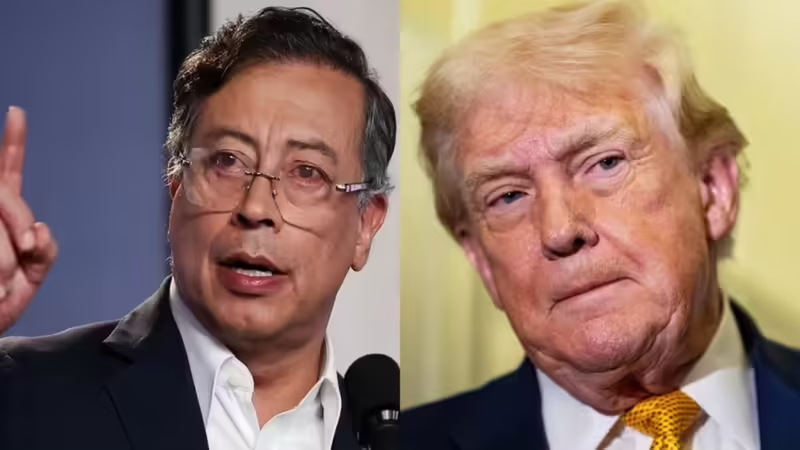
In a surprising diplomatic overture that bridges political chasms, Colombian President Gustavo Petro has publicly praised former U.S. President Donald Trump for his “call and tone” during a recent conversation about the escalating drug crisis. The left-wing leader, known for his sharp critiques of U.S. interventionism and his push to decriminalize drug use, described the exchange as constructive—marking an unexpected moment of alignment between two figures often at odds on nearly every major policy issue .
The conversation, reportedly focused on Colombia’s role as the world’s largest producer of cocaine and the persistent flow of narcotics into the United States, has reignited debate over how to tackle the root causes of the drug trade. While Petro has long argued that the “war on drugs” has failed, Trump’s hardline stance favors intensified interdiction and eradication. Yet, in this instance, both leaders appear to have found common ground—not in strategy, but in dialogue.
Table of Contents
- Colombia President Trump Drug Talk: What Was Discussed?
- Ideological Clash: Petro’s Reform Vision vs. Trump’s Zero-Tolerance
- Why Petro Appreciated Trump’s Tone: Diplomacy Over Doctrine
- The Cocaine Crisis: Colombia’s Production and U.S. Demand
- Historical Context: U.S.-Colombia Drug Cooperation
- Will They Meet? Plans for a Future Summit
- Implications for Bilateral Relations and Regional Security
- Conclusion: A Conversation That Defied Expectations
- Sources
Colombia President Trump Drug Talk: What Was Discussed?
According to President Petro, the call with Trump centered on the “drug situation” in Colombia and its impact on the United States. While no formal policy agreements were announced, Petro emphasized that he valued Trump’s respectful approach. “I appreciate his call and tone,” Petro told reporters, noting that the conversation was “sincere” and acknowledged the complexities of the issue .
Notably, Trump—who has not held public office since 2021—has no official authority to shape U.S. foreign policy. However, as the presumptive Republican nominee for the 2026 presidential election, his views carry significant weight. His reported willingness to listen, rather than dictate, may signal a subtle shift in how he approaches Latin American allies if elected again.
Ideological Clash: Petro’s Reform Vision vs. Trump’s Zero-Tolerance
The two leaders represent opposite ends of the drug policy spectrum:
- Gustavo Petro: Advocates for treating drug addiction as a public health issue, not a criminal one. He has pushed to end aerial fumigation of coca crops and instead invest in rural development and crop substitution .
- Donald Trump: Championed a militarized “zero tolerance” approach, pressuring Colombia to intensify coca eradication and even suggesting U.S. military involvement in spraying operations .
Despite these differences, both recognize that Colombia’s coca production has surged in recent years—reaching record highs of over 300,000 hectares in 2025 —and that U.S. demand remains the primary driver.
Why Petro Appreciated Trump’s Tone: Diplomacy Over Doctrine
Petro’s praise isn’t about endorsing Trump’s policies—it’s about acknowledging a rare moment of diplomatic respect. In past administrations, U.S. officials often issued public ultimatums to Colombia, threatening aid cuts if eradication targets weren’t met. Trump’s reportedly non-confrontational tone may have signaled a willingness to engage as partners, not enforcers.
For Petro, who has accused the U.S. of “imperial hypocrisy” on drug policy, this shift in communication style—even from a political adversary—may open doors for more honest, solution-focused dialogue.
The Cocaine Crisis: Colombia’s Production and U.S. Demand
Colombia produces more than 60% of the world’s cocaine, much of which ends up in the U.S., where overdose deaths involving stimulants like cocaine have risen sharply . The economics are simple: high U.S. demand = high Colombian supply. Eradication efforts alone have failed because farmers turn to coca as a livelihood when legal crops yield little income.
Petro argues that without addressing poverty and lack of infrastructure in rural Colombia—and reducing demand in the U.S.—no amount of spraying or interdiction will solve the problem.
Historical Context: U.S.-Colombia Drug Cooperation
Since the early 2000s, the U.S. has poured over **$10 billion** into Plan Colombia—a counter-narcotics and counter-insurgency initiative. While it weakened guerrilla groups like FARC, it did little to curb long-term coca cultivation .
Today, with FARC demobilized and new armed groups filling the void, the challenge is more complex. Petro’s government seeks a new framework—one that prioritizes peace, development, and human rights over militarization.
For authoritative data on global drug trends, refer to the United Nations Office on Drugs and Crime (UNODC).
Will They Meet? Plans for a Future Summit
Both sides have expressed interest in a face-to-face meeting. While no date has been set, such a summit—whether during a potential Trump 2026 presidency or sooner through backchannel diplomacy—could redefine bilateral cooperation. A joint statement on “shared responsibility” might emerge, balancing U.S. security concerns with Colombian sovereignty.
Implications for Bilateral Relations and Regional Security
If this dialogue evolves into concrete collaboration, it could stabilize a key U.S. partnership in Latin America. It may also influence how other nations—like Mexico and Peru—approach drug policy negotiations with Washington. Most importantly, it could shift the narrative from blame to shared solutions.
Explore more on Latin American geopolitics in our analysis: [INTERNAL_LINK:us-latin-america-foreign-policy-2026].
Conclusion: A Conversation That Defied Expectations
The Colombia president Trump drug talk may not have produced policy breakthroughs, but it achieved something equally rare: mutual respect across a deep ideological divide. In an era of polarized politics, Petro’s acknowledgment of Trump’s “tone” reminds us that diplomacy begins not with agreement, but with the willingness to listen. Whether this leads to a new chapter in U.S.-Colombia relations—or remains a brief, curious footnote—depends on what happens next.
Sources
[1] Times of India. (2026, January 8). ‘Appreciate his call and tone’: Colombia President ‘explains’ to Trump drug ‘situation’. https://timesofindia.indiatimes.com/…
[2] Petro’s public statements on drug policy reform and rural development.
[3] Trump administration’s drug policy directives toward Colombia (2017–2021).
[4] UNODC Coca Cultivation Survey in Colombia (2025).
[5] U.S. CDC and DEA data on cocaine-related overdoses and seizures.
[6] U.S. State Department reports on Plan Colombia expenditures and outcomes.