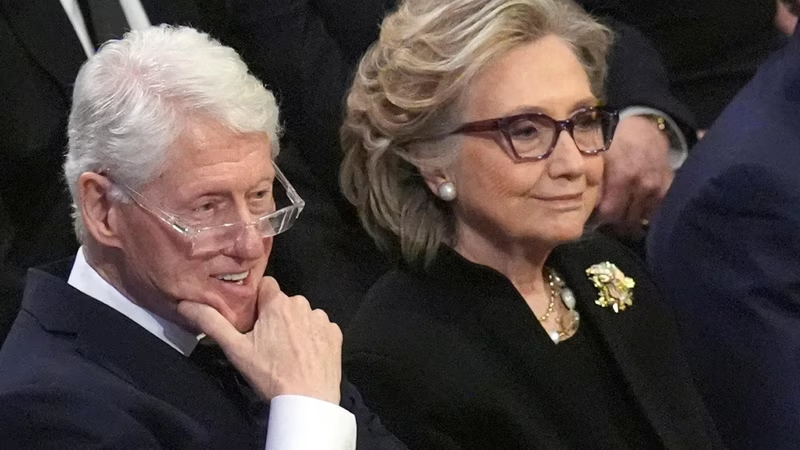
In a dramatic escalation of tensions between former Democratic powerhouses and a Republican-led House committee, Bill and Hillary Clinton have taken a firm public stand against a congressional investigation into their ties with disgraced financier Jeffrey Epstein. In a sharply worded letter made public this week, the couple not only announced they would refuse to testify but also accused the committee’s leadership of orchestrating a process aimed at their “imprisonment” rather than truth-seeking . Their statement—framed around the moral dichotomy of “right and wrong,” not “Right or Left”—has reignited a fierce national debate about political weaponization, due process, and the long shadow of the Epstein scandal.
Table of Contents
- The Clinton Letter: A Moral and Legal Stand
- The House Investigation: What’s It Really About?
- Why They Refuse to Testify: Legality vs. Politics
- Historical Context: The Clintons’ Ties to Epstein
- Political Reactions: Partisan Divide Deepens
- Legal Precedents: Can They Legally Defy a Subpoena?
- Conclusion: A Battle Over Power, Not Just Process
- Sources
The Clinton Letter: A Moral and Legal Stand
Their joint letter, addressed to Rep. James Comer, chairman of the House Oversight Committee, is both a legal brief and a political manifesto. The Clintons wrote: “This is not about Right or Left, but about right and wrong.” They argue that the subpoena lacks legitimate legislative purpose and is instead a “fishing expedition” designed to harass them publicly . Crucially, they assert that the committee has failed to demonstrate any valid connection between their past interactions with Epstein and a current congressional function—a key legal requirement for a valid subpoena.
The House Investigation: What’s It Really About?
Launched in late 2025, the GOP-led probe claims to be examining potential government misconduct related to Epstein’s plea deal and his network of powerful associates. While the committee insists its goal is transparency, critics—including many legal scholars—argue that targeting private citizens like the Clintons, who held no government role during Epstein’s later legal troubles, stretches congressional authority beyond its constitutional limits . The investigation appears to focus on flight logs, meetings, and communications between Epstein and various political figures, including the Clintons.
Why They Refuse to Testify: Legality vs. Politics
The core of the Clintons’ defense rests on two pillars:
- Lack of Legislative Purpose: Under U.S. law, Congress can only issue subpoenas that serve a valid legislative function—such as informing new legislation. The Clintons contend that this probe is purely investigative and punitive, with no path to actual policy change .
- Bad Faith Proceedings: They accuse Chairman Comer of conducting the investigation in bad faith, citing inflammatory public statements and leaks designed to damage their reputation before any evidence is presented .
This stance isn’t just rhetorical—it’s a calculated legal strategy. By framing the subpoena as “legally invalid,” they lay the groundwork for a court challenge if the committee attempts to enforce it through contempt proceedings.
Historical Context: The Clintons’ Ties to Epstein
Public records confirm that Bill Clinton flew on Epstein’s private jet—dubbed the “Lolita Express”—at least once in 2002, accompanied by Secret Service agents and aides . Both Clintons have consistently denied any knowledge of Epstein’s criminal activities, which came to light years later. Hillary Clinton’s campaign emails from 2016 also referenced Epstein, though no evidence of wrongdoing was found. Despite these historical links, no credible evidence has ever tied either Clinton to Epstein’s sex trafficking crimes—a fact they emphasize in their defense.
Political Reactions: Partisan Divide Deepens
Unsurprisingly, reactions have split sharply along party lines. Democratic leaders have rallied behind the Clintons, calling the probe a “witch hunt” and a distraction from pressing national issues. Republicans, meanwhile, insist that all individuals connected to Epstein must be held accountable, regardless of political affiliation. This clash underscores a broader trend of congressional investigations becoming tools of partisan warfare rather than bipartisan fact-finding missions. For more on how political polarization affects oversight, see our analysis on [INTERNAL_LINK:partisan-politics-and-congressional-investigations].
Legal Precedents: Can They Legally Defy a Subpoena?
Historically, defying a congressional subpoena carries serious risks, including fines or even jail time for contempt of Congress. However, courts have often sided with private citizens when subpoenas are deemed overreaching or politically motivated. In Trump v. Mazars USA, LLP (2020), the Supreme Court ruled that Congress must meet a high bar to obtain personal records of a president, emphasizing separation of powers . While the Clintons aren’t currently in office, this precedent strengthens their argument that unchecked subpoena power threatens civil liberties. Legal experts from institutions like the Brookings Institution note that the outcome will likely hinge on whether a judge sees the probe as legitimate oversight or partisan theater.
Conclusion: A Battle Over Power, Not Just Process
The decision by Bill and Hillary Clinton to refuse to testify is more than a personal defense—it’s a direct challenge to the expanding scope of congressional investigative power. By invoking moral clarity (“right and wrong”) and legal principle (“legally invalid”), they aim to reframe the narrative from one of guilt-by-association to one of constitutional rights under siege. Whether this strategy succeeds will depend not just on public opinion, but on the judiciary’s willingness to rein in what many see as an increasingly politicized use of congressional authority.
Sources
- Times of India: ‘Not about Right or Left but Right and Wrong’: The Clintons pen letter on Epstein probe
- U.S. House Committee on Oversight and Accountability: Official Website
- Department of Justice: Epstein Case Archives
- Congressional Research Service: Congressional Subpoena Authority Explained
- Supreme Court of the United States: Trump v. Mazars USA, LLP Decision