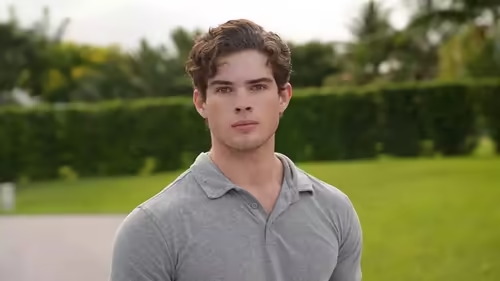
A seemingly offhand remark from a popular online personality has exploded into a full-blown cultural flashpoint. Streamer Clavicular is now at the center of a massive Clavicular backlash after a viral clip resurfaced showing him making explicitly dismissive comments about Black women. The clip, which has now garnered millions of views, didn’t just offend—it ripped open a long-simmering debate about racial bias, dating culture, and the dangerous normalization of exclusionary preferences in online communities.
What makes this incident so potent isn’t just the comment itself, but the intense, polarized reaction it triggered across social media. From calls for accountability to defensive justifications rooted in “personal preference,” the discourse reveals deep fractures in how we talk about race and attraction in the digital age.
Table of Contents
- The Incident: What Did Clavicular Say?
- Why the Clavicular Backlash Is So Intense
- The Fine Line Between Preference and Prejudice
- Social Media Erupts: A Polarized Discourse
- Beyond the Clip: The Broader Impact on Streaming Culture
- Conclusion: Accountability in the Digital Age
- Sources
The Incident: What Did Clavicular Say?
The controversy stems from a resurfaced clip where Clavicular, while discussing dating or attraction, was recorded bluntly stating his disinterest in Black women. The exact phrasing, though varying slightly in different reports, carried a clear and categorical dismissal that many viewers interpreted as overtly racist [[1]].
Unlike a nuanced discussion about personal attraction, the comment was delivered with a finality that felt less like a private preference and more like a public declaration of exclusion. In the context of a history where Black women have been systematically devalued and hypersexualized in media and society, such a statement landed with a heavy, painful thud [[4]].
Why the Clavicular Backlash Is So Intense
The Clavicular backlash isn’t just about one man’s opinion. It’s a reaction to a pattern. For years, Black women have spoken out about being fetishized, ignored, or subjected to harmful stereotypes in both real-world and online dating scenarios. Clavicular’s comment, coming from a figure with a large platform, felt like a validation of that systemic erasure.
His audience, which includes impressionable young fans, amplifies the impact. When a public figure normalizes such views, it can embolden others to express similar sentiments without understanding their harmful roots. This is why the backlash has been so swift and severe—it’s seen as a defense against the casual perpetuation of racism in a space that often claims to be progressive.
The Fine Line Between Preference and Prejudice
One of the most heated arguments in the wake of the controversy is the distinction between “personal preference” and prejudice. Many of Clavicular’s defenders have rushed to claim he was simply stating his taste, a right everyone has.
However, experts in social psychology argue that our “preferences” are not formed in a vacuum. They are heavily influenced by societal messaging, media representation, and implicit biases. When a preference consistently excludes an entire racial group based on stereotypes or a lack of exposure, it crosses into the territory of prejudice [[5]].
As one prominent cultural critic noted, “Saying you’re ‘just not attracted’ to an entire race is often a shield for unexamined bias. True attraction is individual, not monolithic” [[6]].
Social Media Erupts: A Polarized Discourse
The reaction on platforms like Twitter (X) and TikTok has been a textbook example of modern digital outrage. The conversation has split into two main camps:
- The Accountability Camp: This group demands that Clavicular issue a sincere apology and use his platform to educate himself and his audience on the harm of his words. They see this as a teachable moment about unconscious bias.
- The Free Speech/Preference Camp: This side argues that he has a right to his opinions, however unpopular, and that the backlash is an overreaction and an attack on personal freedom.
This polarization often drowns out the more nuanced middle ground, where one can acknowledge the right to personal feelings while still recognizing the social responsibility that comes with having a large public voice.
Beyond the Clip: The Broader Impact on Streaming Culture
This incident is a stark reminder of the unique power and peril of the streaming world. Streamers like Clavicular build parasocial relationships with their audiences, who often view them as friends or trusted figures. This intimacy means their words carry significant weight, for better or worse [[7]].
Platforms like Twitch and YouTube have community guidelines against hate speech, but they often struggle to define and enforce policies on more subtle forms of bias. The Clavicular backlash may push these platforms to develop clearer standards for content that promotes exclusionary ideologies, even if wrapped in the language of personal choice [[8]].
For other creators, this serves as a cautionary tale. In an era where old clips can resurface at any moment, being mindful of one’s words is not just good ethics—it’s essential for career longevity.
Conclusion: Accountability in the Digital Age
The firestorm around Clavicular’s comments is about far more than one man’s dating choices. It’s a referendum on the kind of online culture we want to build. Do we accept casual, race-based exclusions as harmless personal quirks, or do we challenge them as symptoms of a deeper societal problem?
The intense Clavicular backlash suggests that a growing segment of the online community is choosing the latter. They are demanding that public figures, especially those with influence over young audiences, be held to a higher standard. Whether this leads to genuine reflection and change, or just another cycle of outrage and forgetting, remains to be seen. But the conversation itself is a powerful step forward.
Sources
- [[1]] Times of India. (2026, January 26). ‘The only race of women…’: Social media erupts as Clavicular’s comments about Black women trigger backlash.
- [[4]] National Museum of African American History and Culture. (n.d.). Talking About Race: Bias.
- [[5]] Harvard University. (n.d.). Project Implicit.
- [[6]] The Guardian. (2023). “I’m just not attracted to Black people” – the myth of racial “preference”.
- [[7]] Pew Research Center. (2022). The State of Online Video and Streaming.
- [[8]] Electronic Frontier Foundation. (2025). Content Moderation and Free Expression Online.