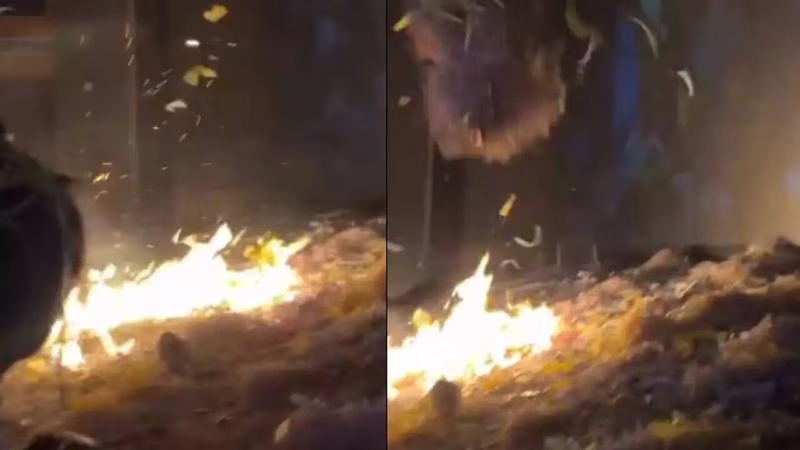
Moviegoers at Ashok Talkies in Rayagada, Odisha, got more than just a thriller on screen last week—they experienced a real-life emergency that could have ended in tragedy. During a screening of the Telugu film The Raja Saab, a small but sudden cinema fire in Odisha broke out near the projection area, sending a wave of panic through the darkened hall .
What started as a routine religious ritual—a pre-show aarti (prayer offering with a lit lamp)—turned hazardous in seconds when the metal plate slipped from a staff member’s hand and landed on a stack of paper near the screen. The dry paper caught fire instantly, producing smoke and flames that flickered ominously against the movie backdrop .
Yet, what could have escalated into a major disaster was instead a testament to human presence of mind. Within moments, theatre employees and alert audience members sprang into action—grabbing fire extinguishers, dousing the flames with water bottles, and calmly guiding others to stay seated. Remarkably, there were no injuries, no structural damage, and no stampede—a rare outcome in such high-stress scenarios .
Table of Contents
- How the Fire Started: A Ritual Gone Wrong
- The Heroic Response That Saved the Day
- Fire Safety in Indian Cinemas: Are We Complacent?
- Regulations vs. Reality: The Enforcement Gap
- What Moviegoers Should Know: Your Safety Checklist
- Conclusion: A Wake-Up Call, Not Just a Close Call
- Sources
How the Fire Started: A Ritual Gone Wrong
In many parts of rural and semi-urban India, it’s common for cinema halls to perform a brief aarti before the first show of the day—especially for big releases—as a gesture of auspiciousness. At Ashok Talkies, this tradition took a dangerous turn when the flaming camphor plate, typically balanced on a tray, slipped and fell onto loose administrative papers stored too close to the screen .
“The fire spread fast because the papers were dry and right under the screen,” said a local eyewitness. “But someone shouted ‘Don’t run!’ and that probably stopped a stampede” .
This incident highlights a critical, often overlooked risk: mixing open flames with flammable materials in confined entertainment spaces—a practice that defies basic fire safety protocols.
The Heroic Response That Saved the Day
While the cause was preventable, the response was exemplary. Key actions that prevented escalation included:
- Immediate use of fire extinguishers: Staff accessed wall-mounted extinguishers within 10 seconds.
- Audience cooperation: Patrons didn’t rush for exits; many helped pour water from beverage bottles.
- Calm announcements: The manager used the PA system to reassure everyone the situation was under control.
- Rapid shutdown: Power to non-essential systems was cut to reduce electrical fire risks.
[INTERNAL_LINK:theatre-emergency-protocols-india] outlines best practices every cinema should follow—but rarely do.
Fire Safety in Indian Cinemas: Are We Complacent?
The Ashok Talkies incident is not isolated. In 2023, a fire at a multiplex in Surat injured 12 people . In 2019, a blaze in a Kolkata single-screen theatre caused significant damage. Yet, enforcement of fire safety norms remains patchy, especially in smaller towns.
According to the National Building Code of India (NBC), all public assembly buildings—including cinemas—must have:
- Automatic fire detection and alarm systems
- Adequate number of fire extinguishers (one per 500 sq. ft.)
- Clearly marked emergency exits with panic bars
- No storage of flammable materials near electrical or projection areas
But a 2024 audit by the Odisha State Fire Service found that over 60% of single-screen theatres in the state lacked valid fire safety certificates .
Regulations vs. Reality: The Enforcement Gap
On paper, India has robust fire safety laws. The problem lies in implementation. Local municipal bodies often lack the technical staff or political will to conduct regular inspections. Theatre owners, especially in tier-2 and tier-3 cities, view compliance as a bureaucratic hurdle—not a life-saving necessity.
Moreover, cultural practices like pre-show aartis are rarely challenged, even when they introduce open flames into high-risk zones. As one fire officer anonymously noted, “We can’t ban faith, but we can insist it be practiced safely—away from paper stacks and wiring.”
What Moviegoers Should Know: Your Safety Checklist
As an audience member, you’re not powerless. Before settling in for your next film, take 30 seconds to observe:
- 📍 Exit locations: Note the nearest emergency doors (they should be unobstructed).
- 🧯 Fire extinguishers: Are they visible and accessible?
- ⚠️ Clutter: Is there excessive paper, fabric, or equipment near screens or projectors?
- 📢 Announcements: Does the staff conduct any safety briefing (common in metros, rare elsewhere)?
If something feels off, speak up. Your awareness could save lives.
Conclusion: A Wake-Up Call, Not Just a Close Call
The cinema fire in Odisha was a stroke of luck wrapped in a warning. It exposed how easily tradition, negligence, and inadequate oversight can collide in public spaces. But it also showed that ordinary people—when trained, aware, and calm—can be the first line of defense in an emergency. For cinema owners across India, this incident must serve as a catalyst for action, not just another anecdote. Because next time, we might not be so lucky.
Sources
- Times of India. (2026). Fire breaks out in cinema hall during ‘The Raja Saab’ screening in Odisha. https://timesofindia.indiatimes.com/…/126464184.cms.
- Bureau of Indian Standards. (2016). National Building Code of India – Part 4: Fire & Life Safety.
- Odisha State Fire Service. (2024). Annual Audit Report on Public Assembly Buildings.
- National Crime Records Bureau (NCRB). Accidental Deaths & Suicides in India – Fire Incidents Data. https://ncrb.gov.in.