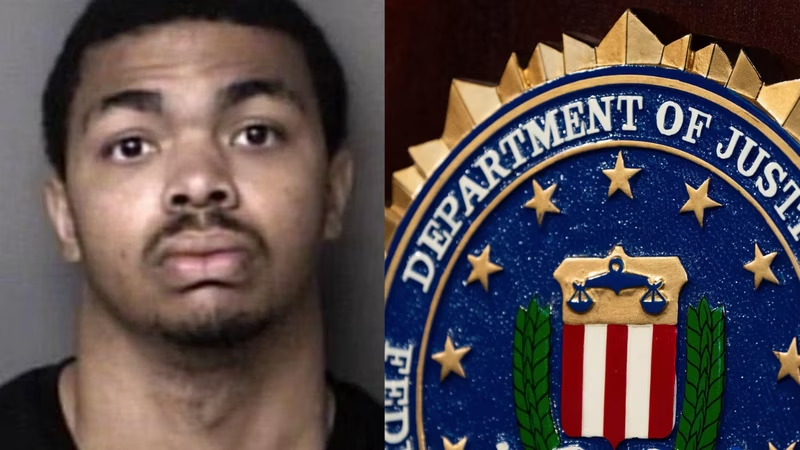
Just as Americans were preparing to ring in 2026, a quiet but urgent operation by federal authorities averted what could have been a devastating act of domestic terrorism. The target? A crowded public space in North Carolina. The would-be attacker? A 19-year-old from Charlotte named Christian Sturdivant—a teenager authorities say had become deeply radicalized by ISIS ideology and was on the verge of carrying out a violent attack on New Year’s Eve.
His arrest, confirmed by the U.S. Department of Justice on January 2, 2026, highlights a disturbing trend: the rise of lone-wolf, self-radicalized individuals who consume extremist content online and act without formal ties to terror organizations—yet with deadly intent. This is the story of how Sturdivant was identified, monitored, and stopped before he could strike.
Table of Contents
- Who Is Christian Sturdivant? Background and Radicalization
- The Terror Plot: Details of the FBI Investigation
- How the FBI Stopped the Attack
- The Rise of ISIS-Inspired Lone-Wolf Attacks in the U.S.
- Legal Charges and What Happens Next
- Conclusion: A Close Call for National Security
- Sources
Who Is Christian Sturdivant? Background and Radicalization
Christian Sturdivant was, by all outward appearances, an ordinary teenager from Charlotte, North Carolina. But behind closed doors—and on encrypted online platforms—he had allegedly embraced the violent ideology of ISIS. According to court documents unsealed by the Department of Justice, Sturdivant consumed ISIS propaganda for months, expressing admiration for the group’s tactics and repeatedly voicing intent to carry out an attack on U.S. soil .
Investigators found that Sturdivant had conducted online research on how to build explosive devices, studied past terrorist attacks for tactical inspiration, and made specific plans to target a public venue during New Year’s Eve celebrations—a time of high foot traffic and symbolic significance .
Notably, Sturdivant acted alone. He had no known direct contact with ISIS operatives overseas, underscoring the modern challenge of “remote radicalization,” where individuals are indoctrinated through social media, encrypted forums, and jihadist content hosted on decentralized platforms .
The Terror Plot: Details of the FBI Investigation
The FBI’s investigation into Sturdivant began in late December 2025 after alarming digital footprints were flagged by intelligence algorithms and human analysts monitoring extremist chatter. His online activity included:
- Searching for “how to make a pressure cooker bomb” and “soft target locations in Charlotte.”
- Downloading and sharing ISIS execution videos and martyrdom statements.
- Expressing frustration that no one in the U.S. had “done anything real” in support of the caliphate .
Undercover agents and confidential informants were quickly deployed to assess the credibility of the threat. Within days, they confirmed Sturdivant was not just venting online—he was actively scouting locations and acquiring materials consistent with bomb-making, including shrapnel and ignition components .
How the FBI Stopped the Attack
On December 30, 2025—just two days before New Year’s Eve—federal agents executed a search warrant at Sturdivant’s residence. There, they allegedly found notebooks filled with attack plans, extremist literature, and components that could be used to construct an improvised explosive device (IED) .
Sturdivant was arrested without incident and charged with attempting to provide material support to a designated foreign terrorist organization (ISIS) and planning a terrorist attack. He made his initial court appearance on January 2, 2026, and remains in federal custody without bail .
The FBI’s swift action was praised by national security experts as a textbook example of proactive counterterrorism in the digital age—using data, surveillance, and rapid inter-agency coordination to stop a plot before lives are lost.
The Rise of ISIS-Inspired Lone-Wolf Attacks in the U.S.
While ISIS has lost its physical caliphate, its digital legacy remains potent. According to the FBI’s Counterterrorism Division, over 100 U.S. citizens have been charged since 2014 with ISIS-related offenses, many of them self-radicalized individuals with no formal group affiliation .
High-profile cases include the 2016 Orlando Pulse nightclub shooter and the 2017 New York subway bombing attempt. What makes the Christian Sturdivant case particularly alarming is his age—just 19—and how quickly his radicalization occurred, largely through algorithm-driven content on mainstream and fringe platforms.
[INTERNAL_LINK:online-radicalization-prevention-strategies] This underscores the urgent need for better digital literacy, platform accountability, and early intervention programs targeting at-risk youth.
Legal Charges and What Happens Next
Sturdivant faces two federal charges:
- Attempting to provide material support to a foreign terrorist organization (18 U.S.C. § 2339B), which carries a maximum penalty of 20 years in prison.
- Planning a violent act of terrorism transcending national boundaries (18 U.S.C. § 2332b), which can result in life imprisonment or the death penalty if a death occurs .
Given the evidence—including his own digital confessions and seized materials—a conviction appears likely. The case will now move through the federal court system, with a trial expected later in 2026. It may also trigger congressional hearings on online radicalization and gaps in youth intervention programs.
Conclusion: A Close Call for National Security
The arrest of Christian Sturdivant is both a victory and a warning. It’s a victory because the FBI’s vigilance prevented what could have been a mass-casualty event during a major holiday. But it’s a warning that the threat of homegrown, ISIS-inspired terrorism remains alive—especially among vulnerable, isolated young people who find belonging in the darkest corners of the internet.
As technology evolves, so too must our strategies for detection, prevention, and deradicalization. For now, thanks to the swift work of federal agents, New Year’s Eve 2026 was a night of celebration—not tragedy.
Sources
- U.S. Department of Justice: “Charlotte Teen Charged with Plotting ISIS-Inspired New Year’s Eve Attack” (January 2, 2026)
- FBI Charlotte Field Office Press Release (January 2, 2026)
- Times of India: “Who is Christian Sturdivant? ISIS-inspired teen captured by FBI…” (January 3, 2026)
- FBI.gov: “Counterterrorism Priorities and Threats” (2025 Summary)