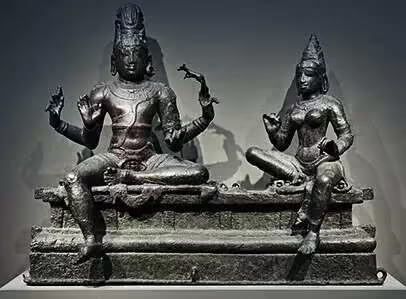
After decades in exile, three of India’s most sacred artistic treasures are finally coming home.
The Smithsonian Institution—the world’s largest museum and research complex—has officially announced the repatriation of three ancient South Indian bronze sculptures: two exquisite idols from the famed Chola dynasty (9th–13th century CE) and one from the later Vijayanagar Empire (14th–17th century). These weren’t just decorative objects; they were consecrated deities once worshipped in village temples in Tamil Nadu, stolen during a wave of idol trafficking that peaked in the 1970s and 80s.
This move marks a watershed moment in India’s long fight to reclaim its looted heritage. And it’s not just symbolic—it sets a powerful precedent for other Western museums holding contested artifacts. The Chola bronzes repatriation is more than a homecoming; it’s justice delayed but not denied.
Table of Contents
- What Artifacts Are Being Returned?
- How Were They Looted?
- The Long Road to Repatriation
- Why Did the Smithsonian Agree Now?
- Broader Impact on Global Repatriation Efforts
- What Happens Next?
- Conclusion
- Sources
What Artifacts Are Being Returned?
The three bronzes include:
- A 12th-century Chola bronze of Lord Shiva as Nataraja (Cosmic Dancer)—renowned for its fluid grace and spiritual symbolism.
- A Chola-era bronze of Goddess Uma (Parvati), Shiva’s consort, noted for its serene expression and intricate jewelry detailing.
- A Vijayanagar-period bronze of Saint Manikkavacakar, a revered Tamil poet-saint, reflecting the devotional intensity of the era.
All three were originally housed in rural temples in Tamil Nadu. They disappeared under suspicious circumstances—likely pried from their altars at night—and eventually surfaced in private collections before being acquired by U.S. institutions, including the Smithsonian’s National Museum of Asian Art in Washington, D.C.
How Were They Looted?
The theft of South Indian temple bronzes is one of the largest art crimes in history. Between the 1950s and 1990s, organized gangs targeted remote, poorly guarded temples, stealing thousands of idols. Many were smuggled out via Sri Lanka or Nepal, laundered through auction houses, and sold as “anonymous antiquities” to unsuspecting museums and collectors.
Investigative journalists like Times of India’s S. Anand and researchers such as Dr. S. Swaminathan have documented how these networks operated with near impunity for decades [[1]]. The bronzes now being returned match photographs and archival records from their original temples—irrefutable proof of their origins.
The Long Road to Repatriation
India’s campaign to recover these artifacts began in earnest in the 2010s, spearheaded by the Ministry of Culture and organizations like the India Pride Project—a volunteer collective using digital forensics to track stolen idols.
In 2023, the Indian government formally requested the Smithsonian’s cooperation. What followed was a meticulous provenance review. The museum’s curators cross-referenced acquisition records, old photographs, and temple archives. Their conclusion? The bronzes lacked legitimate export documentation and were likely stolen.
Unlike past cases where museums resisted repatriation claims, the Smithsonian acted swiftly and transparently—a sign of shifting global ethics in the museum world.
Why Did the Smithsonian Agree Now?
Several factors converged:
- Ethical Policy Shift: In 2022, the Smithsonian adopted a new ethical framework prioritizing source communities and acknowledging colonial-era injustices [[2]].
- Irrefutable Evidence: Digital archives and temple records provided undeniable links between the bronzes and their original shrines.
- Diplomatic Pressure: India has intensified bilateral talks on cultural restitution, especially after successfully recovering over 250 artifacts from the U.S., Australia, and the UK since 2014 [[3]].
- Public Awareness: Documentaries and social media campaigns have made idol theft a mainstream issue in India.
This isn’t charity—it’s accountability. As one Smithsonian spokesperson noted, “When an object’s history reveals harm, returning it is the only ethical choice.”
Broader Impact on Global Repatriation Efforts
The Chola bronzes repatriation sends a clear message to other institutions: the era of hoarding looted heritage is ending. Major museums like the British Museum and the Met still hold hundreds of contested Indian artifacts. Will they follow suit?
UNESCO’s 1970 Convention prohibits illicit trafficking of cultural property, but enforcement has been weak. However, recent successes—like the return of 18 bronzes from the U.S. in 2023 and 29 from Australia in 2024—are building unstoppable momentum [[4]].
For context, the Chola Nataraja is so culturally significant that UNESCO itself has called it a “masterpiece of human creative genius.” Its return isn’t just about art—it’s about restoring spiritual continuity to communities that never stopped worshipping these deities in spirit.
What Happens Next?
The bronzes will be formally handed over to Indian officials in a ceremony at the Smithsonian in early February 2026. They’ll then be flown to Chennai and undergo conservation at the Government Museum before being re-consecrated and returned to their home temples—a process known as prana pratishtha.
This reinstallation won’t just be ceremonial. It will revive centuries-old rituals and reconnect villages with their living heritage. You can explore more about India’s ongoing efforts in our feature on [INTERNAL_LINK:india-temple-idol-recovery-mission].
Conclusion
The return of these three bronzes may seem small in number—but its symbolic weight is immense. The Chola bronzes repatriation proves that persistent advocacy, solid evidence, and evolving ethics can overcome decades of injustice. For every idol still missing, this victory lights a path home. And for India, it’s a reminder that its greatest treasures aren’t just in museums—they’re in the hearts of its people.