Table of Contents
- Escalation at Scarborough Shoal: The Latest Move
- History of the Scarborough Shoal Dispute
- What’s Different This Time?
- Regional and Global Implications
- Conclusion: Navigating a Tense Future
- Sources
Escalation at Scarborough Shoal: The Latest Move
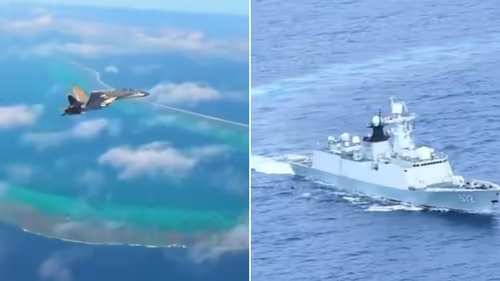
In a stark demonstration of its military might and unwavering stance on territorial claims, China has staged what it calls “combat readiness” patrols at the Scarborough Shoal. On Saturday, January 31, 2026, the People’s Liberation Army (PLA) Southern Theater Command confirmed that a joint naval and air operation was conducted around the disputed atoll, known as Huangyan Dao in China [[2]].
The patrol wasn’t just a routine sail-by. It involved a potent mix of Chinese warships, coast guard vessels, and crucially, bomber aircraft escorted by fighter jets. Reports indicate that H-6K bombers, capable of carrying anti-ship missiles, were part of this show of force [[6]]. This integrated sea-air deployment is a clear signal from Beijing, aimed at what it describes as “resolutely safeguarding China’s sovereignty and security, and upholding peace and stability in the South China Sea region” [[5]].
For anyone following the simmering tensions in the South China Sea, this latest action is a major escalation. It moves beyond the typical cat-and-mouse games played by coast guards and into the realm of overt military posturing.
History of the Scarborough Shoal Dispute
The roots of the current crisis run deep. The Scarborough Shoal dispute is a decades-long conflict between China and the Philippines over control of this strategically located atoll, which sits roughly 120 nautical miles off the Philippine coast but well within China’s expansive nine-dash line claim [[10]].
A major flashpoint occurred in 2012 during the Scarborough Shoal standoff. What began as an attempt by the Philippine Navy to apprehend Chinese fishermen escalated into a tense two-month-long maritime blockade, ultimately resulting in China gaining de facto control of the shoal [[11]]. This event was a pivotal moment, significantly altering the status quo in the region.
Adding another layer of complexity, an international tribunal at The Hague ruled in 2016 that China’s claims in the South China Sea, including those over Scarborough Shoal, had no legal basis under the United Nations Convention on the Law of the Sea (UNCLOS). China, however, has consistently rejected the ruling, calling it “null and void” [[13]].
What’s Different This Time?
While China has maintained a presence near the shoal for years, the January 2026 patrols are distinct in several key ways:
- Military Integration: Previous activities were largely confined to the China Coast Guard. This operation explicitly involved the PLA Navy and Air Force, blurring the line between law enforcement and military action.
- Explicit Terminology: The use of the term “combat readiness” is a deliberate and aggressive choice of language, signaling a state of high alert and preparedness for conflict, not just a routine patrol [[3]].
- Advanced Weaponry: The deployment of H-6K bombers armed with anti-ship missiles represents a significant qualitative leap in the threat posed to any Philippine or allied naval assets in the vicinity [[1]].
This shift suggests a more assertive strategy from Beijing, possibly in response to increased Philippine patrols and its strengthened security ties with the United States and other Western partners [[9]].
Regional and Global Implications
The South China Sea is not just a local squabble; it’s a critical global waterway through which an estimated $3.4 trillion of trade passes annually. China’s actions at the Scarborough Shoal have far-reaching consequences.
For the Philippines, this is a direct challenge to its sovereignty and its Exclusive Economic Zone (EEZ). It will likely accelerate Manila’s efforts to modernize its military and deepen its alliance with Washington. The US, while not a claimant, has a vested interest in freedom of navigation and has repeatedly stated its commitment to defending its allies under the Mutual Defense Treaty.
For ASEAN, the situation is a test of its unity and effectiveness. Member states like Vietnam, Malaysia, and Brunei also have overlapping claims with China in the South China Sea [[18]]. Beijing’s hardline tactics risk further fracturing the bloc, making a cohesive regional response difficult to achieve.
Globally, this escalation adds to the growing list of geopolitical flashpoints. It underscores the intense strategic competition between the US and China, with the South China Sea serving as a primary arena. The world is watching closely to see if this latest move leads to a dangerous miscalculation or if diplomatic channels can prevail.
Conclusion: Navigating a Tense Future
China’s “combat readiness” patrols at the Scarborough Shoal are a clear and calculated escalation in the South China Sea dispute. By integrating its navy and air force into a mission framed as a defense of its core interests, Beijing has raised the stakes dramatically. This move is not just about a remote atoll; it’s about asserting dominance in a vital region and testing the resolve of its neighbors and rivals. The path forward is fraught with risk, and the international community must remain vigilant to prevent a localized dispute from spiraling into a wider conflict. For more on the complex web of territorial claims in the region, see our analysis on [INTERNAL_LINK:south-china-sea-territorial-claims].
Sources
- Chinese military conducts combat readiness patrols around Huangyan Dao. (2026, January 31). Xinhua. Retrieved from https://english.news.cn/20260131/28e7831d9e5e49638355028ec427ef0f/c.html
- Beijing stages ‘combat readiness’ patrols at Scarborough Shoal in disputed South China Sea. (2026). Times of India. Retrieved from https://timesofindia.indiatimes.com/world/china/beijing-stages-combat-readiness-patrols-at-scarborough-shoal-in-disputed-south-china-sea/articleshow/127817382.cms
- H-6K bomber joins PLA sea-air combat readiness patrol in waters and airspace near China’s Huangyan Dao. (2026). Global Times. Retrieved from https://www.globaltimes.cn/page/202601/1354562.shtml
- Scarborough Shoal | Map, Geography, History, Disputes. Britannica. Retrieved from https://www.britannica.com/place/Scarborough-Shoal
- Scarborough Shoal standoff. Wikipedia. Retrieved from https://en.wikipedia.org/wiki/Scarborough_Shoal_standoff
- Why 2026 Could Be a Pivot in the South China Sea? (2026, January 5). Headsight by Anna. Retrieved from https://headsightbyanna.com/2026/01/05/why-2026-could-be-a-pivot-in-the-south-china-sea/