China’s AI Breakthrough: From Sanctions to Self-Reliance
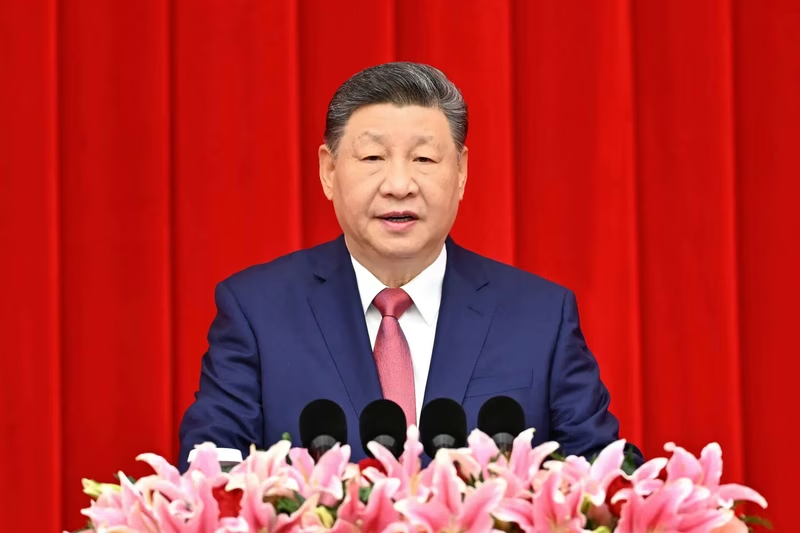
The opening hours of 2026 were not just about fireworks and celebrations in China; they were a declaration of technological war. In his annual New Year address, President Xi Jinping didn’t just offer well-wishes—he delivered a powerful message to Washington and Silicon Valley: China is no longer playing catch-up in the AI race. Framed as a story of resilience, Xi declared that American restrictions have become a “catalyst” for China’s tech independence, a narrative that’s rapidly becoming a reality .
Table of Contents
- Xi Jinping’s Tech Manifesto for 2026
- The Rise of DeepSeek AI: China’s New Open-Source Challenger
- China’s Domestic Chip Powerhouse: Huawei and SMIC Lead the Charge
- The Geopolitical Chess Game: Nvidia, Trump, and a Shifting Market
- Conclusion: A New Global AI Order?
- Sources
Xi Jinping’s Tech Manifesto for 2026
Xi’s speech was a masterclass in turning a perceived weakness into a national strength. He specifically highlighted China’s “significant advancements” in artificial intelligence and the semiconductor industry, directly responding to the years-long US-led campaign to stifle China’s technological ascent . The message was clear: embargoes on companies like Huawei have not crippled China; they have fueled an unprecedented wave of domestic R&D.
For global investors and tech leaders, this isn’t just political posturing. It’s a signal that China is doubling down on its “Made in China 2025” strategy with renewed vigor. Xi’s call to the private sector to “harness technology” is a direct invitation for capital to flow into the China AI ecosystem, which is now seen as a top national priority . This top-down support, combined with a massive domestic market, creates a fertile ground for innovation that’s hard to replicate elsewhere.
The Rise of DeepSeek AI: China’s New Open-Source Challenger
One of the most tangible results of this national push is the meteoric rise of DeepSeek AI. Founded in 2023 and backed by the powerful Chinese hedge fund High-Flyer, DeepSeek has quickly become a formidable player on the global stage . What makes DeepSeek particularly interesting is its open-source strategy. In early 2026, it launched a series of powerful AI models under an open-source license, a direct challenge to the proprietary models from OpenAI and its competitors .
This strategy serves two purposes for China:
- Global Influence: By offering high-quality, free models, DeepSeek is building a global developer community, subtly shaping the future of AI development outside the US sphere of influence.
- Rapid Monetization: While its core models are open, DeepSeek is exploring commercial applications, particularly in the financial sector where its parent company, High-Flyer, has deep expertise . This creates a fast track to real-world value, moving beyond just research benchmarks.
DeepSeek’s emergence is a perfect case study of the ecosystem Xi is championing: a private, agile startup leveraging national ambition to compete globally.
China’s Domestic Chip Powerhouse: Huawei and SMIC Lead the Charge
AI models are only as good as the hardware that runs them. And here, China has made perhaps its most stunning progress. The once-assumed insurmountable gap in advanced semiconductor manufacturing is rapidly closing. Huawei, the flagship of China’s tech defiance, is at the forefront.
In 2026, Huawei plans to double its production of its homegrown Ascend AI chips to around 600,000 units, with even more advanced models like the Ascend 950DT on the horizon . Analysts at firms like [INTERNAL_LINK:semiconductor-industry-analysis] now predict Huawei could command a staggering 50% of the Chinese AI chip market by the end of the year, a dramatic fall for US-based players .
Behind Huawei is its key manufacturing partner, SMIC (Semiconductor Manufacturing International Corporation). Recent reports confirm that SMIC has achieved “incremental but meaningful scaling” in its advanced chip production, allowing it to reliably produce the chips Huawei needs to power its AI ambitions . This vertical integration—designing and manufacturing its own AI silicon—gives China a level of strategic autonomy it never had before.
The Geopolitical Chess Game: Nvidia, Trump, and a Shifting Market
Xi’s message wasn’t just for a domestic audience; it was a direct shot across the bow at two key figures: Nvidia CEO Jensen Huang and former US President Donald Trump. The US’s on-again, off-again policy on chip exports, particularly under a potential second Trump administration, has created massive uncertainty.
Reports suggest a Trump administration might take a hardline stance, potentially blocking Nvidia’s most advanced Blackwell AI chips from China entirely . Yet, another report from late 2025 indicated a possible reversal, allowing sales of the H200 chip, driven by a belief that Huawei’s progress has already shifted the balance .
This policy whiplash is a gift to Chinese tech. It forces global companies like Nvidia to operate in a state of constant uncertainty while simultaneously giving Chinese firms a clear, singular mission: achieve self-sufficiency. For investors, the choice is becoming stark. Do they bet on the volatility of US foreign policy, or on the relentless, state-backed momentum of the China AI industry?
Conclusion: A New Global AI Order?
President Xi Jinping’s 2026 address was far more than a ceremonial speech. It was a confident announcement that China has not just weathered the storm of US sanctions but has used them to forge a new, independent path in the most critical technology of our time. With agile startups like DeepSeek pushing the software frontier and giants like Huawei and SMIC conquering the hardware challenge, the global AI landscape is being irrevocably redrawn. The era of undisputed US tech dominance is ending, and a new, fiercely competitive bipolar world is emerging. The question now isn’t if China can compete in AI, but how the world will adapt to its success.
Sources
- “President Xi touts China’s AI and tech advancements in New Year’s speech,” various sources.
- “Chinese PM Xi Jinping’s New Year address has a message for Nvidia and Donald Trump,” Times of India.
- “Full text: Chinese President Xi Jinping’s 2026 New Year Address,” official sources.
- [[9], [12], [13]] Information on DeepSeek AI from company profiles and news reports.
- [[18], [21], [24]] Reports on Huawei Ascend chip production and SMIC’s progress from industry analysts.
- [[27], [29]] Analysis of potential Trump administration policy on Nvidia chip exports.
- Semiconductor Industry Association (for general industry context).