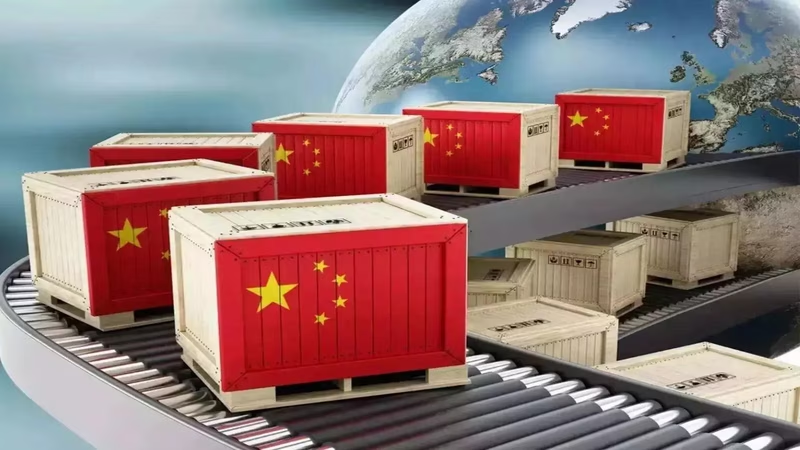
In a move that has sent shockwaves through global financial markets, China has officially logged a historic China trade surplus of nearly $1.2 trillion for 2025. This unprecedented figure isn’t just a number; it’s a powerful statement about the nation’s economic resilience and its complex, often contentious, relationship with the rest of the world. While exports to the United States have taken a hit due to ongoing trade friction, Beijing has aggressively pivoted to other global markets, more than compensating for the shortfall . As we look ahead to 2026, experts are locked in a fierce debate: is this colossal surplus a testament to China’s enduring manufacturing might, or a ticking time bomb that could destabilize the global economy?
Table of Contents
- Breaking Down the Record $1.2 Trillion Surplus
- How China Pivoted Away from the US Market
- China Trade Surplus: What It Means for 2026
- The Global Impact of China’s Economic Muscle
- Potential Risks and Vulnerabilities Ahead
- Conclusion: A New Era of Economic Power?
- Sources
Breaking Down the Record $1.2 Trillion Surplus
To put this figure into perspective, China’s 2025 trade surplus is larger than the entire GDP of most countries on Earth. It represents the difference between what China sold to the world (its exports) and what it bought from abroad (its imports). The key driver behind this record was an extraordinary surge in exports, particularly in high-tech sectors like electric vehicles (EVs), lithium-ion batteries, and solar panels—areas where China has established a dominant global supply chain .
This export-led growth model has been the engine of China’s economy for decades, but the scale achieved in 2025 is unprecedented. It demonstrates a remarkable ability to adapt and find new markets, even in the face of significant geopolitical headwinds.
How China Pivoted Away from the US Market
For years, the United States was China’s single largest export destination. However, the protracted trade war initiated under the previous US administration, coupled with new tariffs and restrictions on advanced technology, has significantly cooled that relationship. Shipments to the US have indeed declined.
Instead of retreating, China executed a masterful strategic pivot. It doubled down on its “Belt and Road Initiative” (BRI), flooding emerging markets in Southeast Asia, Africa, Latin America, and the Middle East with its goods. At the same time, it strengthened trade ties with its regional neighbors through the Regional Comprehensive Economic Partnership (RCEP), the world’s largest free trade bloc . This diversification strategy has proven incredibly effective, turning a potential weakness into a new source of strength.
China Trade Surplus: What It Means for 2026
Looking into 2026, most analysts agree that the China trade surplus will remain a dominant force, likely staying above the $1 trillion mark. Several factors support this outlook:
- Continued EV Dominance: Chinese EV makers like BYD are rapidly expanding their global footprint, undercutting Western competitors on price and innovation.
- Green Tech Exports: Demand for affordable solar panels and batteries from developing nations will keep China’s green tech exports soaring.
- Weaker Domestic Consumption: A relatively sluggish domestic consumer market in China means less demand for imports, which naturally inflates the surplus.
This sustained surplus will continue to be a primary driver of China’s GDP growth, providing the government with ample foreign exchange reserves to manage its economy and fund its ambitious global projects.
The Global Impact of China’s Economic Muscle
China’s massive trade surplus isn’t happening in a vacuum. It has profound implications for the rest of the world. On one hand, it provides consumers globally with access to cheaper goods, helping to keep inflation in check in many countries. On the other hand, it’s causing serious concern among industrialized nations.
European and American manufacturers are struggling to compete with the flood of subsidized Chinese products, leading to factory closures and job losses. This has fueled protectionist sentiments and calls for more tariffs and trade barriers. The International Monetary Fund (IMF) has repeatedly highlighted the risks of such large and persistent global imbalances, warning they can lead to financial instability and currency wars . For a deeper dive into global trade dynamics, see our analysis on [INTERNAL_LINK:global-trade-tensions-and-their-impact].
Potential Risks and Vulnerabilities Ahead
Despite its apparent strength, China’s reliance on a massive trade surplus carries significant risks. An economy so heavily dependent on external demand is vulnerable to global recessions or sudden shifts in trade policy. Furthermore, the very success of its export machine is provoking a powerful backlash.
The European Union has already launched anti-subsidy investigations into Chinese EVs, and the United States is expected to follow suit with even stricter measures after its 2026 elections. If these major markets erect new, formidable trade walls, China’s ability to maintain its current export trajectory could be severely hampered, potentially triggering a sharp economic slowdown.
Conclusion: A New Era of Economic Power?
China’s record-breaking China trade surplus is a clear declaration of its economic ambition and capability. It has successfully navigated a hostile trade environment with the US and emerged stronger by conquering new markets. For 2026, this trend is set to continue, solidifying China’s position as the world’s central manufacturing hub. However, this path is fraught with peril. The growing global resistance to its trade practices could be the biggest challenge yet. The question for the coming year is not just whether China can maintain its surplus, but whether the world will allow it to.