Table of Contents
- Why Greenland Suddenly Matters to World Powers
- Trump’s Greenland Comments: Strategic Alarm or Political Posturing?
- The China-Russia Threat in Greenland: How Real Is It?
- Greenland’s Geopolitical Value: Minerals, Melting Ice, and Missiles
- U.S. Military Footprint: Thule Air Base and Beyond
- Denmark’s Dilemma: Balancing Sovereignty and Security
- Conclusion: Navigating the New Arctic Cold War
- Sources
Why Greenland Suddenly Matters to World Powers
At first glance, Greenland—a sparsely populated island of ice, fjords, and fewer than 60,000 people—might seem an unlikely flashpoint for global tension. Yet, it sits at the epicenter of a new geopolitical scramble. As climate change melts Arctic ice, once-inaccessible shipping lanes and vast mineral reserves are opening up. And strategically, its location between North America and Europe makes it a critical node for defense and surveillance.
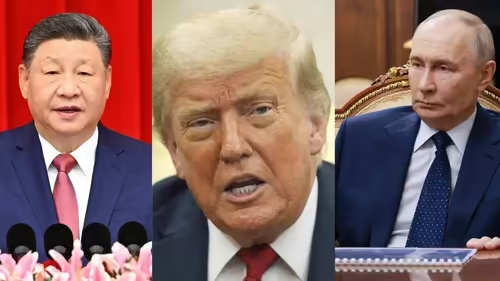
Enter former U.S. President Donald Trump. In recent remarks, he flagged a potential China-Russia threat in Greenland, warning that adversaries are eyeing the island with dangerous intent. His comments have reignited a debate that first flared in 2019 when he reportedly floated the idea of the U.S. buying Greenland—a proposal Denmark swiftly rejected.
Trump’s Greenland Comments: Strategic Alarm or Political Posturing?
Trump’s latest warning isn’t just nostalgia for his 2019 headline-grabbing proposal. It reflects a broader anxiety within U.S. defense circles about great-power competition extending into the Arctic. During a campaign rally, he stated: “If we don’t act, China and Russia will take over Greenland. They’re already there—building, watching, waiting.”
While critics dismiss this as hyperbole, experts note there’s substance beneath the rhetoric. Both China and Russia have increased their Arctic activities in recent years. China declared itself a “near-Arctic state” in 2018 and published an ambitious Arctic policy white paper. Russia, meanwhile, has reopened Soviet-era military bases and expanded its Northern Fleet.
Still, neither country has a physical presence in Greenland—which remains an autonomous territory of the Kingdom of Denmark. So is Trump sounding a necessary alarm—or using Greenland as a campaign talking point? The answer lies in understanding what’s truly at stake.
The China-Russia Threat in Greenland: How Real Is It?
Let’s be clear: there are no Chinese or Russian military bases in Greenland. However, the China-Russia threat in Greenland is more about influence, opportunity, and long-term strategy than boots on the ground.
China’s approach has been economic. In 2016, a Chinese company attempted to buy an abandoned Danish naval base near Nuuk—the capital—but was blocked by Copenhagen over national security concerns. Chinese firms have also shown interest in Greenland’s rare earth minerals, crucial for electronics and green tech. While these investments are legal, they raise red flags in Washington about dependency and leverage.
Russia’s role is more indirect but equally concerning to NATO. Its expanded Arctic military posture—especially along its northern coastline—enhances its ability to project power across the North Atlantic. From Greenland, Russian submarines and bombers could threaten transatlantic supply lines in a crisis.
So while there’s no imminent invasion, the strategic vulnerability is real. As one Pentagon official told The Wall Street Journal, “Greenland is the unsinkable aircraft carrier guarding the GIUK Gap”—the critical sea corridor between Greenland, Iceland, and the UK.
Greenland’s Geopolitical Value: Minerals, Melting Ice, and Missiles
Three factors make Greenland a prize in the 21st century:
- Strategic Location: Just 700 miles from Canada and perfectly positioned to monitor missile trajectories from Eurasia toward North America.
- Resource Wealth: Home to one of the world’s largest untapped deposits of rare earth elements—vital for smartphones, electric vehicles, and defense systems.
- Climate Change: As Arctic sea ice retreats, the Northwest Passage and Northern Sea Route could become viable commercial shipping lanes, cutting weeks off global trade routes.
This convergence of military, economic, and environmental shifts has turned Greenland into a silent battleground for influence.
U.S. Military Footprint: Thule Air Base and Beyond
The United States already has a major presence in Greenland through the Thule Air Base—its northernmost military installation. Operated under a 1951 defense agreement with Denmark, Thule hosts early-warning radar systems, satellite tracking facilities, and space surveillance assets critical to U.S. homeland defense.
In 2023, the U.S. and Denmark signed a $400 million deal to modernize Thule, underscoring its enduring importance. The base is not just a relic of the Cold War; it’s being upgraded for 21st-century threats, including hypersonic missile detection.
For more on U.S. Arctic strategy, see our deep dive on [INTERNAL_LINK:us-arctic-defense-policy].
Denmark’s Dilemma: Balancing Sovereignty and Security
Copenhagen walks a tightrope. On one hand, it fiercely guards Greenland’s autonomy and rejects foreign interference. On the other, it relies on the U.S. security umbrella and NATO solidarity. After Trump’s 2019 purchase comment, Danish leaders were furious—but they’ve since quietly deepened defense cooperation with Washington.
Greenland’s own government has also grown wary of foreign investment. In 2021, it revoked a mining license from a Chinese company over environmental and labor concerns—a move widely seen as aligning with Western security interests.
Conclusion: Navigating the New Arctic Cold War
Donald Trump’s warning about a China-Russia threat in Greenland may sound dramatic, but it’s rooted in a real and accelerating shift in global power dynamics. While there’s no immediate military occupation planned by Beijing or Moscow, their long-term strategies aim to reshape the Arctic order. For the U.S. and its allies, maintaining influence in Greenland isn’t about territorial ambition—it’s about preserving a rules-based international system in one of the planet’s last frontiers.
As ice melts and competition heats up, Greenland’s fate could well shape the security landscape of the entire North Atlantic for decades to come.
Sources
- Times of India: “Donald Trump flags China, Russia threat in Greenland — how real is the danger?”
- U.S. Department of Defense: Arctic Strategy Reports (2023)
- Government of Denmark: Statements on Greenland sovereignty and defense agreements
- The Wall Street Journal: “The U.S. Military’s Arctic Gambit” (2024)
- China’s Arctic Policy White Paper (2018), State Council of the People’s Republic of China
- NATO Review: “Why the Arctic Matters to Transatlantic Security”