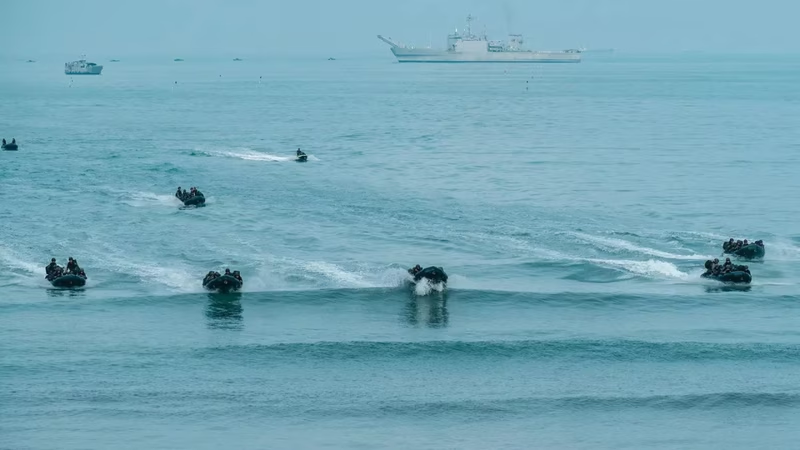
On the first weekend of 2026, the Taiwan Strait once again became a flashpoint in global geopolitics. According to Taiwan’s Ministry of National Defense, China conducted four sorties of military aircraft, deployed six naval vessels, and launched at least two surveillance balloons near Taiwan’s air defense identification zone (ADIZ). This marked one of the most concentrated shows of force in weeks—and a stark reminder of Beijing’s unwavering stance on what it calls a “core national interest.”
But beyond the numbers, what does this China military presence near Taiwan truly signal? Is this routine posturing—or a prelude to something more serious? In this deep-dive analysis, we unpack the strategic motives, historical context, and potential global fallout.
Table of Contents
- What Happened? China’s Latest Military Moves
- China Military Presence Near Taiwan: What It Means
- Why Now? Timing and Potential Triggers
- Taiwan’s Response and U.S. Backing
- Historical Pattern of Chinese Drills
- Regional and Global Implications
- Conclusion: A Calculated Message, Not (Yet) a Crisis
- Sources
What Happened? China’s Latest Military Movements
On January 2–3, 2026, the People’s Liberation Army (PLA) launched a multi-domain operation near Taiwan:
- Air: 4 sorties involving J-16 fighter jets and a Y-9 anti-submarine aircraft crossed the median line of the Taiwan Strait.
- Sea: 6 naval vessels, including a Type 054A frigate and a Type 075 amphibious assault ship, conducted “routine patrols” just outside Taiwan’s contiguous zone.
- Surveillance: Two high-altitude balloons and one intelligence-gathering ship operated in the Bashi Strait, between Taiwan and the Philippines.
Taiwan scrambled F-16s and deployed coastal radar systems in response. No direct confrontation occurred, but the psychological and strategic pressure was palpable.
China Military Presence Near Taiwan: What It Means
This activity isn’t random. Experts interpret it as a layered message from Beijing:
- Deterrence: To discourage Taiwan from declaring formal independence—a red line for China since 1949.
- Normalization of presence: By conducting near-daily incursions (over 1,700 in 2025 alone), China is trying to make its military presence around Taiwan seem routine.
- Testing defenses: Each sortie collects data on Taiwan’s radar response times, fighter interception protocols, and U.S. intelligence sharing.
As one retired U.S. Pacific Command officer noted, “China isn’t preparing for an invasion tomorrow—but it’s building the playbook for one.”
Why Now? Timing and Potential Triggers
Several factors likely prompted this escalation:
- U.S.-Taiwan engagement: Reports of a high-level U.S. congressional delegation planning a visit to Taipei in mid-January may have triggered Beijing’s response.
- Domestic politics: With China’s economy facing headwinds, hardline foreign policy distracts from internal challenges and reinforces Xi Jinping’s nationalist credentials.
- New Year signaling: China often uses early January to set the tone for its annual military posture—this display serves as a warning to Washington and Taipei alike.
Taiwan’s Response and U.S. Backing
Taiwan’s President Lai Ching-te (inaugurated in May 2024) reiterated his policy of “peace through strength,” calling for increased defense spending and asymmetric warfare capabilities like drones and coastal missiles.
Meanwhile, the United States—while not confirming direct involvement in this incident—reaffirmed its “rock-solid” commitment to Taiwan under the Taiwan Relations Act. A U.S. Navy P-8 Poseidon surveillance aircraft was spotted operating in the region the same day, likely monitoring Chinese movements.
The U.S. State Department urged China to “refrain from destabilizing actions” but stopped short of calling the drills aggressive—highlighting the delicate diplomatic balancing act.
Historical Pattern of Chinese Drills
China’s gray-zone tactics around Taiwan have escalated steadily since 2020:
- 2022: Large-scale drills after Nancy Pelosi’s visit.
- 2023–2024: Daily air incursions become normalized.
- 2025: First use of drones and electronic warfare ships near Kinmen.
What’s new in 2026 is the integration of air, sea, and surveillance assets into a single coordinated demonstration—mimicking joint operations doctrine used in actual conflict scenarios.
Regional and Global Implications
This isn’t just a China-Taiwan issue. The ripple effects are global:
- Japan & Philippines: Both nations are increasing defense budgets and deepening security ties with the U.S. in response.
- Global supply chains: Over 50% of the world’s semiconductor production occurs in Taiwan. Any conflict would cripple tech, auto, and defense industries worldwide.
- U.S.-China relations: Escalations around Taiwan remain the single biggest risk of direct military confrontation between the two superpowers.
For deeper regional context, see the International Crisis Group’s East Asia reports.
Conclusion: A Calculated Message, Not (Yet) a Crisis
The recent China military presence near Taiwan is best understood as coercive diplomacy—not an imminent prelude to war. Beijing is signaling resolve, testing responses, and chipping away at Taiwan’s sense of security.
Yet, the danger lies in miscalculation. With both sides on high alert, a single miscommunication could spiral. For now, the world watches—and waits. To understand how such tensions affect global markets, explore our analysis on [INTERNAL_LINK:geopolitical-risk-and-global-markets].
Sources
- The Times of India: “4 sorties of aircraft, 6 naval vessels: China increases military presence around Taiwan—what it means”
- International Crisis Group – East Asia Program
- Taiwan Ministry of National Defense – Daily Air Activity Reports (January 2026)
- U.S. Department of State – Press Briefing Transcript, January 3, 2026
- Reuters & Associated Press field reporting from Taipei and Beijing