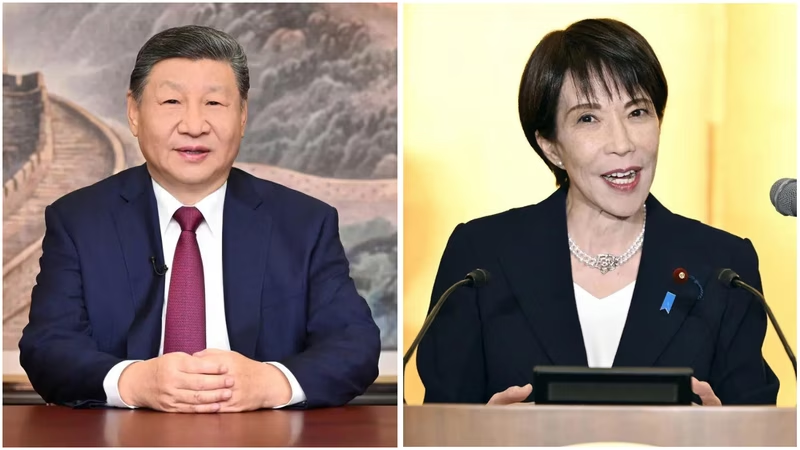
The fragile calm between Asia’s two economic giants has just cracked. In a dramatic geopolitical maneuver, China has imposed a sweeping ban on the export of dual-use goods to Japan—items that can serve both civilian and military purposes. The Chinese Ministry of Commerce announced the restriction on January 6, 2026, explicitly citing “national security concerns” and referencing recent Japanese statements perceived as threatening China’s sovereignty over Taiwan .
This isn’t just a trade policy shift—it’s a calculated act of economic statecraft. By targeting technologies that could indirectly bolster Japan’s defense capabilities, Beijing is sending a clear message: any discussion of military intervention in the Taiwan Strait will carry tangible costs. With global supply chains still reeling from U.S.-China tech wars, this new China Japan dual-use ban could ripple far beyond East Asia.
Table of Contents
- What Are Dual-Use Goods?
- Why the China Japan Dual-Use Ban Was Imposed
- What Items Are Affected?
- Japan’s Stance on Taiwan and the Diplomatic Backlash
- Economic and Technological Implications
- Broader Geopolitical Ramifications
- Conclusion: A New Front in Techno-Nationalism
- Sources
What Are Dual-Use Goods?
Dual-use goods are products, software, or technologies that have legitimate civilian applications but can also be repurposed for military or weapons development. Common examples include:
- High-performance semiconductors and computing chips
- Advanced carbon fiber and rare earth alloys
- Specialized machine tools for precision engineering
- Certain chemical compounds and optical sensors
Nations tightly regulate these exports through frameworks like the Wassenaar Arrangement—a global export control regime designed to prevent the proliferation of weapons technologies . China’s new ban essentially weaponizes its own export control system against Japan.
Why the China Japan Dual-Use Ban Was Imposed
The immediate trigger was a series of public remarks by senior Japanese officials in late December 2025. In response to heightened Chinese military drills near Taiwan, a Japanese defense spokesperson stated that “any unilateral attempt to change the status quo in the Taiwan Strait would be a serious concern for Japan’s national security”—language Beijing interpreted as signaling potential military support for Taiwan .
China views Taiwan as an inseparable part of its territory and considers any foreign involvement in cross-strait affairs as interference in internal matters. The export ban is thus framed not as economic coercion but as a “necessary measure to safeguard national sovereignty and security,” according to China’s official statement . Violations of the ban, Beijing warned, will face “severe legal consequences.”
What Items Are Affected?
While China has not published an exhaustive list, analysts believe the ban likely targets key inputs Japan relies on for its advanced manufacturing and defense sectors:
- Rare earth elements: China controls over 60% of global rare earth processing—critical for electronics, radar systems, and missile guidance.
- High-purity gallium and germanium: Essential for 5G infrastructure and satellite technology; China restricted these globally in 2023 .
- Precision machine components: Used in Japan’s robotics and aerospace industries, which supply defense contractors.
Japanese firms like Mitsubishi Electric, Fujitsu, and Sony could face supply chain disruptions if they cannot source alternatives quickly.
Japan’s Stance on Taiwan and the Diplomatic Backlash
Japan has long adhered to a “One China” policy but has grown increasingly vocal about Taiwan’s strategic importance. Located just 110 km from Japan’s Yonaguni Island, Taiwan’s security is seen as directly linked to Japan’s own defense perimeter.
Prime Minister Fumio Kishida’s government has repeatedly warned that a Taiwan contingency would “jeopardize Japan’s survival.” Tokyo has also deepened security ties with the U.S., Australia, and the Philippines—moves that Beijing views as part of a containment strategy .
In response to the export ban, Japan’s Foreign Ministry called the move “regrettable and unjustified,” urging China to resolve differences through dialogue rather than economic pressure.
Economic and Technological Implications
The ban could accelerate Japan’s efforts to reduce dependency on Chinese tech inputs—a process already underway under the “China+1” supply chain diversification strategy. The Japanese government has allocated billions of yen to onshore critical mineral processing and semiconductor production .
However, short-term pain is likely. Small and mid-sized Japanese manufacturers—many embedded in global tech supply chains—may struggle to find cost-competitive alternatives. The disruption could also affect industries far beyond defense, including automotive and consumer electronics.
Broader Geopolitical Ramifications
This move signals a dangerous normalization of economic coercion in great-power competition. As [INTERNAL_LINK:global-trade-wars-tech-nationalism] shows, the line between trade and national security is blurring.
For the U.S., the ban underscores the urgency of strengthening the “Chip 4 Alliance” (U.S., Japan, South Korea, Taiwan) to counter China’s dominance in strategic materials. Meanwhile, ASEAN nations may feel pressured to choose sides, undermining regional neutrality.
Critically, the ban elevates Taiwan from a bilateral China-U.S. issue to a multilateral flashpoint—where even rhetorical support can trigger economic retaliation.
Conclusion: A New Front in Techno-Nationalism
The China Japan dual-use ban is more than a tit-for-tat response—it’s a harbinger of a fragmented global tech order. As nations increasingly treat advanced materials and components as strategic weapons, the era of frictionless globalization is fading. For businesses and policymakers alike, the lesson is clear: in the new age of techno-nationalism, supply chains are battle lines, and every export license carries a geopolitical price tag.
Sources
- Times of India. “China–Japan row: Beijing bans exports of dual-use goods to Japan amid Taiwan-related tensions.” https://timesofindia.indiatimes.com/business/international-business/chinajapan-row-beijing-bans-exports-of-dual-use-goods-to-japan-amid-taiwan-related-tensions-cites-national-security-concerns/articleshow/126373312.cms
- Wassenaar Arrangement Secretariat. “What Are Dual-Use Goods?” https://www.wassenaar.org
- U.S. Geological Survey. “Mineral Commodity Summaries: Gallium and Germanium.” https://www.usgs.gov/centers/national-minerals-information-center
- Ministry of Foreign Affairs of Japan. “Statement on Cross-Strait Relations (2025).”
- Nikkei Asia. “Japan allocates $2.2 billion to cut rare earth reliance on China.”