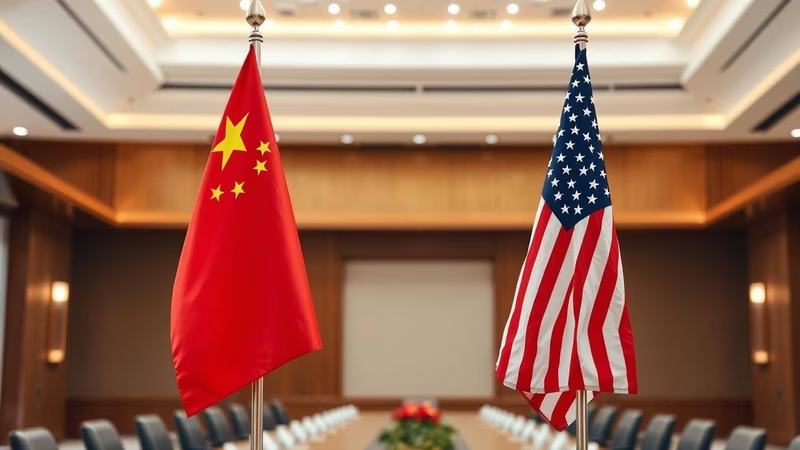
Beijing just drew a hard line in the digital sand. In a sweeping directive that underscores the intensifying tech cold war between East and West, China has formally banned several leading U.S. and Israeli cybersecurity firms from operating within its borders. Companies like VMware, Palo Alto Networks, and Fortinet are now off-limits to Chinese government agencies and state-linked enterprises—all in the name of national security .
This isn’t just bureaucratic caution; it’s a strategic pivot. Chinese authorities claim these foreign tools could secretly transmit sensitive data overseas—a risk they’re no longer willing to tolerate. The move aligns with Beijing’s broader “China cybersecurity ban” strategy: systematically replacing Western tech with homegrown alternatives to achieve digital sovereignty amid escalating U.S.-China tensions .
Table of Contents
- What the China Cybersecurity Ban Actually Means
- Why China Targeted VMware, Palo Alto, and Fortinet
- The Broader Push for Domestic Tech Independence
- Global Implications of China’s Cybersecurity Crackdown
- How Companies Can Navigate This New Reality
- Conclusion: A New Era of Digital Borders
- Sources
What the China Cybersecurity Ban Actually Means
The ban, reportedly issued through internal government memos, instructs all state-owned enterprises (SOEs), public institutions, and critical infrastructure operators to immediately stop using software from the named foreign vendors . While not yet a nationwide legal prohibition, the directive effectively blacklists these firms from China’s most lucrative and influential sectors.
The official justification? Fear that these platforms—despite their global reputation for enterprise-grade security—could contain hidden backdoors or data collection mechanisms that compromise China’s sovereign data. As one unnamed Chinese official told Reuters, “Any system that can access core networks must be under full domestic control” .
Why China Targeted VMware, Palo Alto, and Fortinet
These aren’t random picks. Each company plays a pivotal role in enterprise IT infrastructure:
- VMware: Dominates virtualization and cloud infrastructure—critical for data centers handling government and financial data.
- Palo Alto Networks: A leader in next-gen firewalls and threat detection, often deployed at network perimeters of large organizations.
- Fortinet: Known for integrated security fabric solutions used across telecoms, energy, and transport sectors.
By banning them, China isn’t just removing software—it’s severing dependencies on Western-controlled digital plumbing. The timing is also telling: this follows years of U.S. restrictions on Chinese tech giants like Huawei and ZTE, suggesting a tit-for-tat escalation in the tech war .
The Broader Push for Domestic Tech Independence
This ban is just one piece of China’s grand “Secure and Controllable” initiative—a national strategy to achieve 100% self-reliance in core technologies by 2030 . Already, Chinese firms like Huawei, Qihoo 360, and Sangfor Technologies are being fast-tracked as approved alternatives.
For example, Huawei’s FusionSphere is being positioned as a VMware replacement, while Sangfor’s NGAF firewall directly competes with Palo Alto’s offerings. State subsidies, preferential procurement policies, and regulatory pressure are accelerating this shift—making it nearly impossible for foreign vendors to compete fairly .
Global Implications of China’s Cybersecurity Crackdown
The ripple effects will be felt worldwide:
- Fragmented Internet: We’re moving toward a “splinternet”—where China, the U.S., and allies operate on separate tech stacks with incompatible standards.
- Supply Chain Reconfiguration: Multinationals with operations in China may need dual IT systems: one compliant with Chinese regulations, another for global use.
- Investor Uncertainty: Shares of affected U.S. firms could face long-term pressure as China—a $200B+ enterprise software market—slams its doors shut .
Ironically, this mirrors U.S. actions under the Clean Network program, which barred Chinese apps like TikTok and WeChat over similar data-security concerns. The world is witnessing a dangerous symmetry of digital nationalism.
How Companies Can Navigate This New Reality
For global enterprises, adaptation is non-negotiable:
- Audit Your Stack: Identify any reliance on banned vendors in Chinese operations.
- Partner Locally: Collaborate with approved Chinese tech providers—even if it means compromising on feature parity.
- Data Localization: Ensure all China-generated data never leaves the country, satisfying regulators’ core demand.
- Monitor Policy Shifts: Expect more bans—AI, semiconductors, and cloud services are likely next [[INTERNAL_LINK:china-tech-regulations-2026]].
Conclusion: A New Era of Digital Borders
China’s cybersecurity ban isn’t merely about protecting data—it’s a declaration of technological sovereignty. By expelling U.S. and Israeli cybersecurity giants, Beijing is forcing a bifurcation of the global tech ecosystem. For businesses, the message is clear: in the age of digital great-power rivalry, neutrality is an illusion. You must choose your stack—and your side.
Sources
- Times of India: China bars US, Israeli cybersecurity software over security risks
- Reuters: China orders state firms to drop U.S. cybersecurity tools
- U.S. Department of Commerce – Bureau of Industry and Security: Export controls and entity lists
- China’s “Secure and Controllable” IT Procurement Guidelines (2023 Revision)