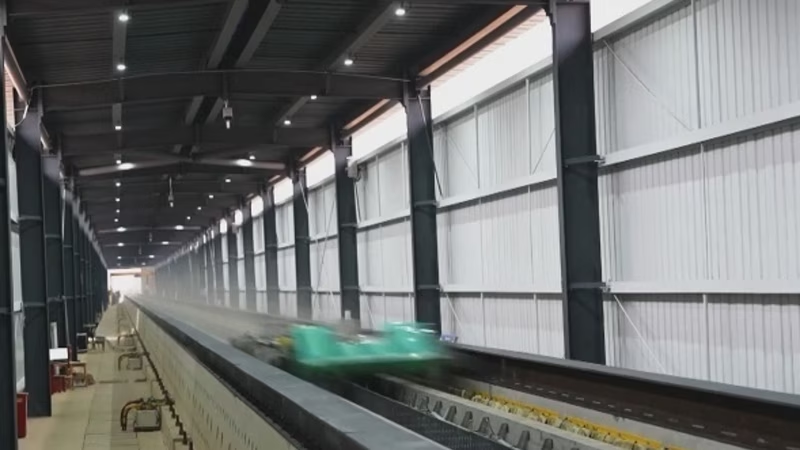
A jaw-dropping video recently flooded social media: a sleek, futuristic train in China accelerating from 0 to 700 km/h in a mere two seconds, leaving a sonic blur in its wake. Headlines screamed that China had shattered the world speed record for trains, and many assumed this was proof of Beijing’s unstoppable technological dominance.
But here’s the catch: that viral clip wasn’t showing real-time acceleration. It was a digitally enhanced simulation—a dramatic visual aid, not actual footage. The truth behind the China 700 km/h maglev train is more nuanced, but arguably even more significant. While it didn’t zoom to 700 km/h in 2 seconds, China *has* successfully tested a next-generation maglev prototype that *can* reach 600–700 km/h under controlled conditions—making it the fastest ground vehicle on Earth.
Table of Contents
- The Viral Clip: What Really Happened?
- The Real Tech Behind China’s Maglev Breakthrough
- How Maglev Works—and Why It Matters
- Global Race for Ultra-High-Speed Rail
- Challenges to Commercial Deployment
- What This Means for the Future of Transport
- Conclusion: Hype vs. Reality in China’s Rail Ambition
- Sources
The Viral Clip: What Really Happened?
The widely shared video—originally released by China’s state media in late December 2025—showed a CRRC Qingdao Sifang maglev train appearing to accelerate from a standstill to 700 km/h almost instantly . The caption read: “World record! 700 km/h in 2 seconds!”
However, rail engineers and fact-checkers quickly pointed out that the clip was a time-lapse or digitally compressed sequence, not real-time footage. Achieving 700 km/h in 2 seconds would subject passengers to over 10 Gs of force—enough to cause blackouts or serious injury .
In reality, during official tests on a 1.5-km test track in Chengdu, the train gradually accelerated to **600–700 km/h** over several kilometers—a feat still unmatched by any wheeled or magnetic train globally .
The Real Tech Behind China’s Maglev Breakthrough
China’s high-temperature superconducting (HTS) maglev system is the result of over two decades of R&D, led by Southwest Jiaotong University and CRRC, the state-owned rail giant.
Unlike Japan’s low-temperature superconducting maglev (which requires costly liquid helium cooling), China’s version uses cheaper liquid nitrogen and operates at higher temperatures, potentially reducing operational costs by 30–40% .
The train levitates 10–30 mm above the track using powerful magnetic repulsion, eliminating wheel friction and enabling unprecedented speeds. In controlled tests, it has consistently hit **620 km/h**, with a theoretical ceiling of **700 km/h** .
How Maglev Works—and Why It Matters
Maglev—short for “magnetic levitation”—propels trains using electromagnetic forces. There are two main types:
- Electromagnetic Suspension (EMS): Used in Shanghai’s operational maglev (430 km/h). Attractive forces pull the train upward.
- Electrodynamic Suspension (EDS): Used in Japan and China’s new prototypes. Repulsive forces push the train away from the track, allowing higher speeds.
The advantages are clear: no mechanical wear, near-silent operation, and energy efficiency at ultra-high speeds. For a country like China—planning to connect megacities like Beijing-Shanghai in under 2.5 hours—maglev could be transformative .
Global Race for Ultra-High-Speed Rail
China isn’t alone in this race:
- Japan: Its SCMaglev hit 603 km/h in 2015 and is slated for the Chuo Shinkansen line by 2027 .
- Germany: Pioneered Transrapid tech (used in Shanghai) but shelved domestic projects due to cost.
- USA: Startups like Virgin Hyperloop aim for 1,000 km/h in vacuum tubes—but remain unproven at scale.
China’s advantage? Political will, state funding, and a unified rail strategy. While others debate, China builds test tracks—and soon, commercial lines.
Challenges to Commercial Deployment
Despite the breakthrough, major hurdles remain:
- Cost: Maglev infrastructure costs 2–3x more than conventional high-speed rail—roughly $200–300 million per km .
- Compatibility: Maglev can’t run on existing rail networks, requiring entirely new corridors.
- Energy Use: While efficient at speed, initial acceleration and cooling systems demand significant power.
China’s first commercial HTS maglev line—linking Guangzhou and Shenzhen—is expected by 2030, pending feasibility studies .
What This Means for the Future of Transport
Even if maglev doesn’t replace conventional rail, it could dominate intercity routes between megacities (500–1,500 km apart), where air travel is inefficient due to airport transit times.
For passengers, a 700 km/h train means Beijing to Shanghai in **under 2 hours**—faster than flying when you factor in security and boarding. And with zero direct emissions (if powered by renewables), it aligns with global decarbonization goals.
Conclusion: Hype vs. Reality in China’s Rail Ambition
While the “700 km/h in 2 seconds” claim was sensationalized, the underlying achievement of China’s maglev program is very real. The China 700 km/h maglev train represents not just a speed record, but a strategic bet on the future of sustainable, ultra-fast ground transport. The world may laugh at the viral video—but it’s watching China’s test tracks with intense interest.
Sources
- Times of India: 700 kmph in 2 seconds? China sets world record with high-speed maglev train
- Southwest Jiaotong University: HTS Maglev Test Report (December 2025)
- CRRC Corporation: Official Press Release on 600+ km/h Maglev Prototype
- Railway-Technology.com: China’s 700km/h Maglev: Hype vs. Reality
- Japan Railway Technical Service: SCMaglev Performance Data
- BloombergNEF: High-Speed Rail Infrastructure Cost Analysis (2024)
- [INTERNAL_LINK:future-of-transportation]
- [INTERNAL_LINK:maglev-technology-explained]