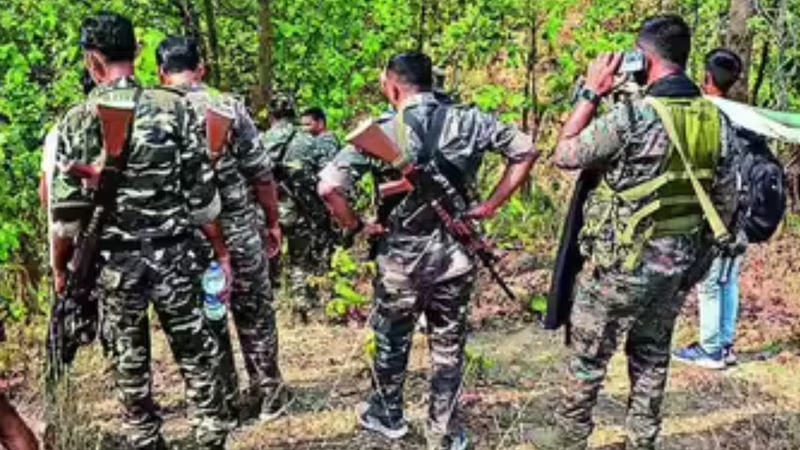
In the dense, forested heart of India’s Bastar region, the relentless cat-and-mouse game between the state and its most persistent internal security threat reached a critical juncture on a cold Saturday morning in January 2026. A massive Chhattisgarh Maoist encounter has sent shockwaves through the insurgency’s ranks, with security forces neutralizing 14 Maoists across the troubled districts of Sukma and Bijapur. This isn’t just another statistic; it’s a calculated strike that may have decapitated a key cell responsible for one of the most audacious attacks on law enforcement in recent memory.
Table of Contents
- The Twin Encounters: Sukma and Bijapur
- Revenge Served Cold: The Killing of ASP Akash Rao Girepunje
- A Treasure Trove of War: Weapons Recovered
- Why This Operation is a Strategic Masterstroke
- Conclusion: A Turning Point in Bastar?
- Sources
The Twin Encounters: Sukma and Bijapur
The anti-insurgency operation, launched in the early hours of Saturday, January 3rd, 2026, was the result of weeks of meticulous intelligence gathering. Acting on a specific tip-off, security forces moved into position, surrounding suspected Maoist hideouts in the forests of Sukma and the National Park region of Bijapur . The subsequent gun battles were swift and decisive. Reports confirm that 12 Maoists were killed in the Sukma district encounter, while a separate team neutralized another 2 in Bijapur . The recovery of bodies from these remote and hostile terrains is a testament to the operation’s success and the forces’ resolve .
Revenge Served Cold: The Killing of ASP Akash Rao Girepunje
What elevates this Chhattisgarh Maoist encounter from a routine counter-insurgency success to a major strategic victory is the identity of the targets. Police sources have strongly indicated that among the 14 dead were senior Maoist commanders who were allegedly the masterminds behind the devastating IED blast that claimed the life of Konta Additional Superintendent of Police (ASP) Akash Rao Girepunje in June 2025 [[19], [20]]. The killing of ASP Girepunje was a significant blow to the morale of the security establishment, and the neutralization of his alleged killers marks a powerful message of accountability and a relentless pursuit of justice. This operation appears to be a direct and forceful response to that heinous act.
A Treasure Trove of War: Weapons Recovered
The success of the operation wasn’t measured just in lives taken, but in the war-making capabilities stripped from the insurgents. The search of the encounter sites yielded a significant cache of weapons and ammunition, a haul that would have fueled future attacks. The recovered arsenal includes:
- Modern assault rifles like the AK-47 and INSAS [[5], [24]]
- SLR (Self-Loading Rifle) rounds
- Country-made weapons and a large quantity of live ammunition, estimated in the hundreds of cartridges [[22], [26]]
This seizure of their primary tools of violence is a crippling setback for the local Maoist units, disrupting their supply chain and operational planning.
Why This Operation is a Strategic Masterstroke
This isn’t an isolated event. It’s part of a broader, more effective strategy that has been steadily dismantling the Maoist network in Chhattisgarh. In 2024 alone, security forces neutralized 57 top Maoist leaders in 121 separate encounters across the Bastar region . The trend is clear: the state is moving from a defensive posture to an offensive, intelligence-led campaign that targets the leadership and logistical backbone of the insurgency. By focusing on high-value targets, like those allegedly linked to the ASP’s killing, the forces are not just reducing numbers but decapitating the command structure that plans and executes complex operations. This latest success in Sukma and Bijapur is a powerful continuation of that strategy, sending a clear signal that even the most remote sanctuaries are no longer safe.
Conclusion: A Turning Point in Bastar?
While the fight against the Maoist insurgency is far from over, the massive Chhattisgarh Maoist encounter of January 2026 stands as a pivotal moment. By eliminating a significant number of fighters, recovering a major weapons cache, and, most importantly, neutralizing key commanders linked to a high-profile assassination, the security forces have delivered a multi-pronged blow to the movement’s operational capacity in its most critical stronghold. This operation demonstrates a mature and effective counter-insurgency model that prioritizes intelligence, precision, and strategic targeting over mere attrition. For the people of Bastar, long caught in the crossfire, this could be a beacon of hope for a more secure future. [INTERNAL_LINK:history-of-maoist-insurgency-in-india]
Sources
- Times of India: Chhattisgarh encounter: Over 10 Maoists killed in Sukma, 2 in Bijapur
- The Hindu: 14 Maoists killed in two encounters in Chhattisgarh’s Bastar region
- Press Trust of India (PTI) via various news outlets.