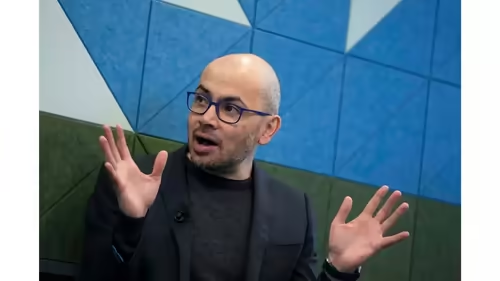
The AI world is buzzing with a new controversy that cuts to the heart of its most ambitious goal: Artificial General Intelligence (AGI). At the center of it all is a pointed critique from Google AI CEO Demis Hassabis, who has called out what he sees as the “big irony” in OpenAI’s recent decision to introduce ChatGPT ads. This isn’t just a business dispute; it’s a fundamental clash of philosophies about what AGI truly means and how close we really are to achieving it.
Table of Contents
- The ChatGPT Ads Announcement and the Backlash
- Demis Hassabis and the “Big Irony”
- Defining AGI: A Battle of Definitions
- The Commercial Pressures on OpenAI
- What This Means for the Future of AI
- Conclusion
- Sources
The ChatGPT Ads Announcement and the Backlash
On January 16, 2026, OpenAI dropped a bombshell: it would begin testing ChatGPT ads in the coming weeks . The announcement marked a significant shift in the company’s business model, aiming to create a new revenue stream as the costs of developing and running massive AI models continue to mount .
This move was met with immediate skepticism and user backlash. Why? Because just a year prior, at a 2024 event at Harvard University, CEO Sam Altman had openly criticized the very idea of ads inside ChatGPT, calling it a “last resort” [[4], [7]]. Users felt betrayed, sharing screenshots of promotional messages appearing under unrelated queries, leading to a swift and negative public reaction .
Demis Hassabis and the “Big Irony”
It was against this backdrop of controversy that Google AI CEO Demis Hassabis made his now-famous remarks. He expressed surprise at OpenAI’s early introduction of ads, suggesting it could damage user trust in the AI’s objectivity . But his most potent criticism was more philosophical.
Hassabis pointed to the “big irony” in OpenAI’s strategy: on one hand, Sam Altman and his team have been making increasingly bold claims about being on the cusp of achieving AGI—a technology that would represent a monumental leap in human capability. On the other hand, they are resorting to a traditional, and some would say primitive, monetization tactic like advertising [[1], [3]].
To Hassabis, these two positions are fundamentally at odds. If you truly believe you are about to unlock the holy grail of AI, why would you need to rely on such a basic revenue model so soon?
Defining AGI: A Battle of Definitions
The core of this conflict lies in the definition of AGI itself. For Hassabis, a Nobel laureate and a scientist at his core, AGI is not a marketing term. It represents a system with human-level or even superhuman capabilities in creativity, reasoning, and the ability to make genuine scientific breakthroughs .
He has consistently maintained a cautious but optimistic timeline, suggesting that true AGI is still 5 to 10 years away, requiring one or two major technological breakthroughs before it becomes a reality [[17], [22]]. His view is that AGI should be a profound scientific milestone, not a product feature to be monetized.
In contrast, the perception is that OpenAI may be using the term AGI more loosely—as a powerful narrative to attract investment, talent, and public attention. By introducing ChatGPT ads while simultaneously talking about AGI, Hassabis implies that OpenAI is prioritizing commercial gain over the rigorous scientific pursuit of the technology’s ultimate potential.
The Commercial Pressures on OpenAI
It’s important to understand the immense pressure OpenAI is under. As a for-profit company backed by massive investments, it faces the constant challenge of justifying its valuation and finding a sustainable path to profitability. The cost of training and running models like GPT-5 is astronomical.
Sam Altman himself has acknowledged this, stating, “People want to use a lot of AI and don’t want to pay,” which explains the controversial new feature . From this perspective, ads might seem like a necessary evil—a pragmatic step to keep the lights on while the long-term vision is pursued.
However, Hassabis’s critique suggests that this pragmatism comes at a cost: the dilution of the AGI mission. Once an AI assistant is funded by advertisers, its primary incentive can subtly shift from providing the best answer to providing the most commercially advantageous one, even if OpenAI claims user conversations won’t be shared with advertisers .
What This Means for the Future of AI
This public disagreement between two of the world’s leading AI figures is more than just corporate rivalry. It highlights a critical crossroads for the entire industry:
- The Scientist vs. The Entrepreneur: Will the future of AI be driven by pure scientific discovery, or by market forces and the need for rapid monetization?
- Trust and Transparency: How will users trust AI systems that are funded by advertising? Can a clear wall be maintained between the AI’s reasoning and its commercial interests?
- The AGI Timeline: Is the race to AGI being accelerated by competition, or is it being distorted by hype and financial pressure?
For consumers and developers, this debate is crucial. It will shape the kind of AI tools we interact with every day. Will they be impartial, truth-seeking agents, or will they be sophisticated salespeople in disguise? The answer may well depend on who wins this philosophical battle between Mountain View and San Francisco.
Conclusion
Demis Hassabis’s critique of ChatGPT ads is a stark reminder that the path to AGI is not just a technical challenge but an ethical and philosophical one. The “big irony” he points out—that a company claiming to be on the verge of a world-changing breakthrough is simultaneously turning to conventional advertising—forces us to question the motivations and definitions driving the AI gold rush. As the competition between Google DeepMind and OpenAI intensifies, the choices they make about monetization will reveal their true priorities and, ultimately, shape the future of artificial intelligence for all of us. For more on the evolving landscape of AI ethics, see our deep dive on [INTERNAL_LINK:ai-ethics-in-the-modern-era].
Sources
- Google DeepMind CEO Demis Hassabis calls ChatGPT ads ‘premature…
- Google AI CEO Demis Hassabis has questioned Sam Altman’s claims…
- During a 2024 event at Harvard University, Sam Altman openly criticized…
- Google DeepMind CEO Demis Hassabis expressed surprise at OpenAI’s early introduction…
- Several experts recall CEO Sam Altman calling ChatGPT Advertising a “last resort”…
- OpenAI Brings Ads To ChatGPT As Costs Mount…
- OpenAI announced Friday that it will begin testing ads on ChatGPT…
- Google DeepMind CEO Demis Hassabis has indeed stated that artificial general intelligence…
- Hassabis clarifies his definition of AGI, contrasting it with superintelligence…
- Only 5 years left? Nobel laureate Hassabis reveals the AGI timeline…