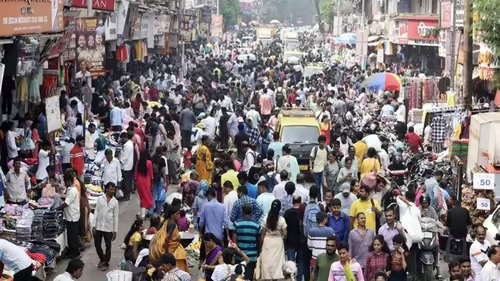
Get ready, India. The most significant data-driven event of the decade is officially on the calendar. The Ministry of Home Affairs (MHA) has just dropped the final blueprint for Census 2027, and it’s far more than just a headcount. With a detailed list of 33 questions and the historic decision to collect caste-based data for the first time in nearly a century, this census is poised to be a game-changer for governance, social justice, and national planning .
But what exactly does this mean for you, your community, and the future of the country? Let’s break down the official schedule, the controversial questions, and the massive implications of this monumental exercise.
Table of Contents
- The Official Census 2027 Schedule and Phases
- Why the Caste Census is a Historic Turning Point
- A Deep Dive into the 33 Census Questions
- The Political and Social Storm Around Caste Data
- What to Expect Next: Preparing for the Count
- Conclusion: The Future Shaped by Census 2027
- Sources
The Official Census 2027 Schedule and Phases
The MHA has confirmed that the Census 2027 will be a two-phase operation, marking India’s first fully digital census . This structured approach ensures a comprehensive data collection framework.
Phase 1: Houselisting and Housing Census (April – September 2026)
This initial, six-month phase is all about the physical and economic landscape of every household. From April 1 to September 30, 2026, enumerators will visit homes to collect information on:
- Building materials (walls, roof, floor)
- Access to basic amenities like drinking water, sanitation, and electricity
- Ownership status of the dwelling
- Availability of assets like computers and internet access
This phase essentially creates the master list—the frame—for the population count that follows .
Phase 2: Population Enumeration (February 2027)
The main event happens in February 2027. Over a few weeks, the focus shifts from the house to its inhabitants. Enumerators will collect detailed demographic data on every individual present in the household on the reference night, covering age, sex, religion, education, occupation, and crucially, caste .
Why the Caste Census is a Historic Turning Point
The most explosive element of the Census 2027 announcement is the return of the caste census. The last time such a nationwide exercise was conducted was way back in 1931 under British colonial rule . That census recorded a staggering 4,147 distinct castes, providing a complex social map of pre-independence India .
For over 90 years, successive Indian governments have avoided a full caste count, relying instead on surveys like the Socio-Economic and Caste Census (SECC) of 2011, whose caste data remains largely unpublished. The 2027 census breaks this long silence, promising an official, comprehensive dataset on the country’s caste composition. This data is expected to be pivotal for evidence-based policymaking on reservations, welfare schemes, and social equity .
A Deep Dive into the 33 Census Questions
The MHA has released the questionnaire for the first phase, which contains 33 specific questions designed to paint a holistic picture of India’s living conditions . These questions go far beyond simple demographics and delve into the quality of life and access to modern infrastructure.
Key areas covered include:
- Housing Structure: Materials used for walls, roof, and floor.
- Water and Sanitation: Source of drinking water, type of toilet facility, and waste disposal methods.
- Energy and Lighting: Primary source of lighting and cooking fuel.
- Digital Access: Ownership of a computer and internet connectivity, reflecting the government’s push for a digital India .
- Asset Ownership: Details on vehicles and other household assets.
This granular data will be invaluable for urban planners, public health officials, and economists. It will help identify pockets of deprivation and track progress on national development goals. You can learn more about past census methodologies on the official [Office of the Registrar General & Census Commissioner, India](https://censusindia.gov.in/) website.
The Political and Social Storm Around Caste Data
The decision to include caste in the census has reignited a fierce national debate . Proponents, particularly from Other Backward Classes (OBC) communities and various state governments, argue that accurate caste data is essential for ensuring fair representation and equitable distribution of resources . They believe it will finally provide the empirical backbone needed to address historical injustices.
On the other hand, critics express concerns that officially categorizing citizens by caste could harden social divisions and be exploited for political gain, potentially leading to a fragmented electoral landscape . The central question at the heart of this controversy is whether recognizing caste in an official document promotes social justice or perpetuates an outdated hierarchy.
What to Expect Next: Preparing for the Count
With the houselisting phase kicking off in just a few months (April 2026), the government machinery is in high gear. Massive recruitment drives for enumerators are expected, along with extensive training programs to handle the new digital data collection tools.
As a citizen, you can expect an official enumerator to visit your home during the designated phases. It is not just your civic duty but a crucial contribution to the nation’s future to provide accurate and honest information. Your data will remain confidential and will be used solely for statistical and planning purposes. For more on your rights and responsibilities, check out our guide on [INTERNAL_LINK:civic-duties-in-india].
Conclusion: The Future Shaped by Census 2027
Census 2027 is much more than a bureaucratic exercise; it’s a mirror held up to the nation. By combining a detailed snapshot of our housing and amenities with the long-awaited caste data, this census has the potential to fundamentally alter the course of India’s social and economic policies for decades to come. Whether it leads to greater equity or deeper division will depend not just on the data collected, but on how we, as a society, choose to use it.
Sources
- Times of India: MHA notifies Census 2027 schedule, lists 33 questions
- Office of the Registrar General & Census Commissioner, India: Official Website
- The Hindu: The last caste census was in 1931. A look back at its findings
- PRS Legislative Research: Analysis on Census and Social Policy