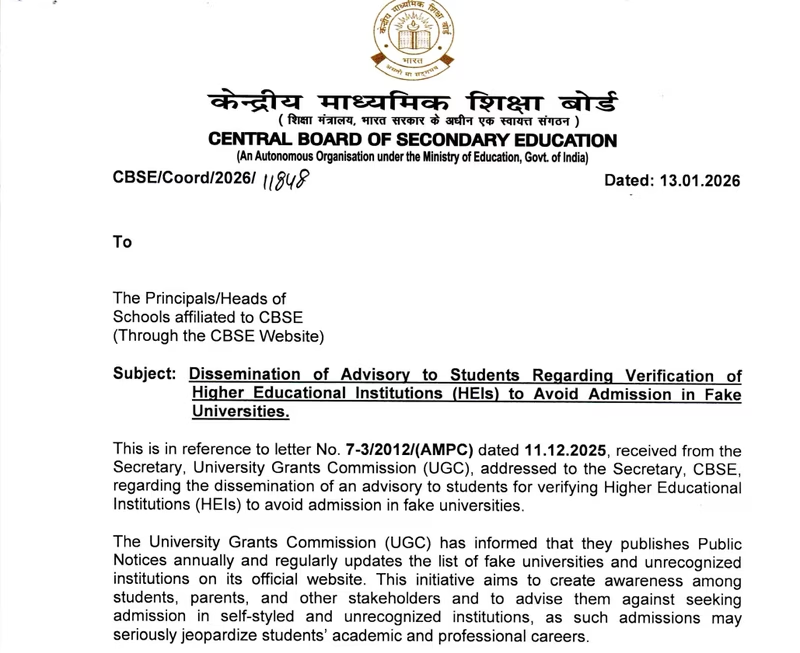
Imagine spending four years, lakhs of rupees, and endless sleepless nights on a degree—only to find out it’s worthless because your college wasn’t even real. Sounds like a nightmare? It’s happening right now across India. And that’s exactly why the Central Board of Secondary Education (CBSE) has just issued an urgent, nationwide advisory to all Class 10 and 12 students: verify your college’s UGC recognition before you apply.
Released in January 2026, this directive isn’t just bureaucratic noise—it’s a lifeline. The CBSE is sounding the alarm on the growing menace of fake universities and unapproved institutions that lure unsuspecting students with glossy brochures, celebrity endorsements, and promises of “global placements.” But without official recognition from the University Grants Commission (UGC), your degree holds no legal or professional value .
Table of Contents
- What the CBSE Advisory Actually Says
- Why UGC Recognition Matters More Than You Think
- How to Check if a College Is UGC-Recognised (Step-by-Step)
- 5 Red Flags That Signal a Fake or Unapproved College
- The Role of Schools and Parents in Preventing Scams
- Conclusion: Your Degree Is Your Future—Protect It
- Sources
What the CBSE Advisory Actually Says
The CBSE has formally instructed all its affiliated schools to actively counsel students and parents about the risks of enrolling in institutions that lack UGC approval. The board emphasizes that admission to such colleges can lead to severe academic and professional consequences—including ineligibility for government jobs, competitive exams like UPSC or GATE, and even postgraduate programs abroad .
Crucially, the advisory also reminds students that “deemed-to-be-university” status or state-level approvals are not enough. Only institutions listed on the official UGC website are considered legitimate for higher education degrees in India.
Why UGC Recognition Matters More Than You Think
Many students assume that if a college has a website, a campus, and takes exams, it must be valid. That’s dangerously wrong. The UGC is the sole statutory body empowered by the Government of India to recognize universities and ensure they meet minimum academic standards .
Without UGC recognition:
- Your degree won’t be accepted by employers or government bodies.
- You cannot appear for national-level entrance exams that require a “recognized degree.”
- Foreign universities may reject your application during credential evaluation.
- You have no legal recourse if the institution shuts down or defrauds you.
How to Check if a College Is UGC-Recognised (Step-by-Step)
Don’t rely on Google ads or Instagram influencers. Here’s how to verify a college’s legitimacy in under 2 minutes:
- Go to the official UGC website: https://www.ugc.gov.in/.
- Click on “University List” or “Institutions” under the ‘Recognition’ section.
- Search by the university’s name or state.
- Confirm the institution appears on the latest list of UGC-recognised colleges.
- For extra caution, cross-check with the National Academic Depository (NAD) or AICTE (for technical courses).
Pro tip: Bookmark the UGC’s list of fake universities—updated regularly—to avoid known scams .
5 Red Flags That Signal a Fake or Unapproved College
Stay alert for these warning signs:
- “Instant admission” with no entrance exam or interview.
- Campus located in a residential building or shared office space.
- Website uses a .com or .net domain instead of .ac.in or .edu.in.
- Promises “international degrees” through vague foreign partnerships.
- No mention of UGC, NAAC, or AICTE accreditation anywhere on official materials.
The Role of Schools and Parents in Preventing Scams
The CBSE has directed all affiliated schools to hold mandatory counseling sessions for students and parents before the 2026 admission season begins. Teachers and career counselors are now on the front lines of this awareness campaign. Parents, too, must take an active role—not just trusting flashy marketing but verifying credentials themselves. After all, this isn’t just about college; it’s about your child’s entire career trajectory.
For more on navigating college admissions safely, explore our guide on [INTERNAL_LINK:how-to-choose-the-right-college-in-india].
Conclusion: Your Degree Is Your Future—Protect It
The CBSE’s advisory on UGC-recognised colleges is more than a notice—it’s a wake-up call. In an era where digital deception is rampant, due diligence is non-negotiable. Take five minutes today to learn how to verify your college. That small step could save you years of regret and financial loss tomorrow. Remember: a degree from an unapproved institution isn’t just a piece of paper—it’s a dead end.