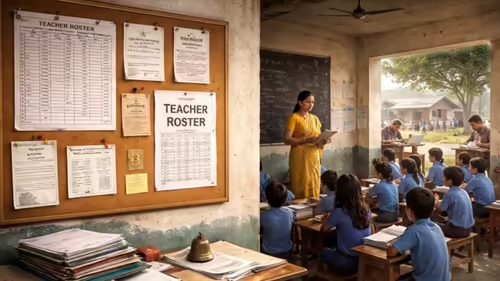
In a landmark move that could reshape accountability in Indian education, the Central Board of Secondary Education (CBSE) has issued a clear directive: no more hiding behind closed administrative doors. By February 15, 2026, every CBSE-affiliated school must publish detailed information about its teaching staff—names, numbers, and crucially, their qualifications—directly on its official website . This CBSE teacher disclosure mandate isn’t just bureaucratic paperwork; it’s a direct challenge to a system that has long relied on misleading national averages to mask deep, systemic inequities in teacher distribution.
Table of Contents
- What the CBSE Mandate Actually Requires
- The Deceptive Comfort of India’s National PTR
- The Reality on the Ground: Extreme Disparities
- Why Transparency in Teacher Qualifications Matters
- Potential Impact on Schools and Parents
- Conclusion: Beyond the Numbers, Toward Equitable Education
What the CBSE Mandate Actually Requires
The new rule falls under the board’s “Mandatory Public Disclosure” framework. Schools can no longer treat staffing data as an internal file. They must now publicly list:
- The total number of teaching and non-teaching staff.
- The name and subject specialization of each teacher.
- The academic and professional qualifications of every educator.
- The current student enrollment figures.
The CBSE has issued a stern warning: any discrepancies, omissions, or false information can lead to serious consequences, including action under the board’s affiliation bylaws . This is a significant shift from a culture of opacity to one of enforced transparency.
The Deceptive Comfort of India’s National PTR
For years, policymakers have pointed to India’s national Pupil-Teacher Ratio (PTR) as evidence of a functioning system. The national average often hovers around a seemingly manageable 25:1 or 30:1, which, on paper, meets or exceeds many international benchmarks . This CBSE teacher disclosure order, however, exposes why this figure is dangerously misleading. Averages smooth out extremes. They tell you nothing about the stark reality in thousands of schools across the country where the ratio is either catastrophically high or bizarrely low.
The Reality on the Ground: Extreme Disparities
The truth hidden behind the national average is jarring:
- Urban Overload: In major cities like Delhi or Mumbai, a single government school classroom can easily hold 60, 70, or even 80 students for one teacher. The effective PTR here is more than double the national claim.
- Rural Isolation: Conversely, in remote villages of states like Jharkhand, Chhattisgarh, or the Northeast, there are thousands of “single-teacher schools.” One educator is responsible for teaching all subjects to students from grades 1 through 5, or sometimes even up to 8. Their PTR might be a perfect 10:1, but the quality of education is severely compromised due to the impossible workload and lack of subject-matter expertise .
- State-Wise Spikes: Data from the Unified District Information System for Education (UDISE+) consistently shows massive state-wise variations. While some states boast ratios below 20:1, others struggle with figures well above 40:1 .
This uneven distribution means that a child’s access to a qualified, dedicated teacher is often determined more by their postal code than by national policy.
Why Transparency in Teacher Qualifications Matters
The mandate goes beyond just counting heads. Requiring schools to publish teacher qualifications is perhaps its most powerful aspect. It addresses a critical, often ignored issue: not all teachers are created equal. A school might meet its PTR requirement by hiring under-qualified staff or those without the necessary subject-specific training (for example, a history graduate teaching advanced mathematics). This practice, while common, directly impacts learning outcomes. By making this information public, parents can make informed choices, and the market can begin to reward schools that invest in truly qualified educators .
Potential Impact on Schools and Parents
This move is a game-changer for parental empowerment. For the first time, parents will have a clear window into the actual teaching resources at their child’s school. This could lead to:
- Informed School Choice: Parents can compare staffing data before enrolling their children.
- Community Accountability: Local communities can use this data to demand better resources from school management and government bodies.
- Pressure on Underperforming Schools: Schools with poor staffing or unqualified teachers will face reputational risk, pushing them to improve or lose students.
For schools, this is a call to action to audit their own staffing and ensure compliance, not just with the letter of the law, but with the spirit of providing quality education.
Conclusion: Beyond the Numbers, Toward Equitable Education
The CBSE teacher disclosure mandate is a bold and necessary step toward a more transparent and equitable education system in India. It forces a reckoning with the uncomfortable truth that a comfortable national average is a poor substitute for real, on-the-ground quality. By shining a light on the actual distribution and qualifications of teachers, the CBSE is empowering stakeholders and demanding accountability. The success of this initiative will depend on strict enforcement and active engagement from parents and civil society. The goal is no longer just to count teachers, but to ensure every child has access to a great one.
Sources
- CBSE orders schools to disclose teacher strength. Times of India.
- By February 15, 2026, they must put teacher details and qualifications on their websites under Mandatory Public Disclosure, with the board warning that gaps or errors can invite action under affiliation rules.
- India’s PTR can look comfortable in national averages, but state-wise spikes and single-teacher schools reveal how unevenly teachers are actually spread.
- Unified District Information System for Education (UDISE+) data on state-wise PTR. Ministry of Education, Government of India.
- National Education Policy 2020 guidelines on teacher qualifications and deployment.